![[Fitness Industry Inspection ④] 50,000 KRW a Month for 20 Years... Why Have Gyms Fallen into 'Impoverished Infinite Competition'?](https://d1gl51xbrxoj65.cloudfront.net/uploads/2025/12/30/1767063018896-x78jyu.webp)
Even when the price of jajangmyeon was 2,500 KRW 20 years ago, and now that it has reached 7,000 KRW, gym membership fees still remain at around 30,000 to 50,000 KRW per month. A bizarre phenomenon is occurring where only gym prices remain stagnant in an era of high inflation. This is the result of the industry's chronic reliance on a 'breakage revenue (Ghost Member)' model combined with oversupply.
As a result, the saying "The equipment is luxury, but the price is ultra-low" has become a paradox that penetrates the current South Korean fitness market. It is pointed out that gym closures are not merely an economic issue, but the result of an abnormal structure of 'high cost and low efficiency.'
◇ Dead Last in Fee Increase Rates over 24 Years... Failing Even to Reflect Inflation
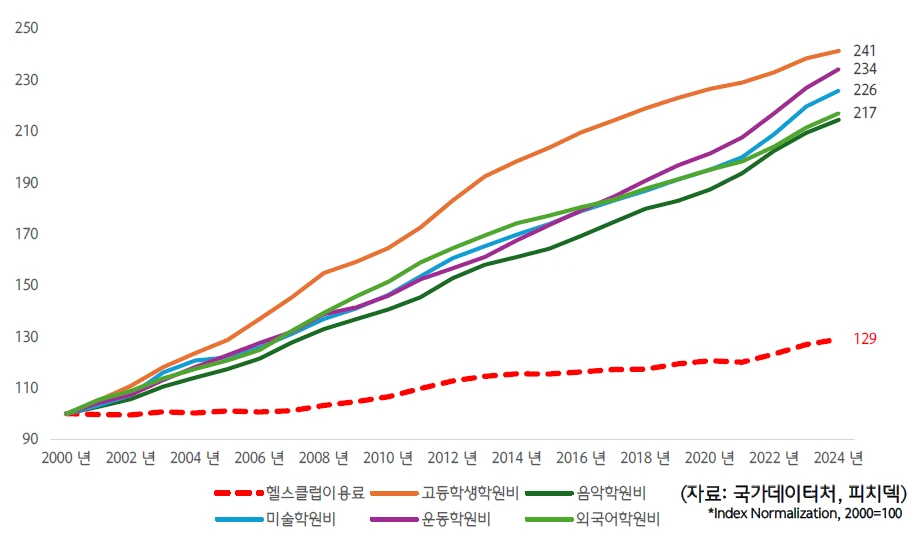
According to data analysis by the National Data Center and Pitchdeck, the long-term stagnation of gym fees is at a severe level. Using the year 2000 as a baseline (100), the health club fee index in 2024 was only 129. This means that the price increase over the past 24 years has fallen short of even 30%. Considering inflation, it is virtually negative.
On the other hand, during the same period, the fee index for bowling alleys soared to 196 and swimming pools to 169, reflecting inflation. Compared to the private education market, the gap widens further. The index for high school cram school fees recorded 241, and art academy fees reached 226, showing a sharp contrast to gyms. Experts analyze that gyms did not simply choose not to raise prices, but rather 'could not raise them' due to excessive competition.
◇ A Structure Where Increased Investment is Covered by PT... Coupled with the Expansion of Apartment Communities
The barrier to entry in the gym startup market has risen to a level incomparable to the past. In the past, it was possible to operate with just basic weight equipment and shower facilities, but now the so-called 'equipment lineup' has become the measure that determines the quality of a center.
According to industry insiders, it is common for customers not to even come in for a consultation unless the gym is equipped with overseas luxury machines that cost between 10 million and 20 million KRW per unit. Furthermore, with the prevailing perception that "scale equals competence," there is a distinct trend of insisting on top-tier locations, even if it means bearing the burden of large floor spaces and expensive rent. As a result, a 'high-cost structure' has become entrenched, requiring at least 500 million to 1 billion KRW in initial capital just to open a proper gym. The problem is that recovering this massive investment is a distant prospect.
While investment costs have skyrocketed, membership prices have actually taken a step backward. When a new gym opens nearby and hangs a banner offering a 'special opening price of 30,000 KRW per month,' existing centers repeatedly engage in a 'cutthroat' game of chicken, reluctantly lowering their prices regardless of their facility quality.
For a long time, the industry has operated by throwing out low-cost memberships as 'loss leaders' to attract members, and then covering fixed costs with the breakage revenue from so-called 'ghost members' who do not actually show up. The shortfall in profit was compensated for by selling high-priced PT (Personal Training) packages in an abnormal structure.
In this process, the role of a trainer has essentially deteriorated from a fitness instructor to a 'salesperson.' As PT became commercialized in the early 2010s, a tendency solidified to prefer trainers with excellent "looks and eloquence (sales skills)" over professional expertise. This has led to coercive sales tactics and a decline in service quality, which is pointed out as a primary cause of consumers distrusting gyms.
To make matters worse, 'light users,' who used to form a pillar of gym revenue, are also leaving. The decisive blow has been the rise of 'community gyms' within apartment complexes.
Since the 2000s, construction companies have branded apartments under names like 'Raemian,' 'Hillstate,' and 'Xi,' starting to mandatorily introduce saunas and high-end gyms in their community facilities. With the emergence of apartment gyms that offer excellent accessibility and low prices, members aiming for light workouts, who have no need to spend a lot of money visiting outside gyms, have been absorbed en masse.
In fact, this is the background behind the fierce backlash from nearby gym owners who argued that their right to survival was being threatened when the Ministry of Land, Infrastructure and Transport considered allowing outsiders to use resident communal facilities in 2017. Ultimately, regular gyms are suffering from a double whammy of losing potential customers while marketing costs increase and cash flow worsens.
◇ An Era of 16,000 Trainers... A 'Game of Chicken' Brought on by Oversupply
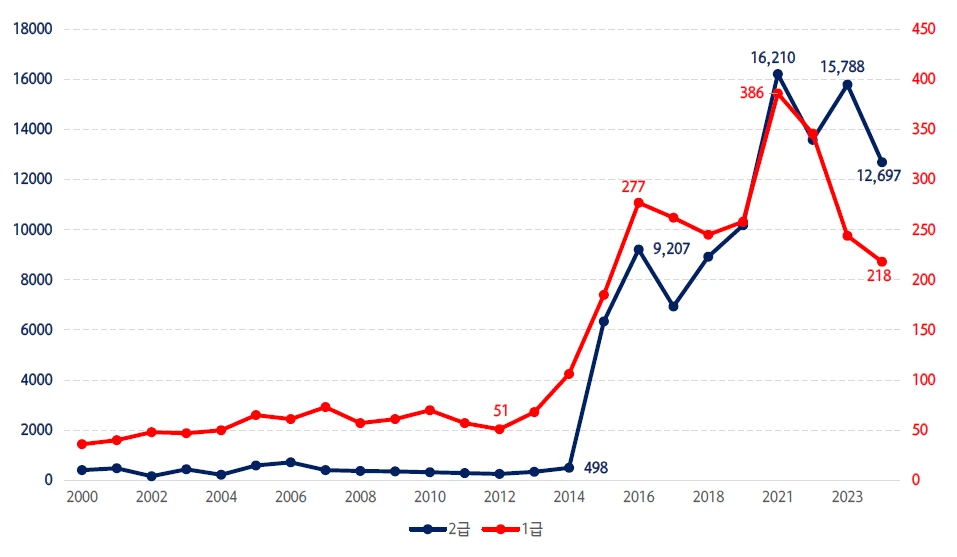
The explosive increase in workforce supply is pointed out as a key factor fueling market overheating. The number of successful applicants for the 'Level 2 Sports Instructor for Everyday Life' certificate, an essential gateway to becoming a fitness trainer, skyrocketed approximately 35-fold in seven years, from 458 in 2014 to 16,210 in 2021. This oversupply is leading beyond cutthroat competition among centers to a 'startup rush' among trainers.
Typically, a trainer's salary system is an incentive structure with a low base pay of around 1 million to 2 million KRW per month, splitting PT revenues roughly 5:5 with the center. The problem is that as the number of members a trainer manages increases, dissatisfaction over the 'profit distribution' grows. It is a structure where the temptation grows stronger to open a small PT shop and monopolize 100% of the profits instead of paying half the revenue to the center. Consequently, experienced trainers become independent and open gyms or PT shops that are mushrooming everywhere, repeating a vicious cycle of 'infinite multiplication' that further intensifies competition.
A change in trends is also being detected. The 'body profile' craze that previously drew the 20s and 30s demographic to gyms is on a downward trend after peaking, due to controversies over 'CG profiles' caused by excessive photo editing techniques and the fatigue of strict diet management.
Instead, the MZ generation, who desire a sense of immediate accomplishment, are turning their eyes away from boring and isolated weight training to sports that immediately stimulate dopamine, such as running crews, martial arts, and tennis. In particular, the sense of alienation created by drug users ('roiders') in gyms and the psychological intimidation felt by beginners act as high barriers preventing new entry.
Ultimately, the fitness industry is suffering from the burden of labor costs and a 'facility spec competition' that requires bringing in expensive imported machines in a situation where realizing realistic user fees is impossible. Experts forecast, "The era of competing simply on price is over," adding, "It will be difficult to survive without a fundamental constitution improvement of the revenue and operational structure, such as moving toward premium services or implementing a professional PT system."
Company financial data, investment reports, and startup analysis — all in one place
Explore PitchdeckCurated news, every week — straight to your inbox
Every Friday · Unsubscribe anytime