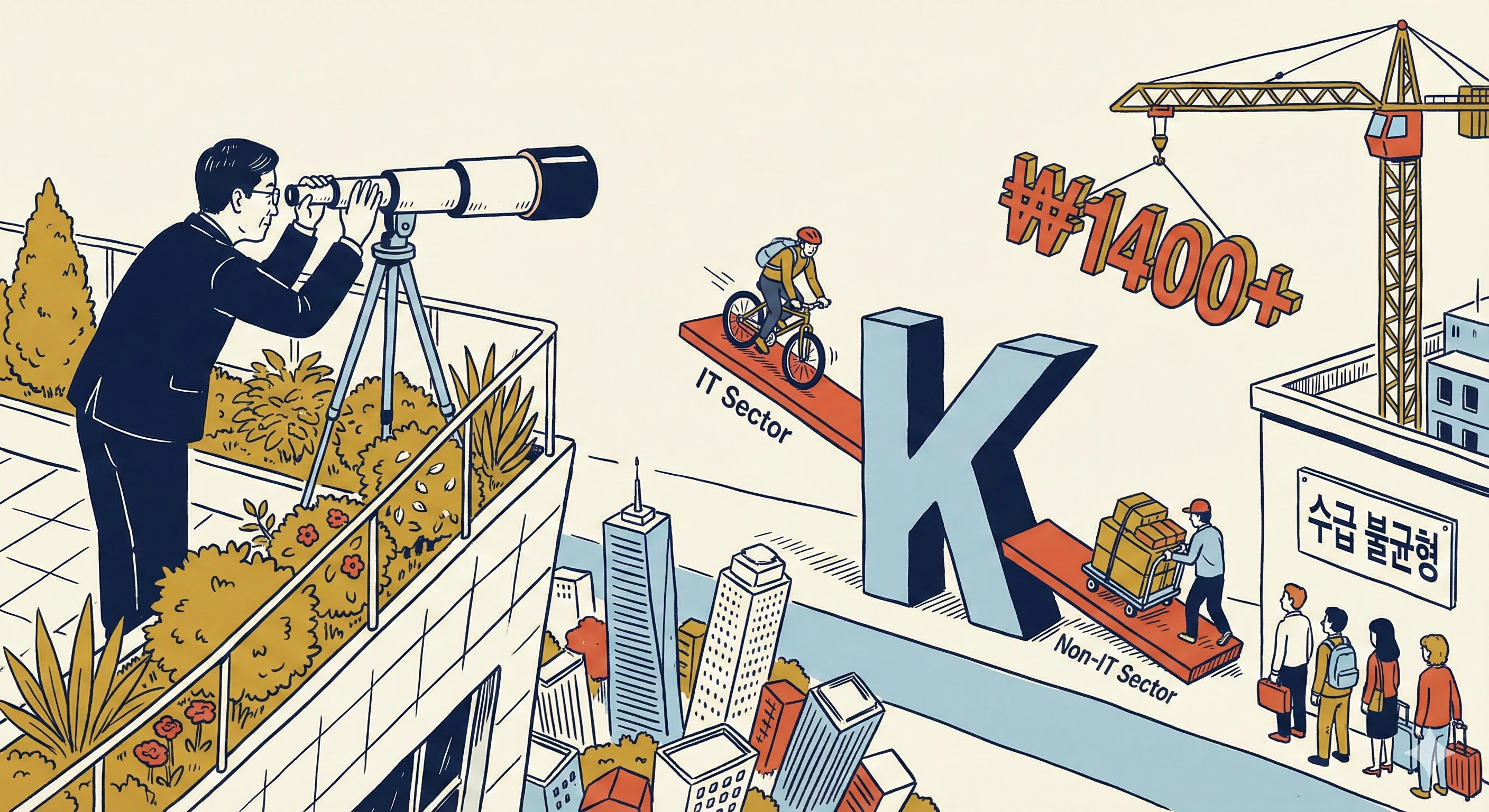
Through his New Year's address: "Excluding IT, growth rate is only 1.4%... concerns of a 'K-shaped recovery'" "$20 billion investment in the US is not a mechanical outflow... to be determined within foreign exchange market stability"
Bank of Korea Governor Rhee Chang-yong diagnosed through his New Year's address that the won-dollar exchange rate, which recently reached the high 1,400 won range, has a large disconnect from our economy's basic strength (fundamentals). Additionally, while forecasting that this year's economic growth rate will approach the potential level of 1.8%, he expressed concern that excluding the IT sector, the recovery trend is slow, which could result in a 'K-shaped recovery' where the perceived economy is poor.
Governor Rhee focused on exchange rate volatility in his New Year's address that day. He assessed, "While it is difficult to determine the appropriate level of the exchange rate, the recent exchange rate in the high 1,400 won range is at a level that has a large disconnect from our economy's fundamentals." He cited the growth rate and interest rate gaps between Korea and the U.S., as well as the Korea discount, as the background for the rise in the exchange rate.
In particular, he pointed to a 'supply-demand imbalance' as the cause of the won's depreciation exceeding the dollar's strength since October 2025. Governor Rhee stated, "The continuously increasing overseas securities investment by residents has caused a supply-demand imbalance in the foreign exchange market, placing significant upward pressure on the exchange rate in the short term," and emphasized, "It is time to comprehensively review the impact that the expansion of residents' overseas investments has on the macroeconomy and capital markets."
However, he drew a line against the view comparing the current exchange rate level alone to past crisis situations. The reason is that our country is a net external creditor nation with sound external health. But Governor Rhee warned, "There is a possibility that the rise in the exchange rate will increase inflationary pressure and act unfavorably for domestic-focused companies, thereby worsening polarization."
Regarding this year's economic outlook, he expressed concern about a 'K-shaped recovery'. Governor Rhee explained, "This year's growth rate will approach the potential level at 1.8%, but excluding the IT sector, it will only reach 1.4%," adding, "Due to the recovery gap between sectors, there could be a large disconnect from the perceived economy." He pointed out that such an unbalanced recovery is not sustainable and is difficult to view as a complete recovery.
Regarding inflation, he foresaw, "If temporary factors ease, the annual rate for this year will record 2.1%, the same as last year, showing a more stable trend than major countries." However, he added that if the high exchange rate persists, upward inflationary pressure could reignite, and the elevated cost of living due to the accumulated inflation since the pandemic remains a concerning part.
He also expressed his position on concerns raised by some regarding the investment agreement with the U.S. Governor Rhee explained, "There are concerns that the annual $20 billion investment in the U.S. will cause the won to weaken, but this represents the maximum amount," adding, "Actual investments will be determined within a range that does not hinder the stability of the foreign exchange market, and funds will not mechanically flow out every year."
The Bank of Korea plans to strengthen communication with the market and expand the financial safety net in operating its monetary policy this year. Governor Rhee stated, "It is the central bank's responsibility not to lag behind market expectations and to explain the direction in a timely manner when policy conditions change," and revealed plans to reexamine the operation of the Monetary Policy Board members' conditional base rate forecasts (for the next 3 months). In addition, the central bank plans to expand its role as a liquidity safety valve by operating the 'eligible collateral system for bank loan receivables' and consulting on revising the Bank of Korea Act to expand its target to non-bank depository institutions.
Company financial data, investment reports, and startup analysis — all in one place
Explore PitchdeckCurated news, every week — straight to your inbox
Every Friday · Unsubscribe anytime