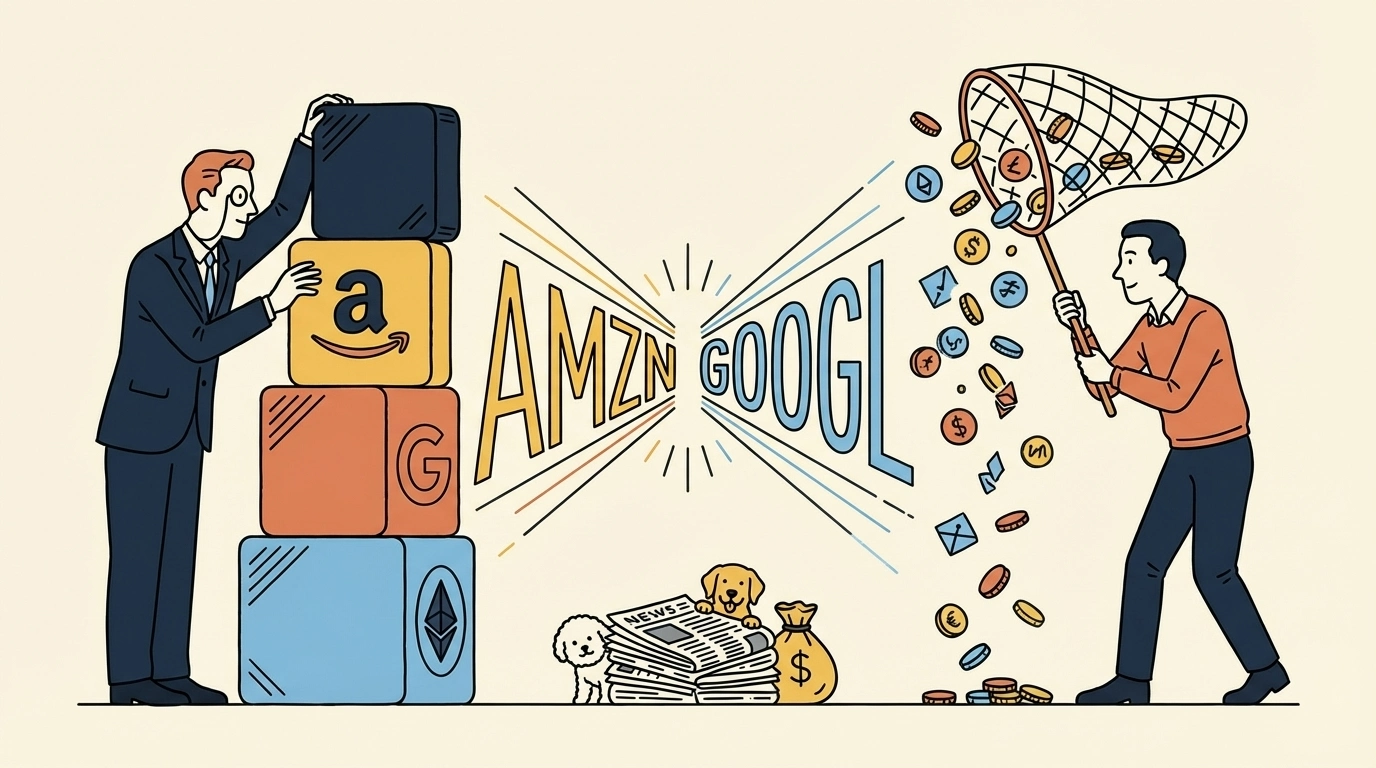
Citadel's $666B (approx. 880 trillion KRW) Diversified Across 15,403 Positions vs. Berkshire's $274B Concentrated in 110 Positions
Up to an 82-Fold Difference in the Amount Bet on the Same Stock Among 37 Overlapping Stocks
Amazon is the Stock Simultaneously Held by 9 Out of 14 Institutions
Massive capital that leads market trends a step ahead, the so-called 'smart money,' refers to the funds of large institutional investors or hedge funds that drive the market based on immense financial power and top-tier information networks. Where did this massive stream of money head at the end of 2025? A comprehensive analysis of 21,171 13F disclosure data entries for the fourth quarter of 2025 (including some from the third quarter) from top 14 global investment institutions, including Berkshire Hathaway and Citadel, revealed that their portfolios contained a mixture of starkly contrasting viewpoints based on their investment philosophies and meticulous stock picking.
Extreme Portfolio Structures of Large Funds
The management styles of Citadel and Berkshire Hathaway, which divide the global capital market, diverged completely. Citadel diversified its massive assets of $665.8 billion by splitting them into 15,403 positions, with an average investment of about $43 million per position. On the other hand, Berkshire Hathaway concentrated its $274.1 billion in assets into just 110 positions (39 stocks) and executed a focused investment strategy, injecting an average of $2.492 billion per position.
In fact, Berkshire's top three stocks—Apple, American Express, and Bank of America—are so concentrated that they account for 53% of its total assets under management. In contrast, Citadel placed SPY ($39.4 billion), which tracks the S&P500, and QQQ ($36.2 billion), which tracks the Nasdaq, at the very top, employing a strategy to radically reduce individual corporate risk and follow the overall flow of the market.
The Contrast Between Traditional Moat Defense and Growth Stock Concentration
Looking at the 37 overlapping stocks held by both institutions simultaneously, their divergent perspectives become even more evident. Among these overlapping stocks, Berkshire holds a larger position in 29 stocks, while Citadel holds a larger position in 8 stocks.
Berkshire holds 81.9 times more shares in the internet infrastructure company VeriSign compared to Citadel, and placed overwhelming weight on traditional companies with strong monopolistic moats, such as American Express (76.5 times), Moody's (73.8 times), and Kraft Heinz (62.3 times). Conversely, Citadel built a position in Amazon that is 25.1 times larger than Berkshire's, and concentrated on growth stocks by also holding much heavier positions in UnitedHealth (4.4 times) and Alphabet (3.5 times).
The Real Target Pointed to by the Intersection of 9 Massive Capital Funds
By excluding the bias of specific institutions and extracting the consensus stocks commonly invested in by 3 or more funds among the 14 major institutions, the true consensus of massive capital can be confirmed.
The company chosen by the most funds is Amazon, which a total of 9 institutions held to the tune of $19.7 billion. This was followed by Alphabet (8 institutions, $31.4 billion) and Visa (7 institutions, $6.8 billion). On the other hand, Apple, Berkshire's largest holding, was chosen by only 5 institutions, showing relatively weak buying interest. Meanwhile, Nvidia, Meta, and UnitedHealth, as well as AppLovin and Uber, are also simultaneously held by 6 funds each.
Samsung Asset Management — A Korean Institution Building an Independent Position
Amid the big tech-oriented concentration of large global funds, the portfolio of South Korean capital Samsung Asset Management shows a distinct point of differentiation. Samsung Asset Management placed Salesforce at the top of its portfolio with a $793 million position, and following Amazon ($783 million) in second place, it made a strong bet on the real estate fintech company Rocket Companies ($762 million) in third place.
Its most prominent feature is the strategy of preemptively discovering leading stocks in specific industries, such as MongoDB ($590 million) and Roblox ($484 million), when the market's bulk money was concentrated on Apple or Nvidia.
What 13F Tells Us, and What It Doesn't
The investment landscape at the end of 2025 shows a tense standoff between diversified investments that capture the entire market like a net and compressed investments that place heavy weight on a very small number of stocks. Even amidst such completely divergent investment philosophies, there exists a convergence point for massive capital in the intersection of Amazon and Alphabet. However, 13F filings only include long positions, omitting short positions and derivative products. For multi-strategy funds like Citadel, the inability to judge actual directionality based solely on long positions is a clear limitation of this data.
This article was written by News Epoch by securing and analyzing SEC EDGAR 13F data through The Proxy collection pipeline.
Targeting 14 institutions, as of the reporting date of December 31, 2025 (September 30, 2025, for ARK Investment Management).
13F filings only include long positions, and short and derivative positions are not reflected.
Company financial data, investment reports, and startup analysis — all in one place
Explore PitchdeckCurated news, every week — straight to your inbox
Every Friday · Unsubscribe anytime