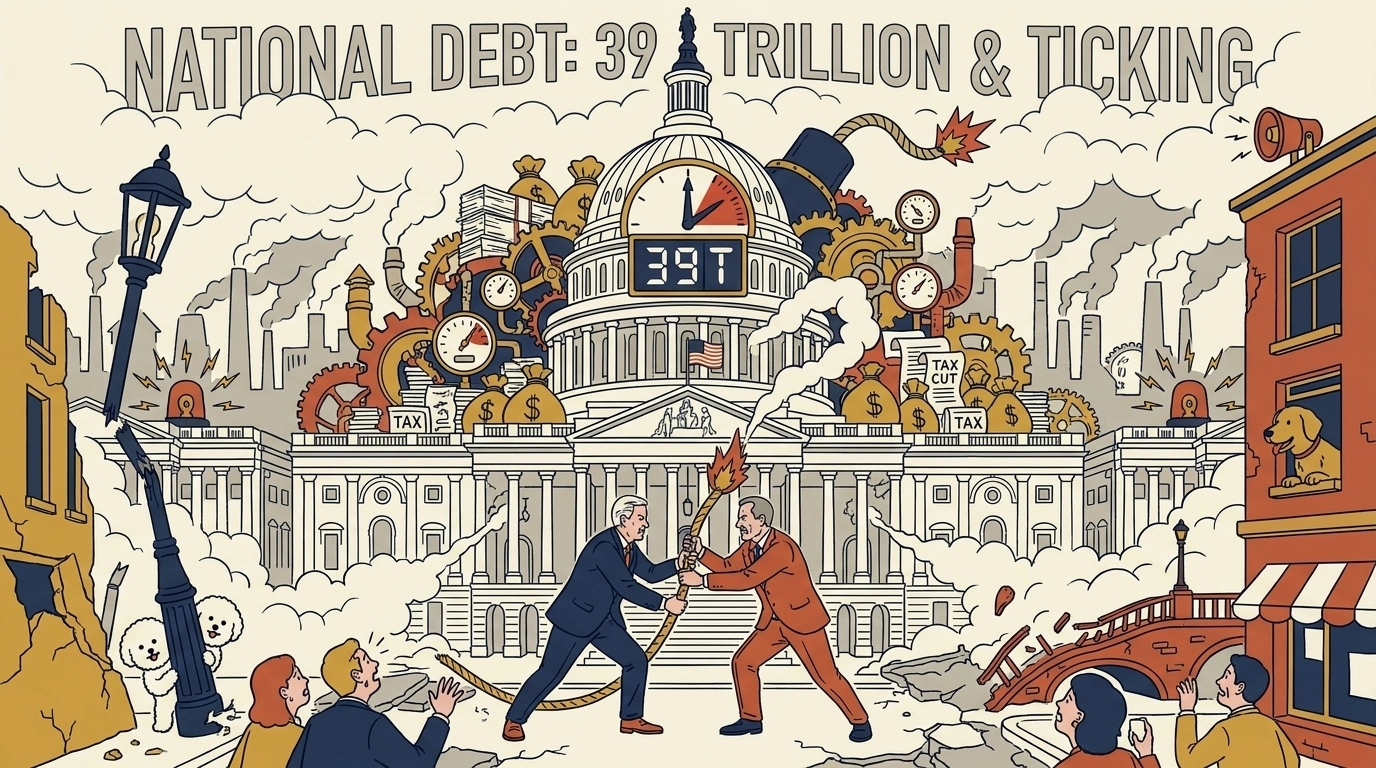
Massive interest burden and bipartisan fiscal negligence pressure the national economy... Concerns over credit downgrade and impacts spreading to state economies
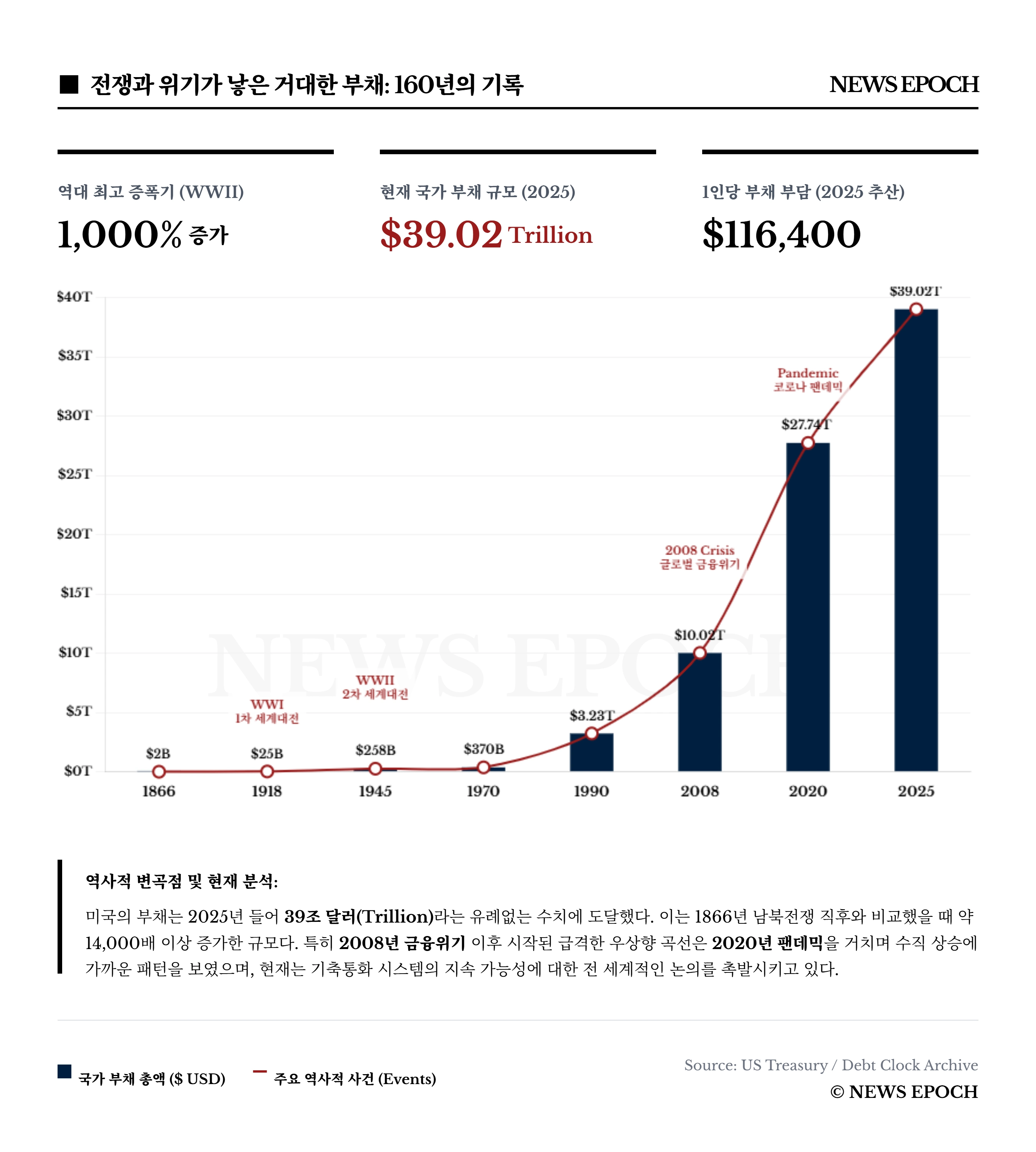
The U.S. national debt has crossed the painful milestone of $39 trillion for the first time in history, surpassing the size of the entire national economy. Excluding the brief pandemic period, this is the first time this has happened since right after World War II, and concerns about fiscal health are reaching a peak. According to a Fortune report, as the debt reaches unprecedented levels since World War II, credit rating agencies are uniformly sounding alarms, and The Hill reported that House Republicans strongly criticized it as a 'ticking time bomb' that could explode at any moment.
Mountain of debt exceeding the size of the economy, annual interest alone reaches $1 trillion
According to data from the U.S. Department of Commerce and the Bureau of Economic Analysis (BEA), as of March, the U.S. nominal gross domestic product (GDP) was approximately $31.22 trillion, whereas the national debt held by the public recorded $31.27 trillion, meaning the debt exceeded 100% of the economic size (GDP). The interest cost of the national debt has surpassed $1 trillion annually, an amount that far exceeds the defense or Medicare budgets.
Bloomberg highlighted the fact that international credit rating agency Fitch warned the nation's credit rating faces challenges due to these massive U.S. fiscal deficits and debt issues. Washington's $39 trillion debt bomb is not ending merely as a federal government problem. As analyzed by Talk Business & Politics, soaring interest rates and inflationary pressures are having a direct and negative impact on the local economies of individual states, such as Arkansas.
Politicians' lack of reality awareness exposed amidst optimism
Some point out that crossing the historic debt threshold has clearly exposed the unreality of former President Trump's campaign promises (MS NOW). Former President Trump remains optimistic, claiming about the current economic situation that "more people are working than at any time in history, and the economy is doing wonderfully." However, the reality is that the government is spending far more money than its revenue, recording a massive deficit amounting to $1.6 trillion every year despite being in a time of peace and prosperity.
Maya MacGuineas, president of the bipartisan Committee for a Responsible Federal Budget (CRFB), asserted regarding the debt ratio surpassing 100% that it is "an absolutely unhealthy signal for the economy." She also sharply criticized that the current debt crisis is not due to unavoidable global conflicts, but rather "the result of a bipartisan populism where both parties have completely abdicated making hard choices." The argument is that the fiscal situation has plummeted to its worst as politicians competed over tax cuts and spending expansions.
Debt eating away at future generations' prosperity... "Immediate stopping of the bleeding is necessary"
The Congressional Budget Office (CBO) strongly warned that if the current trajectory is not controlled, the debt ratio will break the record high of 106% set right after World War II to reach 108% by 2030, and soar to 120% in 10 years. The increase in debt slows income growth, raises borrowing costs to shrink private investment, and paralyzes the nation's ability to cope in the event of a geopolitical crisis or severe economic recession.
Experts agree that resolving the problem requires an accompaniment of tax increases and spending cuts. President MacGuineas urged that taxing billionaires or printing money alone cannot solve this problem, stating, "Everyone's sacrifice is needed to stop the national bleeding and fix the situation." If decisions and actions are delayed, a devastating fiscal crisis is expected to be inevitable.
Company financial data, investment reports, and startup analysis — all in one place
Explore PitchdeckCurated news, every week — straight to your inbox
Every Friday · Unsubscribe anytime