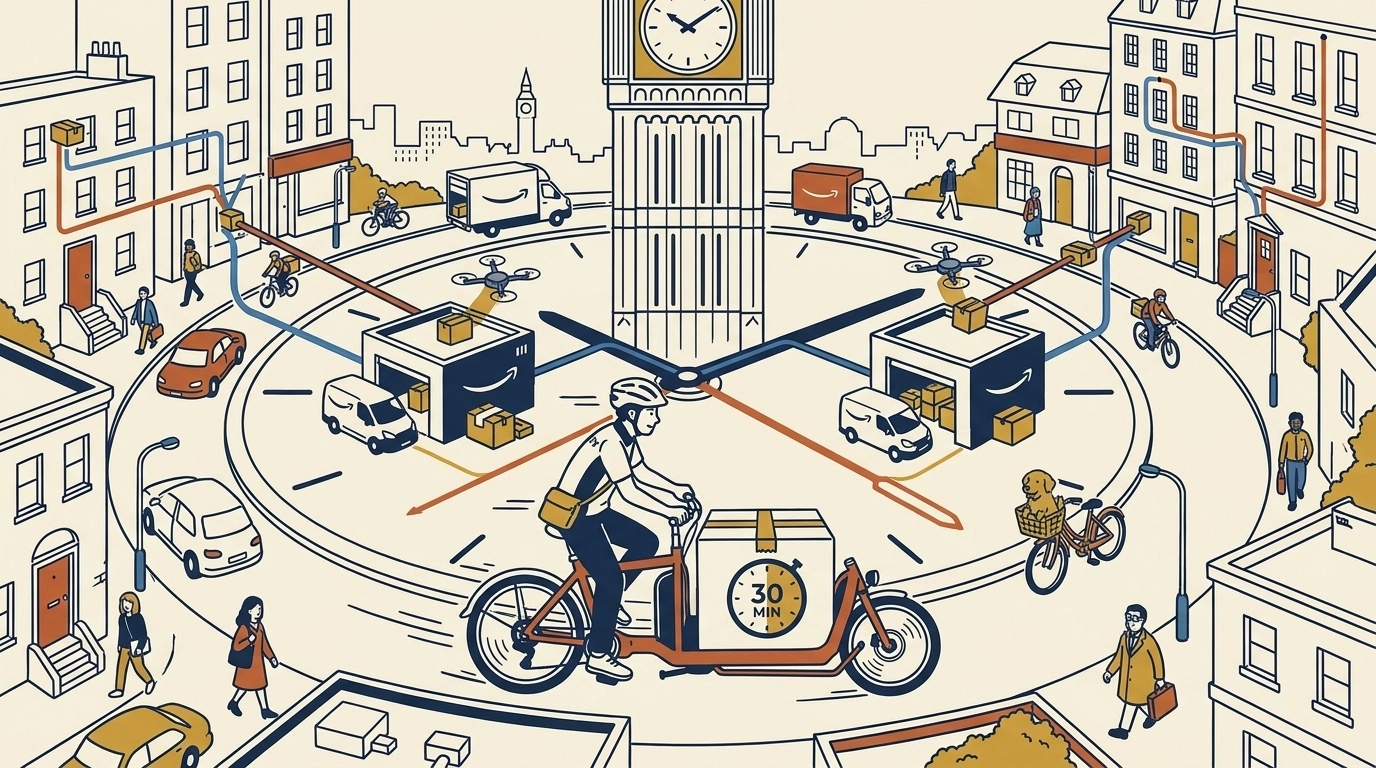
Amazon, which previously changed the landscape of the global retail industry with 'two-day delivery', is now reigniting the delivery speed war by proposing a new standard of '30-minute delivery'.
Amazon announced that it will massively expand its ultra-fast delivery service, 'Amazon Now', which delivers groceries and daily necessities within 30 minutes of ordering, making it available to tens of millions of customers across the United States by the end of this year.
'30-Minute Delivery' operating 24 hours... 3,500 items handled
Amazon Now is a service focused on quickly delivering the products customers need most urgently right to their doors. It handles about 3,500 different items, ranging from groceries like fresh produce and dairy products to pet food, non-prescription medicines, cell phone chargers, and even alcohol (in permitted areas only), and is operated 24 hours a day, 365 days a year in most of the areas where the service is provided.
This service, which began pilot operations in Seattle and Philadelphia in December of last year, is currently widely available in Atlanta, Dallas-Fort Worth, and other areas. The plan is to expand its scope to dozens of cities including Austin, Denver, Minneapolis, and Phoenix, as well as New York by the end of the year. Along with this, the service has already been introduced in global key markets such as India, Brazil, Mexico, the United Arab Emirates (UAE), and the UK, centering around urban areas.
[Source: Amazon News]
The Secret to 30-Minute Delivery: 'Dark Stores' and 'Amazon Flex'
Behind this unprecedented speed are small-scale urban logistics hubs called 'Dark Stores'. Unlike massive fulfillment centers located near major highways, small warehouses ranging from 5,000 to 10,000 square feet—the size of a CVS pharmacy—are densely placed close to customers' residences and workplaces.
Here, artificial intelligence (AI) is utilized to analyze the purchasing patterns of customers by region, and high-demand products, ranging from toilet plungers and toothpaste to wireless earbuds (AirPods), are custom-stocked. The actual delivery is handled by 'Amazon Flex' drivers who deliver using their own vehicles, and electric cargo bikes have also been introduced in some cities.
Pricing and Management Strategies Aimed at Loyal Customer Lock-in
The service pricing is designed to be overwhelmingly advantageous for Amazon Prime members. Prime members only need to pay a delivery fee of $3.99 per order, while non-members are charged $13.99. However, for small orders under $15, an additional fee is applied to both Prime members ($1.99) and non-members ($3.99).
The management believes that ultra-fast delivery is a powerful weapon that stimulates customer purchases. Amazon CEO Andy Jassy stated in a shareholder letter that investments in fast delivery increase conversion rates and make customers visit Amazon more frequently. Beryl Tomay, head of Amazon's transportation sector, also explained that fast delivery speeds drive additional purchases on Amazon, and in fact, in the Indian market, the number of 30-minute delivery orders from Prime members increased threefold after the service was introduced.
Intensifying Competition in the Retail Industry and Remaining Challenges
Amazon's latest move is directly targeting gig economy-based delivery platforms such as Instacart, DoorDash, and Uber Eats, as well as traditional offline retail giants like Walmart, which are closely trailing by guaranteeing 'delivery within 1 hour'.
However, voices of concern are also emerging from some parts of the industry. This is because there is a painful precedent where Domino's Pizza, which previously promoted a '30-minute delivery guarantee', had to abolish the policy in 1993 after a barrage of accidents and lawsuits caused by the reckless speeding of its delivery drivers. Experts point out that Amazon should learn from this case. In response, Amazon has drawn a line, stating that it does not force delivery drivers or packaging staff to rush, and does not make unreasonable time guarantees to customers.
Furthermore, among young consumers such as Gen Z, there is a growing tendency to prefer relaxed deliveries that bundle several items at once out of environmental consideration. Therefore, it is analyzed that further observation of market reactions will be necessary to see whether an unconditional 'speed war' can be the absolute answer that encompasses all generations.
Company financial data, investment reports, and startup analysis — all in one place
Explore PitchdeckCurated news, every week — straight to your inbox
Every Friday · Unsubscribe anytime