![[Data Pick] A Map of the Residential Moves of 7,172 Listed Company CEOs... From Apgujeong to Dogok, Then to Banpo, and the Emergence of Songdo](https://d1gl51xbrxoj65.cloudfront.net/uploads/2026/05/14/1778727074196-ghngk8.webp)
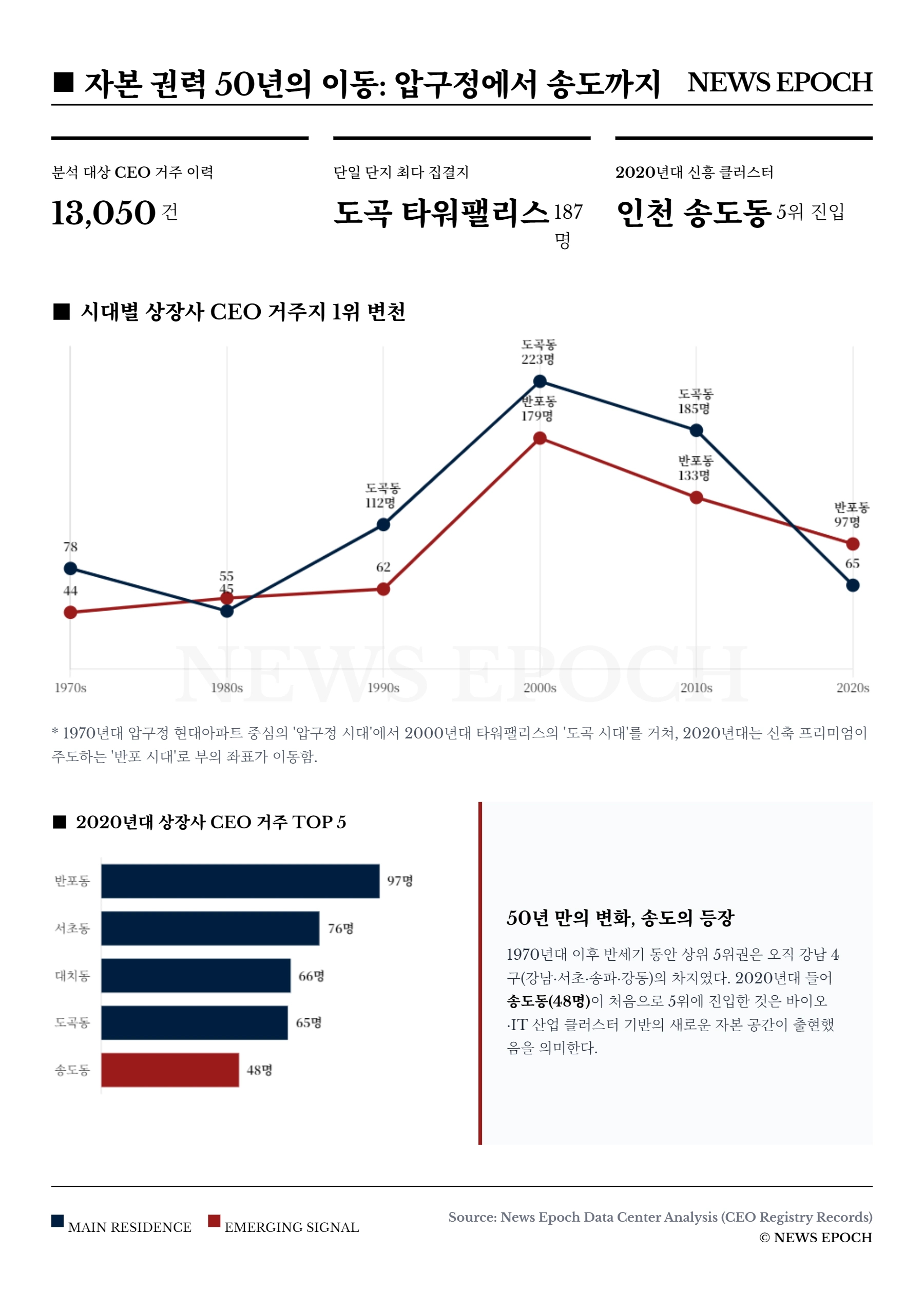
7,172 former and current CEOs have passed through South Korean listed companies. When their residential histories are mapped out in chronological order, the 50-year migration path of Korean capital converges onto a single map. The power that originated in Apgujeong in the 1970s shifted to Dogok in the 2000s, and to Banpo in the 2020s. And there is a decisive change captured for the first time in this analysis. For the first time in 50 years, the only neighborhood (dong) outside the four districts of Gangnam to rank in the top five is Songdo, Incheon.
Apgujeong and Seocho, the Birthplace of First-Generation Capital
When tallying the residential neighborhoods of CEOs by the decade their companies went public, the coordinates of South Korean capital power distinctly vary by era.
Although Dogok-dong is the most resided neighborhood for CEOs of companies listed in the 1970s, the next four—Seocho-dong, Apgujeong-dong, Banpo-dong, and Daechi-dong—making up the top five, are all located within the four districts of Gangnam. The data plainly demonstrates that the executives of Korea's first-generation manufacturing and chaebol companies were concentrated in a single point called Gangnam.
The stronghold symbolizing this era is Hyundai Apartment in Apgujeong-dong. Since its occupancy in 1976, 168 listed company CEOs have passed through over half a century. Combined with Hanyang Apartment (53 people) in the same Apgujeong-dong, the two complexes alone housed 221 people. It is well worth calling "the archetype of first-generation Korean wealth."
Moving to companies listed in the 1980s, the number one spot shifts to Seocho-dong, with Banpo-dong rising to second place. For companies listed in the 1990s, Seocho-dong maintains its first-place position. This is a sign that Gangnam's center of gravity was slowly shifting from Apgujeong to Seocho and Banpo.
The 2000s, Tower Palace Changed the Coordinates
The 2000s was the era when South Korea's real estate power map was most dramatically reorganized. Tower Palace in Dogok-dong, which began occupancy in 2002, simultaneously absorbed newly rich figures from the IT bubble era, financial sector executives, and later generations of traditional chaebols, catapulting Dogok-dong to the number one spot at once.
Out of the CEOs of 612 companies listed in the 2000s, 223 resided in Dogok-dong. It overwhelmed second-place Banpo-dong (179 people) by a margin of 44 people.
The symbol is Tower Palace Apartment in Dogok-dong. It ranks first for the concentration of Korean listed company CEOs in a single complex, with 187 individuals. This number surpasses Apgujeong Hyundai. It was the decisive moment when the 30-year equation of "coordinates of wealth = Hyundai Apartment" was replaced by "coordinates of wealth = Tower Palace."
For companies listed in the 2010s, Dogok-dong maintained its first-place position. The era of Dogok effectively lasted for 20 years.
The 2020s, The Era of Banpo, and the Emergence of Songdo
Moving into the 2020s, two decisive changes occurred simultaneously.
First, the number one spot shifted from Dogok to Banpo. The most popular residential neighborhood for CEOs of 517 companies listed in the 2020s was Banpo-dong (97 people). Dogok-dong fell to fourth place (65 people). The rise of Banpo was driven by Banpo Xi Apartment (109 people), which began occupancy in 2008, and Raemian Firstige (82 people), occupied in 2009. There are 191 people in these two complexes alone. The two representatives of South Korea's newly built premium apartments had become the new coordinates of capital.
Second, and a more significant change. Songdo-dong (48 people) made its first appearance in fifth place among the residential neighborhoods for CEOs of companies listed in the 2020s. Over the 50 years analyzed since the 1970s, Songdo is the only neighborhood outside the four districts of Gangnam to enter the top five.
Songdo's rise is not a simple dispersion within the metropolitan area. Songdo International City, an Incheon Free Economic Zone, is an industrial city that serves as a core cluster for Korea's bio-industry, such as Celltrion and Samsung Biologics, and where IT, gaming, and fintech companies have moved into newly built complexes like Songdo The Sharp, Songdo Xi, and Songdo Prugio Harbor View in a form of work-life proximity.
The significance of Songdo-dong entering the top five is clear. If Gangnam is a capital space bound by school districts, personal connections, and traditional wealth networks, Songdo represents the emergence of a capital space combining industrial clusters and work-life proximity. It is the first case to appear on the South Korean capital map in 50 years.
A Country Where 168 People Gather in One Complex, and 187 in Another
The top four apartment complexes symbolize the four eras of the South Korean economy.
1. Tower Palace Apartment in Dogok-dong: The coordinates of emerging wealth in the 2000s, including IT, finance, and Samsung Group executives
2. Hyundai Apartment in Apgujeong-dong : The archetype of first-generation wealth
3. Banpo Xi Apartment in Banpo-dong : The representative of newly built premiums in the 2010s
4. Hannam The Hill in Hannam-dong : One of the newly spotlighted hubs of emerging wealth
Simply linking these four complexes in chronological order paints the history of wealth formation in South Korea.
Even at a regional level, the concentration is overwhelming. The three districts of Gangnam-gu, Seocho-gu, and Songpa-gu alone account for about 38% of the total residential histories. They are followed by Yongin City, Yongsan-gu, Yangcheon-gu, Seongnam City, and Suwon City. The combination of Yongin and Suwon reveals the outline of the Samsung Electronics executive belt, while Seongnam City clearly shows the Bundang-Pangyo belt of IT companies like Naver and Kakao.
The Map of the Next 10 Years Will Be Drawn by New CEOs in Their Late 30s
There is one final group to note. Among the analyzed CEOs, those first inaugurated in their 50s or older hold an overwhelming first place at 26.2%, but the most prominent signal of generational change in the analysis is the group first inaugurated in their mid-to-late 30s (7.1%). Most of them are founders in the IT, bio, and platform sectors, or second- to third-generation owners.
These new CEOs in their mid-to-late 30s have a lower proportion of residence in traditional Gangnam cores like Apgujeong and Dogok than previous generations, and show a relatively higher rate of residence in emerging areas such as Seongsu-dong and Songdo-dong. The direction in which the South Korean capital map will be redrawn over the next 10 years may depend on where they establish their base.
Inside Gangnam for 50 Years, and Outside Gangnam for the First Time
Condensing the map into a single line looks like this: 1970s-80s Apgujeong and Seocho → 1990s-2000s Seocho and Dogok → 2010s-2020s Dogok and Banpo → And Songdo, which first emerged in the 2020s. To the coordinates of power that moved only within the single point of Gangnam for 50 years, a region outside Gangnam has appeared for the first time in the recent decade.
The essence of this change is not a simple shift in location preference. The generational shift in South Korea's industrial power—from first-generation manufacturing and chaebol capital to second-generation IT and finance capital, and again to third-generation bio and platform capital—is directly engraved in the residential data of the CEOs.
Will the capital map of the next 10 years be drawn within Gangnam, or will it be drawn in Songdo? Or will it newly emerge in a third region? The answer may lie in where the newly inaugurated emerging CEOs are heading.
Company financial data, investment reports, and startup analysis — all in one place
Explore PitchdeckCurated news, every week — straight to your inbox
Every Friday · Unsubscribe anytime