![[Data Pick] Where Have CEOs of Listed Companies Moved From and To?](https://d1gl51xbrxoj65.cloudfront.net/uploads/2026/05/15/1778808892812-k0peot.webp)
The narrative that a company's sales jump in the year its CEO moves is an attractive one, but it puts the cause and effect backwards. A change of residence does not drive performance; rather, it is only because the company has grown, gone public, and accumulated profits that the CEO finally moves. It is reasonable to view residential relocation as a result of growth, neither the cause nor a prelude to it.
So the real question to ask is this: Where do the CEOs who have achieved growth go? When we connect the chronological data of residential moves left by 7,172 former and current CEOs of listed companies, there is a consistent direction in the residential movements of South Korean executives.
CEO Relocations Were Linked to Corporate Growth
Timing data directly shows that CEO residential relocation is the result of growth.
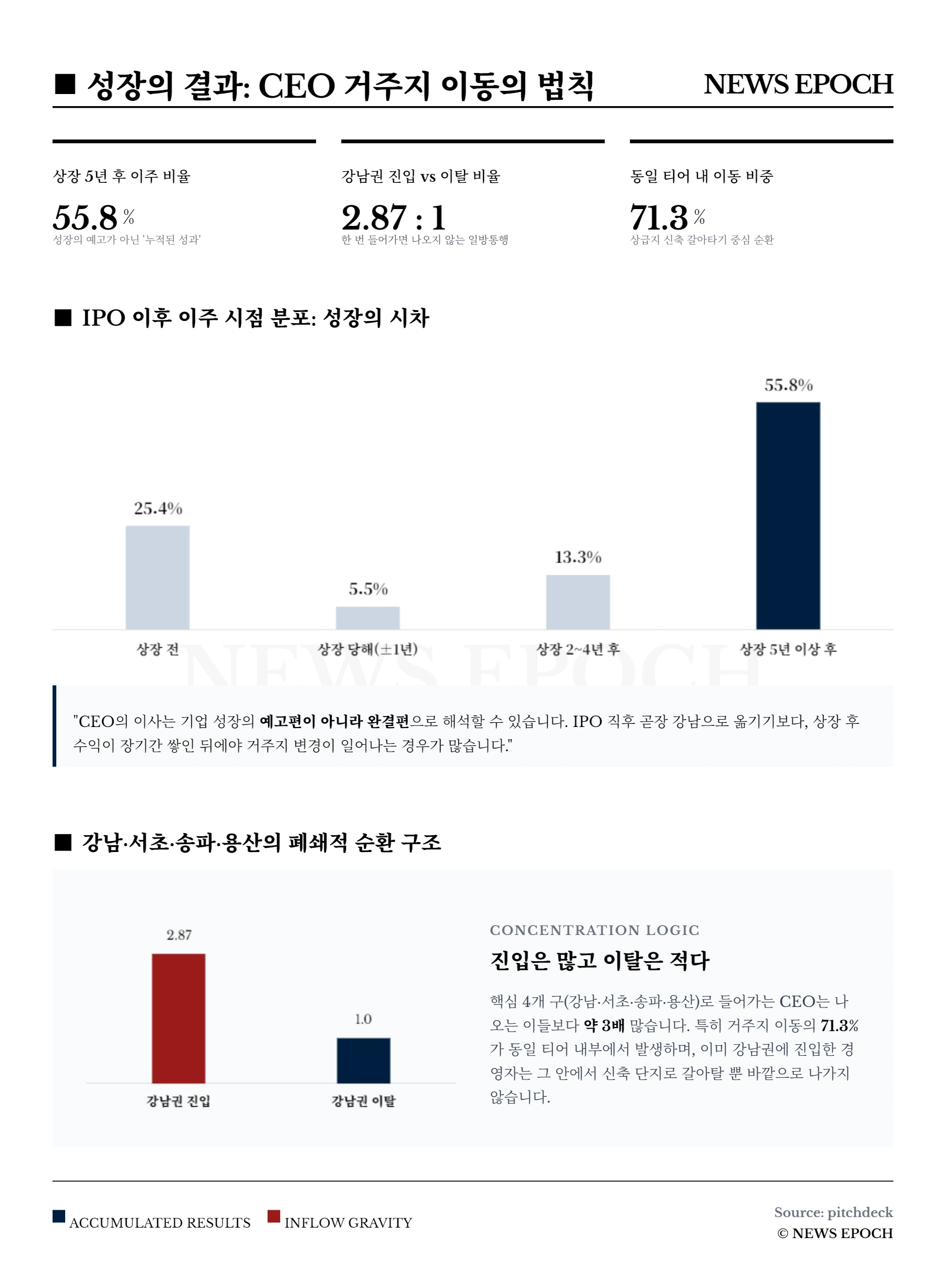
Analyzing the timing of CEOs moving in based on the listing date of their companies, the largest chunk was 'more than 5 years after listing,' accounting for 55.8% of the total. In contrast, cases of moving 'within ±1 year of the listing year' accounted for only 5.5%.
This differs from the conventional wisdom that 'a successful IPO leads to moving to a desired location.' The personal assets of a CEO are not created by the single event of going public. Only after the company accumulates profits over a long period post-listing and those achievements are sufficiently built up does it manifest as a change of residence. Moving can be seen not as a prelude to growth, but as an event that occurs after the company has grown.
Therefore, residential data is not for predicting 'whether this company will grow.' There is a need to look at the direction of 'where the CEOs who led the corporate growth are gathering.'
All Roads Lead to Banpo
When tallying the pairs of dongs (neighborhoods) that the same CEO moved between in chronological order, the top most frequent migration routes head towards one destination almost without exception. It is Banpo-dong.
The top 10 most frequently appearing dong-to-dong migration routes. The percentage represents the proportion each route accounts for within these top 10 routes.
Rank | Migration Route | Proportion within Top 10 Routes |
|---|---|---|
1 | Seocho-dong → Banpo-dong | 15.2% |
2 | Bangbae-dong → Banpo-dong | 14.1% |
3 | Daechi-dong → Dogok-dong | 12.1% |
4 | Banpo-dong → Seocho-dong | 10.1% |
5 | Jamwon-dong → Banpo-dong | 9.1% |
6 | Seocho-dong → Dogok-dong | 9.1% |
7 | Dogok-dong → Seocho-dong | 8.1% |
8 | Dogok-dong → Banpo-dong | 8.1% |
9 | Banpo-dong → Jamwon-dong | 7.1% |
10 | Banpo-dong → Hannam-dong | 7.1% |
The destination of 3 out of the top 5 routes (originating from Seocho, Bangbae, and Jamwon) is Banpo-dong. If we add the routes originating from Dogok-dong (such as Dogok → Banpo), no matter which dong in Gangnam they depart from, the 'second home' or 'third home' of CEOs converges on Banpo with high probability.
The reason is simple. Banpo-dong is the standard for newly built premium apartments in South Korea, represented by Banpo Xi Apartment, occupied in 2008, and Raemian Firstige, occupied in 2009. When an executive living in an older complex in Seocho, Bangbae, or Jamwon reorganizes their assets, it became the most natural destination for 'upgrading to a higher-tier area.'
What is interesting is that Banpo is not merely a final destination. Routes departing again from Banpo, such as Banpo-dong → Seocho-dong, Banpo-dong → Jamwon-dong, and Banpo-dong → Hannam-dong, are also substantial. Banpo serves not only as a destination but also as a massive transfer station for residential moves within Gangnam.
Even Looking at the Gu (District) Level... An 'Internal Circulation' within Gangnam, Seocho, and Songpa
When tallying migration routes at the gu (district) level, one step broader than the dong level, another pattern emerges. It is an internal circulation where major districts exchange with each other.
The most frequent gu-to-gu migration routes are Seocho-gu → Gangnam-gu and Gangnam-gu → Seocho-gu. The two directions are almost symmetrical. These are followed by Songpa-gu → Gangnam-gu, Gangnam-gu → Songpa-gu, Gangnam-gu → Yongsan-gu, and Seocho-gu → Yongsan-gu.
Looking at the origins and destinations of the top routes, Gangnam, Seocho, Songpa, and Yongsan almost exclusively exchange CEOs among themselves. The residential movements of South Korean executives are not 'to anywhere in the country,' but are in fact closer to a closed circuit occurring within these four districts.
Of course, there are also paths heading outward. Routes like Gangnam-gu → Yeonsu-gu (Songdo direction), Dogok-dong → Songdo-dong, and Dogok-dong → Seongsu-dong are signs of departure toward emerging clusters. Suwon-si → Yongin-si shows movement within the Samsung executive belt. However, looking at the numbers, such 'outward bounds' are still a minority.
Once They Enter, They Don't Leave
Condensing the routes so far into a single question goes like this: Are there more CEOs entering areas such as Gangnam, Seocho, Songpa, and Yongsan, or more CEOs leaving them?
There are about three times (exactly 2.87 times) as many executives entering the Gangnam, Seocho, Songpa, and Yongsan areas as there are leaving. Statistically, residential mobility data appears closer to a one-way street.
The more decisive number comes next. Of the inter-dong migration data, 71.3% is 'movement within the same tier'; that is, moving from Gangnam, Seocho, Songpa, and Yongsan to Gangnam, Seocho, Songpa, and Yongsan, or moving from areas outside Gangnam, Seocho, Songpa, and Yongsan to areas outside Gangnam, Seocho, Songpa, and Yongsan. In particular, CEOs already in the Gangnam, Seocho, Songpa, and Yongsan areas merely switch to newly built complexes within them and do not move outside.
The fact that entries are high, departures are low, and internal circulation is overwhelming—this is the essence of the South Korean CEO residential map. Gangnam is becoming an area where once entered, one does not leave.
Long-Surviving CEOs Settle in Gangnam
For CEOs who have passed through four or more residential complexes—making up 10% of the total—their median tenure is 13.4 years, with 62.5% being long-serving executives who have held their positions for over 10 years.
There is a certain rhythm to their movement history. The timing of the first move for CEOs who have lived in two or more complexes almost coincides with their inauguration year. The median is the year of inauguration, and 85% completed their first move within one year before or after inauguration. After that, movements decrease. CEOs with less than two years in office changed addresses at a rate of 1.2 times a year, whereas CEOs who served for over 20 years only moved 0.15 times a year. It is a curve where they make a major move when newly appointed, and stay in one place as time goes by.
Their settlement destination converged on the Gangnam area. The proportion of CEOs with 10 to 20 years in office whose final residence is in Gangnam, Seocho, Songpa, or Yongsan increased to 49.7%. The longer they hold their position, the clearer the tendency to settle in Gangnam becomes.
This settlement did not unravel even after resignation. 58% of CEOs who stepped down from their position as CEO maintained their registered address even after leaving office. This is the exact opposite of 6 out of 10 newly appointed CEOs moving within their first year. Relocation of residence does not coincide with the retirement of the CEO. It means that a spot once secured in Gangnam is not relinquished even upon laying down management control.
The Map is Drawn in Only One Direction
The attempt to read residential relocation as a leading indicator of sales turns causality upside down. The CEO moves because the company has grown, and even that occurs well over five years after going public.
Instead, if we ask 'where do they go,' the map becomes clear. All roads lead to Banpo. Whether starting from Seocho, Bangbae, Jamwon, or Dogok. And the movement occurs within the closed circuit of four districts: Gangnam, Seocho, Songpa, and Yongsan. The ratio of entry to departure is 2.87 to 1. Once they enter, they do not leave. The center of gravity within it shifted from Dogok to Banpo, and the area of Songdo appeared for the first time.
The residential movements of South Korean listed company CEOs seem like the sum of free choices, but looking at the data, they are closer to a river flowing in one direction. And the shape of this river bears no small resemblance to the flow of funds in the South Korean real estate market. It showed a concentration toward areas with strong real estate, commonly referred to as leading areas, a closed circulation in core regions, and a pattern of not leaving once entered.
The residential map of CEOs is a microcosm of South Korea's real estate flow, and perhaps its leading cross-section. It remains to be seen whether the shift in the center of gravity from Dogok to Banpo, along with interest in newly emerging areas like Songdo and Yongsan, will flow similarly to the direction that South Korean real estate funds will head in the future.
Company financial data, investment reports, and startup analysis — all in one place
Explore PitchdeckCurated news, every week — straight to your inbox
Every Friday · Unsubscribe anytime