Transforming EV battery plant into Energy Storage System (ESS) production base... Investors go wild over Morgan Stanley's "$10 billion valuation"
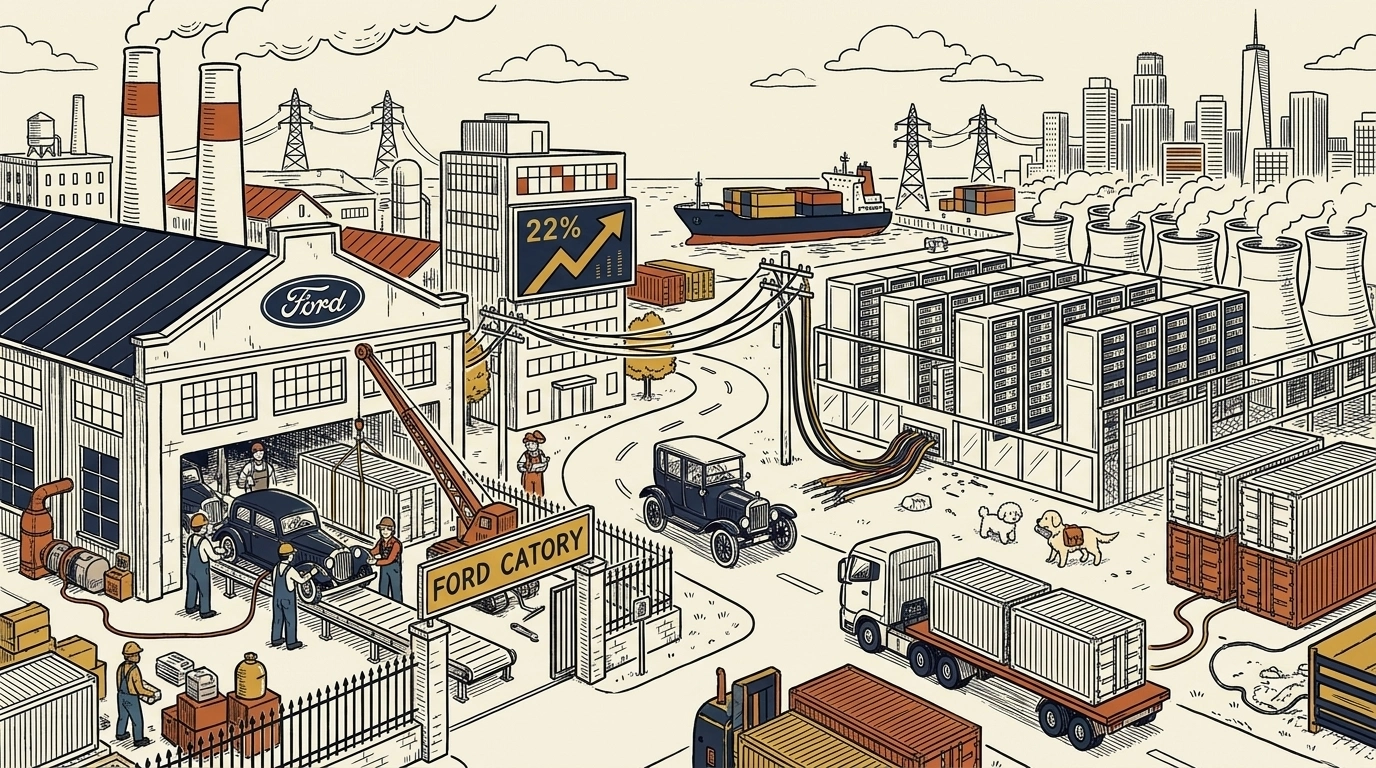
Struggling with slowing electric vehicle (EV) demand, Ford has drawn a heated response from Wall Street by pivoting to an Energy Storage System (ESS) business targeting artificial intelligence (AI) data centers. Ford's stock surged by about 22% over two days, recording its largest gain since March 2020.
Kentucky battery plant transforms into a data center power supply base
Ford announced it is investing $2 billion to convert its Kentucky plant, which was originally intended to produce EV batteries with SK On, into a large-scale energy storage system production facility. The newly launched subsidiary, 'Ford Energy', plans to produce large-scale battery systems with an annual capacity of 20 gigawatt-hours (GWh) by the end of 2027. The flagship system they will produce is a 20-foot-long containerized battery similar to Tesla's Megapack, which is used for renewable energy storage and power grid stabilization.
Emerging as a solver for AI power shortages... Favorable review from Morgan Stanley
The catalyst for this stock price surge was a report by Morgan Stanley analyst Andrew Percoco. He assessed that Ford's energy business division could be worth $10 billion in the long term. The analysis suggests that with massive power demand arising from AI data center training and inference operations, Ford could become a core infrastructure company providing essential power.
Limitations and risks behind the rosy outlook
Experts point to the licensing agreement with Chinese battery company CATL as Ford's powerful weapon. Ford will introduce CATL's lithium iron phosphate (LFP) battery technology, but the product itself will be manufactured in Kentucky, USA, by American workers. This secures technological superiority while simultaneously meeting the requirements for a 30% investment tax credit under the US Inflation Reduction Act (IRA), providing a massive competitive advantage.
However, some in the market are raising a cautious view, arguing that Ford's stock price surge is highly speculative in nature, riding on the AI theme rather than actual earnings.
Above all, Ford must overcome the double dilemma of massive deficits in its existing business and strong competitors. Ford's EV division (Model e), which was its core future business, recorded a massive loss of $4.8 billion in the year 2025 alone. Furthermore, fierce competition is inevitable in the newly entered energy storage system market, where the absolute powerhouse Tesla stands firm, dominating a 39% market share in North America.
Political risks stemming from geopolitical factors are also an unignorable factor of instability. Ford's core strategy, the partnership with the Chinese company CATL, is currently regarded as an economic and security threat by hardline anti-China lawmakers in the US, facing continuous checks and investigations. Consequently, the possibility cannot be ruled out that the tax credit benefits Ford touts as a core competitive edge could be shaken depending on the future direction of the political sphere.
Furthermore, fundamental questions regarding technical suitability are also being raised. The lithium iron phosphate (LFP) battery adopted by Ford is originally a technology optimized for vehicles that release energy at a constant rate. However, AI data centers exhibit a very dynamic cycle, where power usage fluctuates rapidly from 10% to 90% in an instant depending on the computational workload. Energy and battery experts are expressing deep technical concerns over whether existing automotive batteries can stably withstand the extreme data center environment that requires such short and powerful power discharges.
Company financial data, investment reports, and startup analysis — all in one place
Explore PitchdeckCurated news, every week — straight to your inbox
Every Friday · Unsubscribe anytime