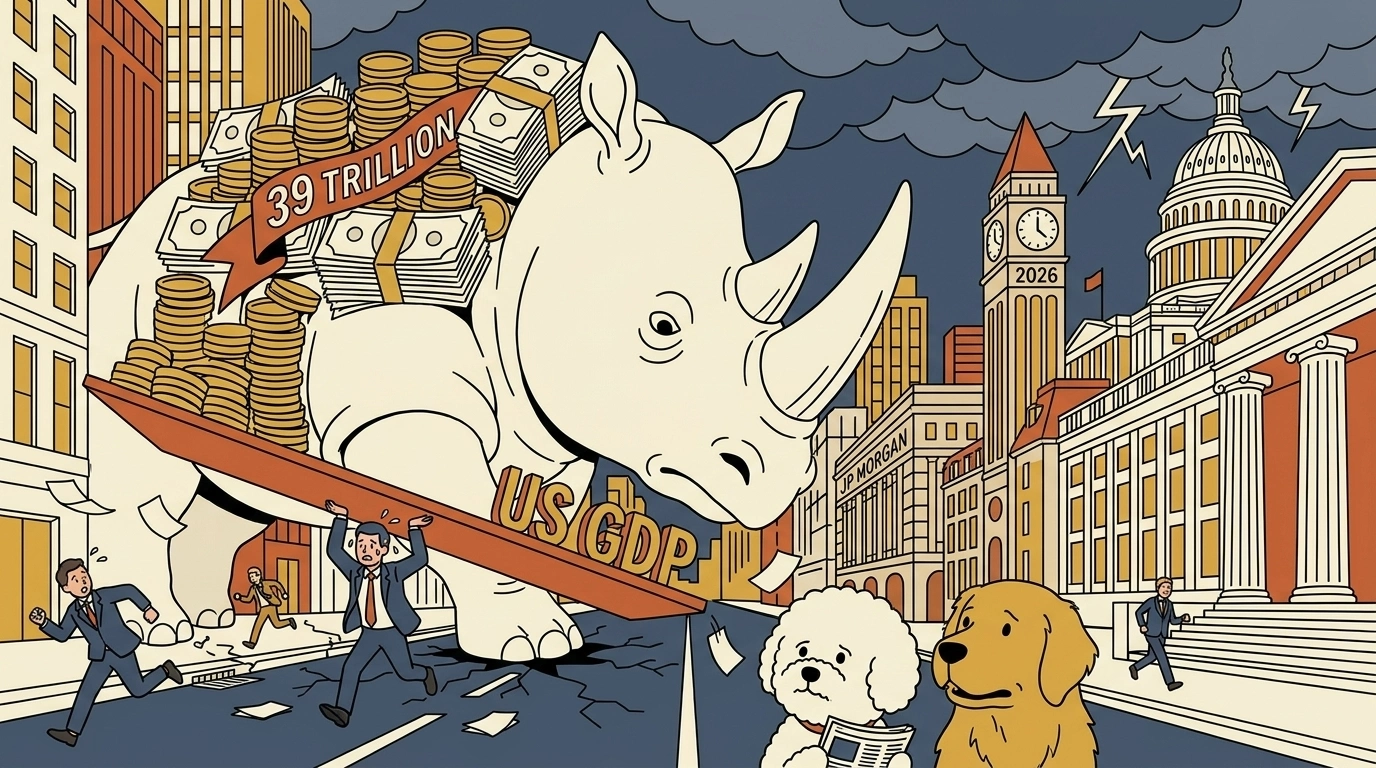
Recently, ChainCatcher, a media and data service platform specializing in Web3 and cryptocurrency, warned that the U.S. national debt has surpassed $39 trillion for the first time in history, exceeding GDP, and will become an unavoidable, massive threat—a 'Gray Rhino'—that all investors must face in the upcoming year of 2026. The Atlantic also pointed out 'The National Debt’s Unforgiving Math', and Slow Boring expressed deep concerns over the endlessly growing national debt. Amidst this sense of crisis, Jonathan Williams of the American Radio Journal urged discussions on sustainable national debt management and fiscal responsibility through the American Legislative Exchange Council (ALEC).
As warning signs surrounding the U.S. debt grow louder, J.P. Morgan Asset Management presented 5 scenarios of how the U.S. debt crisis could unfold in the future. As reported by Fortune, even the 'best-case scenario' among these points to a worrisome future that can never leave investors feeling relieved.
The Current State of the Snowballing Fiscal Deficit
According to J.P. Morgan's analysis, the U.S. fiscal deficit for the 2026 fiscal year is expected to reach approximately $1.89 trillion, amounting to 5.9% of GDP. Consequently, the federal debt held by the public is projected to surge to $32.2 trillion, or 100.4% of GDP. Based on this, J.P. Morgan analyzed the future trajectory of the debt issue by dividing it into the following 5 scenarios.
1. Steady Debt Growth and Rising Borrowing Costs (Base Scenario) If tariff revenues fall short of expectations and recent tax cut policies become permanent, the U.S. debt-to-GDP ratio could soar to 127.7% by 2036. Furthermore, if inflation and a recession occur over the coming decade, this ratio could reach up to 130%. Under this scenario, it is expected that bond yields will rise significantly, dealing a negative blow to investment returns in the long term.
2. Slow Debt Growth and Market Indifference (Optimistic Scenario) If productivity improves due to AI innovation, the labor force increases following relaxed immigration restrictions, or a divided Congress limits government fiscal overreach, the debt ratio could be contained at the 115% level by 2036. Like in the past, global investors might ignore the rising debt, and U.S. stocks and bonds could continue to perform well. However, as Fortune pointed out, even this most optimistic situation is merely a 'worrisome best' in that debt continues to increase.
3. Fiscal Crisis Outbreak (Pessimistic Scenario) This is a catastrophic scenario that could be triggered more by political risks than economic fundamentals. It could occur if Congress refuses to raise the debt limit, or if the White House undermines the independence of the Federal Reserve (Fed) and forces interest rate cuts. If the government borrows unlimited amounts of money for populist tax cuts and spending until global investors lose confidence in U.S. Treasuries, the global financial market could face a devastating collapse.
4. Slowing Debt Growth Through Spending Cuts Theoretically, debt could be controlled by reducing spending on Medicare (healthcare) or defense. However, considering the aging population, the emergence of expensive new drugs, and worsening geopolitical conflicts, this is highly unrealistic. The number of federal employees has also fallen to its lowest level relative to total employment since 1939, leaving virtually no room for further cost reductions.
5. Slowing Debt Growth Through Tax Increases This is a measure to curb debt by raising corporate taxes, income taxes for high-income earners, and capital gains taxes. While this could slow the rise in the debt ratio and be positive for the Treasury market, it could lower after-tax returns on investment assets, thereby negatively impacting the prices of risk assets such as equities.
Unavoidable Debt Increase, Portfolio Diversification is the Way to Survive
Considering the polarized electoral system and political environment in the U.S., J.P. Morgan asserted that there will be no serious attempt at deficit reduction through tax increases or spending cuts over the next decade. Ultimately, it is highly likely that debt will continue an upward trajectory.
To confront the impending massive 'Gray Rhino' starting in 2026, as warned by ChainCatcher, J.P. Morgan advises investors that they must actively diversify their portfolios into foreign and alternative assets in preparation for a weaker dollar, alongside high-quality bonds. While the political sphere neglects its fiscal responsibilities, the burden of protecting assets has been left entirely up to the investors.
Company financial data, investment reports, and startup analysis — all in one place
Explore PitchdeckCurated news, every week — straight to your inbox
Every Friday · Unsubscribe anytime