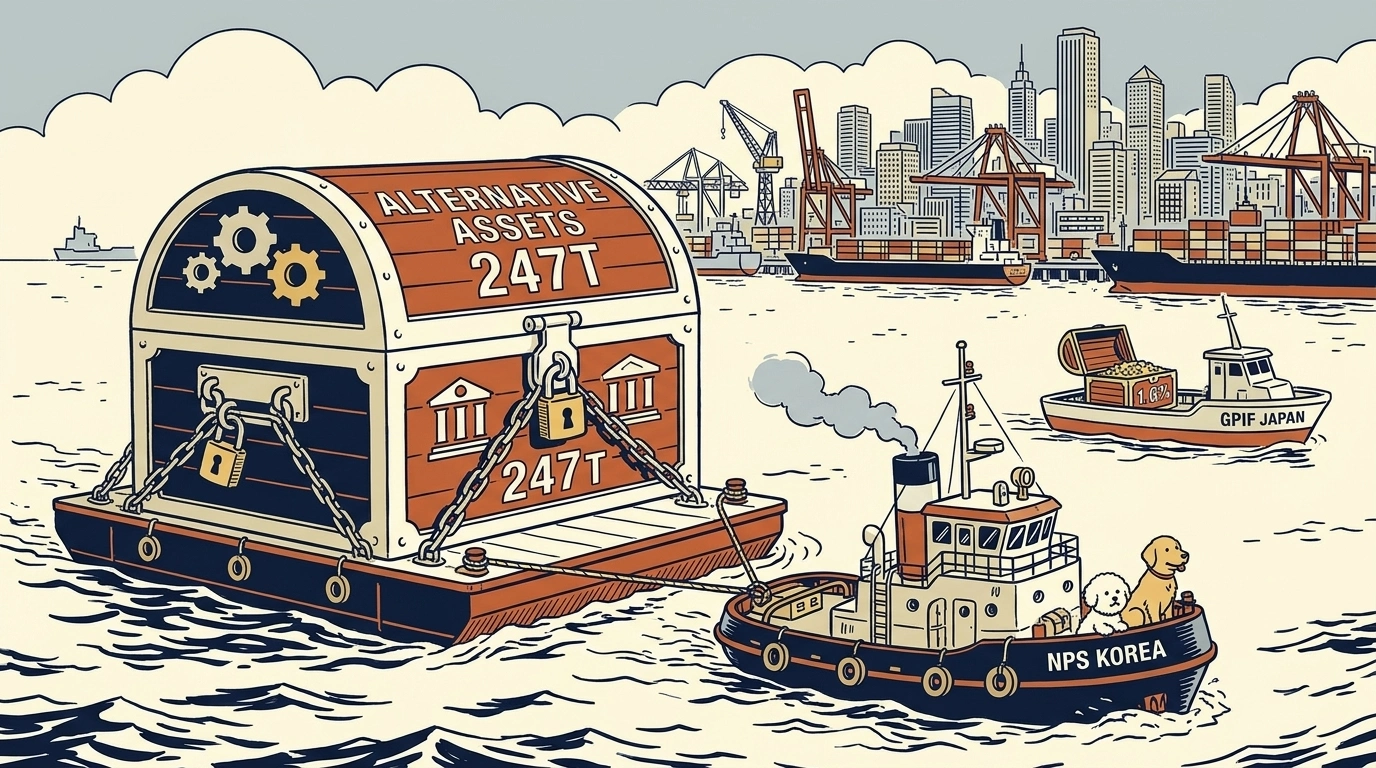
Sixteen percent of the retirement funds managed by the National Pension Service (NPS), or 247 trillion won, is invested in 'alternative investments.' These are unlisted assets, such as private equity funds, infrastructure, and real estate, which are difficult to buy and sell once acquired and have less public information disclosure. This proportion is about 10 times that of Japan's public pension fund (1.6%). Although it is the result of aiming for higher returns amidst a narrow domestic market and forecasts of fund depletion, it means that Korea's retirement funds are increasingly tied up in assets that will be difficult to sell later.
Over the past 20 years, NPS assets have shifted from domestic bonds to overseas assets, and from listed assets to unlisted ones. The proportion of overseas investments, which was a mere 0.8% in 2003, has now grown to 58%, and unlisted alternative investments like private equity funds have expanded to 16%. The management structure of Korea's retirement funds has changed that much.
Pension Fund Allocation: NPS Alternative Investments at 16%, Japan's GPIF at 1.6%
According to the National Pension Service Investment Management (NPSIM), out of the 1,526 trillion won fund as of the end of March 2026, alternative investments account for 247.6 trillion won, or 16.2%. Of this, 90%, or about 224 trillion won, are overseas assets, while domestic assets amount to only 24 trillion won, making NPS alternative investments effectively overseas unlisted investments. Broadening the scope to total overseas investments, the proportion reaches 58.1% (886.2 trillion won).
This is the result of diversifying a portfolio that was previously focused on domestic bonds into overseas and unlisted assets. As recently as 2012, more than half of the fund consisted of domestic bonds, but that proportion has been steadily reduced, redirecting funds to overseas equities and alternative investments. Looking at the proportion of overseas equities alone, it increased from 23.1% in 2020 to 35.5% in 2024.
The most comparable counterpart to the NPS is Japan's Government Pension Investment Fund (GPIF). This is because it is the world's largest pension fund (with assets under management of approximately 277 trillion yen, or about 1.87 trillion dollars) and faces the same issues of pension sustainability due to an aging population and low birth rate as Korea. Under the same pressures, the two funds have gone in opposite directions. It was not until 2014 that GPIF moved away from an approach centered on Japanese government bonds and introduced a policy of allocating 25% each to domestic and international equities and bonds. It does not treat alternative investments as an independent asset class, but rather classifies them within bonds and equities according to their risk-return characteristics, setting a maximum limit of 5% of the total. The actual proportion falls short of that limit at 1.6%, amounting to about 27.3 billion dollars (or about 48 billion dollars on a committed basis, combining infrastructure, real estate, and private equity funds). While GPIF's assets under management are larger than those of the NPS, looking only at the alternative investment proportion, Korea's is about 10 times higher.
This movement is not limited to the NPS. Korean institutional investors as a whole have been shifting funds into overseas unlisted assets, and how Korean securities firms bring in such funds is more clearly documented in US disclosures rather than in Korea.
Korea Ranks First Outside the US in US SEC Disclosures as Well
In the US Securities and Exchange Commission's (SEC) private fund disclosures (Form D), the placement agents that sell the funds to investors in each country are listed along with their country of location. When News Epoch compiled funds from global asset managers such as Blackstone, KKR, and Carlyle, and tallied the placement agents listed in that section by their location, funds listing Korean securities firms were the most numerous, excluding the United States.
Rank | Placement Agent Location Country | Number of Funds |
|---|---|---|
1 | United States | 417 |
2 | South Korea | 87 |
3 | United Kingdom | 82 |
4 | Hong Kong | 62 |
5 | Chile | 54 |
6 | Singapore | 48 |
10 | Japan | 21 |
This tally eliminates search bias by country by finding funds solely by the asset manager's name rather than the securities firm's name. The ranking remained the same in another sample (1,082 funds) separately discovered using the names of major securities firms — United States 735, South Korea 251, United Kingdom 152, Hong Kong 102, Japan 70. In both samples, South Korea ranked first outside the US, and here too, Japan was at one-third to one-quarter the level of Korea. The gap between Korea and Japan seen in pension fund allocation was reflected exactly in the fund sales records as well.
London and Hong Kong Feature Asset Manager Subsidiaries, While Korea Uses Independent Securities Firms
Just as important as the ranking is the nature of the numbers. A significant portion of the listings in the UK, Hong Kong, and Singapore—which trail behind Korea—are in-house sales entities established in each country by a single asset manager, Brookfield. Out of 82 in the UK, 33 are 'Brookfield Private Capital (UK)'; out of 62 in Hong Kong, 26 are 'Brookfield Advisors (Hong Kong)'; and out of 48 in Singapore, 34 are 'Brookfield Singapore'.
On the other hand, the 87 listings in Korea were filled by independent securities firms such as NH Investment & Securities, Samsung Securities, Korea Investment & Securities, KB Securities, and Mirae Asset Securities. They are not asset manager subsidiaries, but third-party channels that sell external funds to Korean institutional investors. If asset manager subsidiaries like Brookfield are removed from the UK and Hong Kong numbers, the gap with Korea widens significantly more than 87 to 82.
What KB, Mirae Asset, and Samsung Sell Are Blackstone and KKR Funds
There are currently 210 overseas private equity funds listing Korean securities firms as placement agents, and the cumulative total is 222 if those once listed but since removed are included. Of these, 94% involve one of the five firms—KB, Mirae Asset, Korea Investment, Samsung, and NH—with KB Securities having the most at 61.
The asset managers of the listed funds are top-tier globally. Korea Investment & Securities is listed as a placement agent for the Blackstone Real Estate Fund (Blackstone Real Estate Partners X.F, cumulative 28.2 billion dollars), NH Investment & Securities for the Blackstone VIII buyout fund (24.5 billion dollars), and four firms—NH, Samsung, Eugene, and Korea Investment—are simultaneously listed for the KKR Asian Fund IV (13.2 billion dollars).
Background of the Gap: Narrow Domestic Market and Forecast of Depletion
The background of the gap lies in market structure. The Korean stock market accounts for less than 2% of the global market capitalization. If the NPS, which has swelled to 1,526 trillion won, allocates all this money solely domestically, it would excessively dominate the market, collapsing the principle of diversification. The structure inevitably forces the enlarged fund to move beyond the narrow domestic market and go overseas.
Added to this is the forecast of fund depletion. The exhaustion point was delayed from the previous 2056 to 2064 by the 2025 pension reform (raising the premium rate from 9% to 13%), and estimates suggest it could be pushed back to 2069 if recent investment performance is reflected. Still, the fundamental structure remains the same: the fund will eventually pass its peak and shrink. To raise target returns, listed equities and bonds are insufficient, leading to a shift in allocation toward high-yield unlisted assets like private equity funds and infrastructure. In fact, the NPS has increased its target proportion for alternative investments from the 13% range to around 15%.
Japan's choice was different. The GPIF also allocates about half of its assets overseas, but those overseas investments have stayed in listed assets like equities and bonds. A conservative policy capping alternative investments at 5% of the total and treating them merely as supplementary assets, along with a deep Japanese government bond market to hold funds, prevented the expansion of unlisted investments. Both countries ventured overseas, but they diverged in direction, with Korea moving toward unlisted assets and Japan toward listed ones.
Retirement Funds Shifted to Unlisted Assets, Cashing Out is the Next Challenge
Two sets of data with different sources and methodologies point to the same conclusion. In pension fund allocation, Korea's alternative investment proportion is about 10 times that of Japan, and in US SEC sales records, Korea ranks first outside the US. This means the extent to which Korean institutions have shifted retirement funds into overseas unlisted assets is noticeably greater than that of Japan. For the NPS alone, alternative investments total 247 trillion won, 90% of which are overseas assets, and a significant portion is difficult to buy and sell once entered. When the fund passes its peak and enters a phase where assets must be sold to pay out pensions, the remaining challenge will be whether these can be monetized in a timely manner.
This article was written by News Epoch by securing US Securities and Exchange Commission (SEC) private fund disclosures (Form D) and asset allocation data from the National Pension Service Investment Management and Japan's GPIF through The Proxy collection and analysis pipeline.
The ranking of placement agent location countries is the result of collecting funds from 40 global asset managers (1,134 cases) via SEC EDGAR Full Text Search (EFTS) and funds discovered using the names of major securities firms (1,082 cases), and classifying each fund by the country of its placement agent's address. Placement agents located in Korea were tallied almost exhaustively using the names of major securities firms, and international comparisons were cross-checked for ranking consistency by extracting via both global asset manager name discovery and securities firm name discovery methods. Since not all Form Ds were exhaustively examined, there may be margins of error in the absolute number of funds for each country; however, the ranking that Korea has the most after the United States appeared identical in both methods. Being listed as a placement agent solely indicates the distribution rights of the respective securities firm and is unrelated to the Korean investment amount in each fund. The asset allocation figures for the NPS and GPIF follow the disclosures of their respective investment management bodies. Data baseline: SEC June 2026, NPS March 2026, GPIF FY 2024.
Company financial data, investment reports, and startup analysis — all in one place
Explore PitchdeckCurated news, every week — straight to your inbox
Every Friday · Unsubscribe anytime