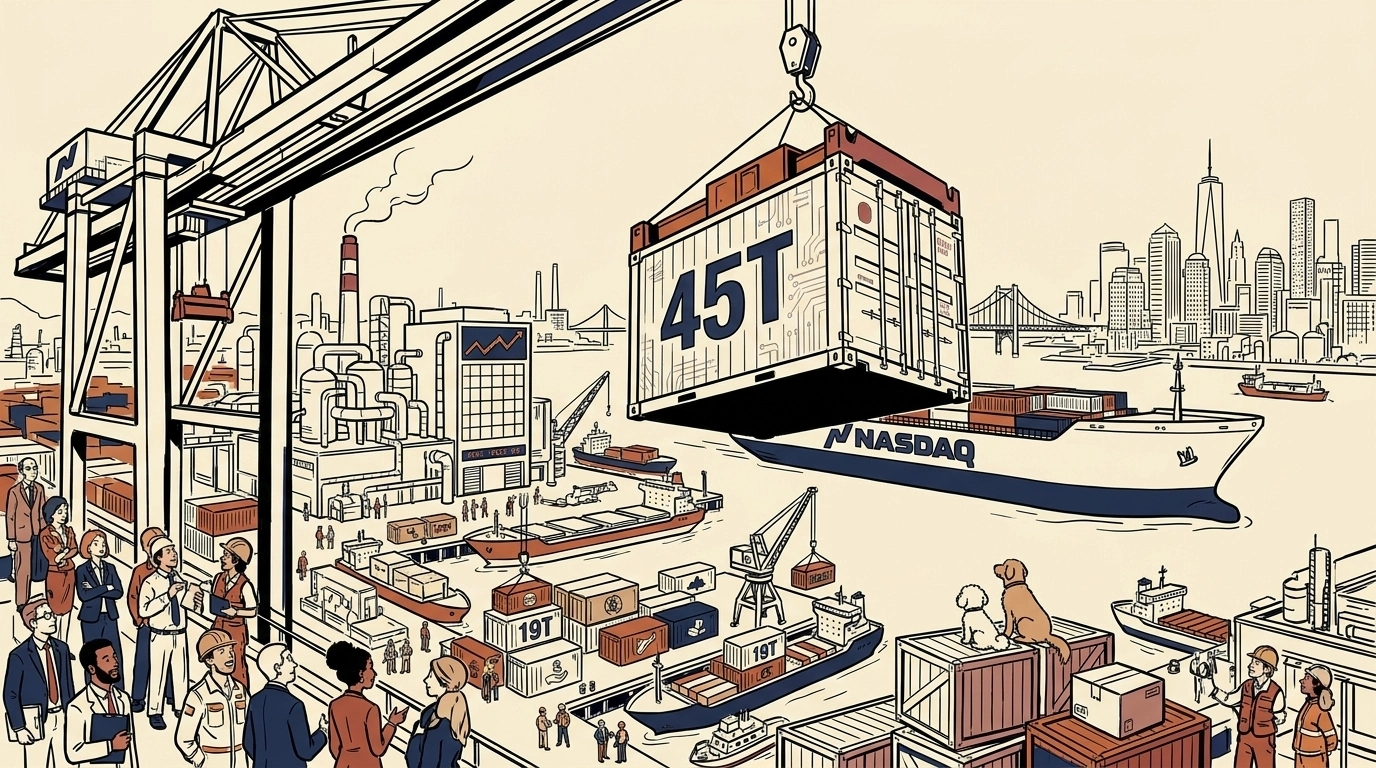
In the first half of this year, domestic companies resolved 418 paid-in capital increases through their boards of directors, with a total reported amount of 64.4594 trillion won. Among these, 45.4534 trillion won, or 70.5% of the total, came from a single SK Hynix deal. Excluding this case, the remaining 417 deals shrink to 19 trillion won. While third-party allotments account for the majority of the number of deals, two-thirds of the total amount is concentrated in allotments to existing shareholders.
45 Trillion Won is Not for Attracting Investment, but Underlying Shares for Nasdaq Listing
SK Hynix's 45 trillion won is a paid-in capital increase only in format and is not a conventional investment attraction. The recipient of the new shares is Citibank, a U.S. depository institution, and the issuance is for underlying shares to be used for the Nasdaq American Depositary Receipt (ADR) listing on July 10. It is not a transaction selling stakes to domestic and foreign investors, but a part of the listing process. The entire 45.4534 trillion won raised will be used as facility funds for the Yongin Semiconductor Cluster, the Cheongju Packaging Fab, and EUV lithography equipment. Since this single deal exceeds 70% of the total, leaving it as is would skew both the total sum and proportions of the first half's paid-in capital increases to reflect only SK Hynix's figures. Therefore, the aggregation below is based on the 417 deals excluding this case.
Third-Party Allotments Lead in Deal Count, Shareholder Allotments Take Two-Thirds of the Money
When breaking down the 417 deals and 19 trillion won excluding SK Hynix by funding method, the ranking of deal counts and amounts is reversed. By deal count, third-party allotments account for 60% with 251 deals, but the amount only reaches 5 trillion won. This is because most are small-scale capital increases of billions of won for Kosdaq-listed and unlisted companies. Conversely, methods granting subscription rights to existing shareholders (shareholder allotments and public offerings of forfeited shares after shareholder allotments) account for about a quarter of the deal count, but as trillion-won large-scale capital increases cluster here, the amount reaches 13.2 trillion won, accounting for two-thirds of the total.
Top Tier is Split Between Large Capital Increases by Financial Firms and Conglomerates
The upper ranks of the 32 capital increases with a reported amount of 100 billion won or more are divided into two categories. One is the capital expansion of financial companies, such as securities firms and financial holding companies. Six deals, including Korea Investment & Securities and KB Securities, amount to 5 trillion won, accounting for 26% of the 19 trillion won excluding SK Hynix. This is due to the nature of the securities industry, where equity capital scale dictates entry into businesses like Comprehensive Investment Accounts (IMA) and issued promissory notes, making first-half capital increases by securities firms the highest since 2016. The other category is the procurement of facility and investment funds by large manufacturing conglomerates. Hanwha Solutions resolved to raise 2.3976 trillion won (in March, later reduced to 1.8144 trillion won), EcoPro BM 1.2 trillion won, and SKC 1 trillion won, respectively, through public offerings of forfeited shares after shareholder allotments.
June Hit the Peak… National Growth Fund Supports Defense and Biotech
June was the highest in the first half for both deal count (101 deals) and amount, and what stood out within it was the emergence of government funds. Defense contractor LIG Defense & Aerospace raised 500 billion won and biotech company LigaChem Biosciences raised 330 billion won through third-party allotments, and both deals were reported to be funded by the government-led National Growth Fund. A government fund has appeared in first-half paid-in capital increases as a large-scale financing channel for defense expansion and new drug research and development (ADC).
Three prominent trends emerge from the 19 trillion won, after stripping away SK Hynix's 45 trillion won and hundreds of small Kosdaq capital increases. These are securities firms looking to expand equity capital to enter new businesses, large manufacturing conglomerates undertaking massive facility investments, and government funds providing capital to defense and biotech. Rather than the superficial figure of 64 trillion won, where this 19 trillion won was directed reveals the actual landscape of corporate financing in the first half.
This article was written by News Epoch by fully collecting the original public disclosures of decisions on paid-in capital increases and paid-in/free capital increases for the first half of 2026 from the Financial Supervisory Service's electronic disclosure system (DART), and extracting and classifying the amounts and capital increase methods through its own pipeline. The amounts are the reported amounts at the time of the board of directors' resolutions, not the completed payment amounts.
Company financial data, investment reports, and startup analysis — all in one place
Explore PitchdeckCurated news, every week — straight to your inbox
Every Friday · Unsubscribe anytime