![[Supermarket Industry Review ①] 'Growing in Size to Survive'... The Landscape of the Korean Supermarket Industry](https://d1gl51xbrxoj65.cloudfront.net/uploads/2026/01/07/1767769309458-lgr05.webp)
The central axis of the Korean retail industry has completely shifted from traditional markets in the past to convenience stores (CVS), hypermarkets, and corporate-type supermarkets (SSM). In particular, in supermarkets, which have established themselves as short-distance shopping channels, various types of players, including large conglomerates, Nonghyup, and independent self-employed alliances, are seeking survival through 'economies of scale'. This journal diagnosed the current state of the Korean supermarket industry and analyzed the strategies and report cards of major retail companies.
From Traditional Markets to SSMs... A Tremendous Upheaval in the Retail Landscape
The flow of the Korean retail industry was rapidly reorganized from traditional markets and neighborhood stores before the 1980s to corporate retail channels since the 1990s. The convenience store era began in 1989 when the 7-Eleven Olympic Village branch opened, and the hypermarket era opened with the opening of E-mart's Chang-dong branch in 1993. In the 2000s, corporate-type supermarkets (SSM) such as Lotte Super and Homeplus Express emerged, leading the modernization of alley commercial districts.
Under the retail industry classification, supermarkets belong to 'general retail' among retail businesses, establishing an independent domain distinct from hypermarkets, department stores, and convenience stores.
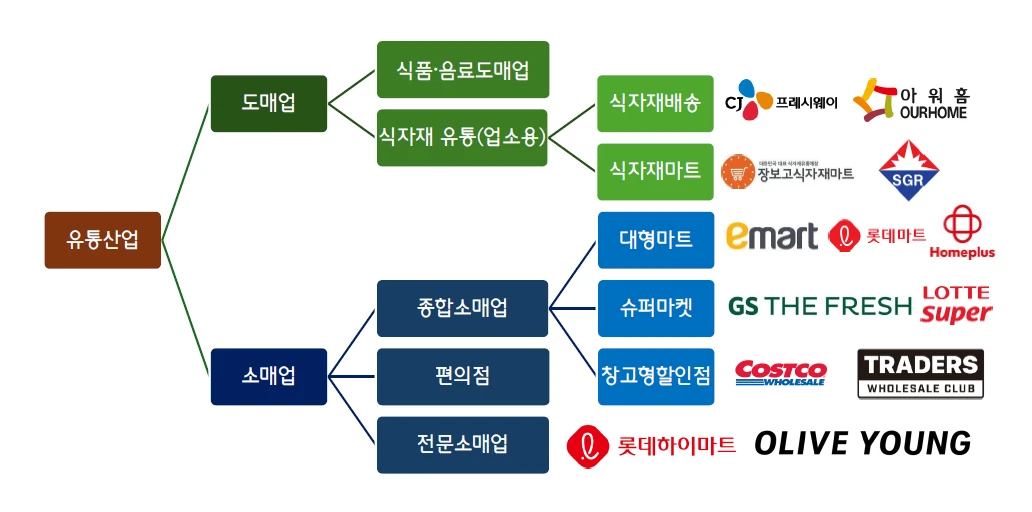
Department Stores, Hypermarkets, and SSMs: What is the Difference?
Retail channels are clearly classified according to their size and characteristics. Hypermarkets have a scale of over 3,000 square meters (about 900 pyeong) and cover food, home appliances, and household goods, with an initial investment cost reaching about 60 to 70 billion won (based on 9,900 square meters). On the other hand, department stores are a facility- and location-based industry equipped with a rich assortment of products such as clothing and miscellaneous goods, requiring an enormous cost of about 300 billion won to open a large store.
Corporate-type supermarkets (SSM) are exactly what targeted the 'niche market' between them. SSMs range in size from 300 to 3,000 square meters, taking an intermediate form between large discount stores and convenience stores. They have the lowest opening costs, making it easy to enter small-scale commercial districts, and they are targeting short-distance customers by increasing the proportion of fresh food and home meal replacements (HMR) from the past focus on daily necessities.
Strategic Differences Among the Top Three Supermarkets: 'Directly Managed' vs. 'Franchise'
The SSM operation strategies of the three large retail companies leading the domestic supermarket market (Lotte, E-mart, GS) diverge distinctly.
'E-mart Everyday', an affiliate of E-mart, adheres to an operation strategy centered on directly managed stores. According to analysis data, E-mart Everyday has 232 directly managed stores, while it has only 25 franchise stores, showing an overwhelming ratio of directly managed locations. This is interpreted as a strategy to consistently maintain quality and service by increasing the headquarters' control.
On the other hand, 'GS The Fresh', operated by GS Retail, has placed its focus on the franchise business. GS The Fresh has 113 directly managed stores compared to 418 franchise stores, with the number of franchise stores reaching about four times that of directly managed ones. This is a strategy to rapidly expand the number of stores while sharing risks and profits between the franchise headquarters and store owners. In the case of Lotte Super, it maintains a relatively balanced portfolio with 171 directly managed and 153 franchise stores, and Homeplus Express has a high proportion of directly managed stores with 237 directly managed and 60 franchise stores.
'United We Survive'... Nonghyup, KOSA, and Nadeul-gage
In addition to large conglomerates, Nonghyup and independent supermarket alliances exist in the supermarket market. The Nonghyup affiliates are divided into Nonghyup Retail (large directly managed stores in the metropolitan area), Nonghyup Hanaro Retail (chain headquarters and SSM), and Hanaro Marts independently operated by about 1,100 regional agricultural and livestock cooperatives.
Independent supermarkets are responding in an organized form to survive. The Korea Supermarket Cooperative Alliance (KOSA) is a cooperative form established for joint purchasing and logistics efficiency, and 'Nadeul-gage' is a model that promoted the facility modernization and joint branding of neighborhood supermarkets with the support of the Ministry of SMEs and Startups. The fundamental reason they unite in the form of large conglomerates, Nonghyup, and cooperatives is to maximize economic profits through cost reduction via joint purchasing and distribution channel efficiency.
Mixed Fortunes: Korean Retail Stocks 'Plummet' vs. US Costco 'Soars'
While domestic retail companies engaged in fierce competition, their report card in the stock market was dismal. Over the past few years, the stock prices of Korea's top three retail companies have drawn a downward curve. GS Retail fell by about 59.37% from its peak, and E-mart and Lotte Shopping also recorded drops of about 59.51% and 69.01% respectively, suffering significant damage to their corporate value.
This sharply contrasts with the moves of the representative US retail company, Costco (COSTCO). During the same period, Costco's stock price showed a continuous upward trend, soaring vertically. This is a point that shows that while the Korean retail industry is losing its growth momentum amid sluggish domestic demand, regulations, and the e-commerce offensive, Costco, equipped with global competitiveness, continues its solid growth.
The Korean supermarket industry faces the task of establishing an independent survival domain between convenience stores and hypermarkets in line with the increase in single-person households and the trend preferring short-distance shopping. An efficient mix of directly managed and franchise stores, along with securing price competitiveness through economies of scale, are expected to be the keys to future survival.
Company financial data, investment reports, and startup analysis — all in one place
Explore PitchdeckCurated news, every week — straight to your inbox
Every Friday · Unsubscribe anytime