![[Supermarket Industry Check ②] "The Broken Backbone of the Retail Industry"... Supermarkets in 'Crisis of Extinction' Under Joint Attack by Coupang and Convenience Stores](https://d1gl51xbrxoj65.cloudfront.net/uploads/2026/01/09/1767925435833-ldnq7f.webp)
SSM Average Annual Growth Rate Steps Back to -2.6%... While Online Surges by 15%, Offline Remains Stagnant at 2%
Supermarkets, which once served as the 'backbone' of the Korean retail industry, are facing a desperate crisis. They are losing ground amid relentless offensives from convenience stores that are taking over local commercial districts and online shopping malls armed with 'dawn delivery.' According to retail performance data obtained by this paper, the sales of major super supermarkets (SSMs) are experiencing negative growth, and even traditional markets are rapidly disappearing.
"Worrying About Survival, Let Alone Growth"... The Fall of SSMs
Analyzing the sales trends of major domestic retail channels from 2020 to 2024 reveals a stark contrast in market fortunes. The convenience store industry soared, recording a compound annual growth rate (CAGR) of 5.6%, and warehouse discount store Costco also showed a high growth trend of 7.6%. On the other hand, the combined average annual revenue growth rate of the three major corporate super supermarkets (SSM) (GS The Fresh, Nonghyup Hanaro Retail, Lotte Super) stepped backward, recording -2.6%.
The contrast between individual companies was also distinct. While GS The Fresh put up a good defense by maintaining a growth rate of 0.8% through franchise business expansion, Nonghyup Hanaro Retail (-3.3%) and Lotte Super (-4.8%) could not escape negative growth. Coupled with the stagnation of hypermarkets (0.3%), this is an indicator that demonstrates the overall weakening competitiveness of mid-to-large offline retail channels.
Although some regional-based marts, such as 'Top Mart' in Busan and Gyeongnam, 'Daebaek Mart' in Daegu and Gyeongbuk, and 'Y-MART' in Gwangju and Jeonnam, are keeping their lineage alive, the majority of regional supermarkets are losing their footing or taking steps toward closure, pushed out by the expansion of SSMs and food materials marts. The fact that food materials marts have emerged as new competitors with an average annual growth of 4.0% is also a threat to existing supermarkets.
Disappearing Traditional Markets... 15,000 Stores Vanish Nationwide
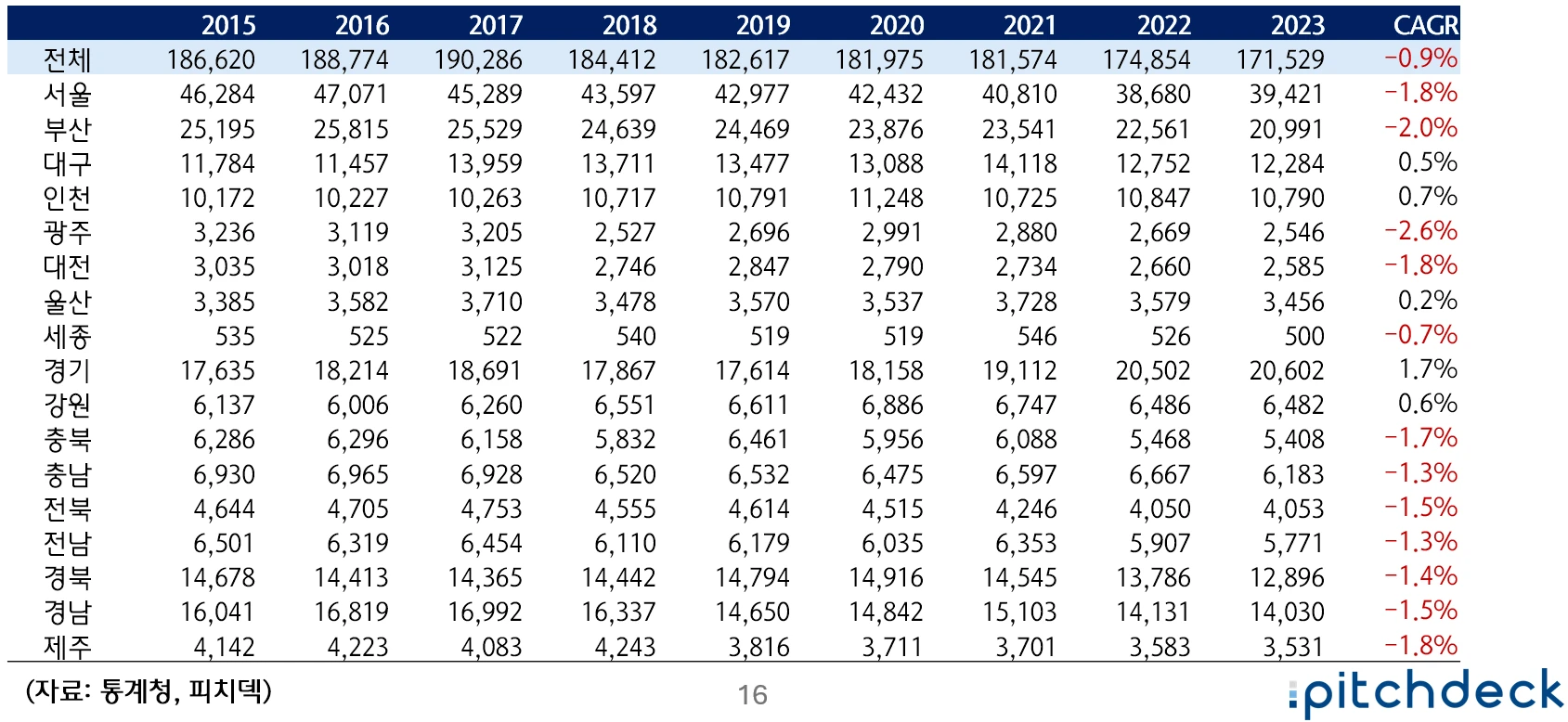
The pace of decline in traditional markets, the barometer of the working-class economy, is even steeper. The number of traditional market stores nationwide decreased from 186,620 in 2015 to 171,529 in 2023, with about 15,000 stores disappearing over eight years.
By region, the downward trend was prominent in major metropolises such as Seoul (-1.8%), Busan (-2.0%), and Gwangju (-2.6%). Among the 17 cities and provinces nationwide, only five saw an increase in the number of stores: Gyeonggi (1.7%), Incheon (0.7%), Gangwon (0.6%), Daegu (0.5%), and Ulsan (0.2%), suggesting that regional extinction and the collapse of commercial districts are progressing simultaneously.
"Grocery Shopping is Done on Phones"... Parcel Delivery Usage Hits 177 Times a Year per Economically Active Person
The supermarket crisis stems from fundamental changes in consumption patterns. Online shopping, which was mainly centered on manufactured goods in the past, has now completely encroached upon the core categories of supermarkets, such as food and beverages, daily necessities, and agricultural and livestock products.
This change is starkly revealed in parcel delivery usage statistics. The number of parcel deliveries per economically active person, which was only 5.0 times a year in 2000, exploded to 177.6 times in 2023. Even on a per capita basis, it increased from 2.4 times to over 100 times, showing that offline grocery shopping has been replaced by parcel delivery.
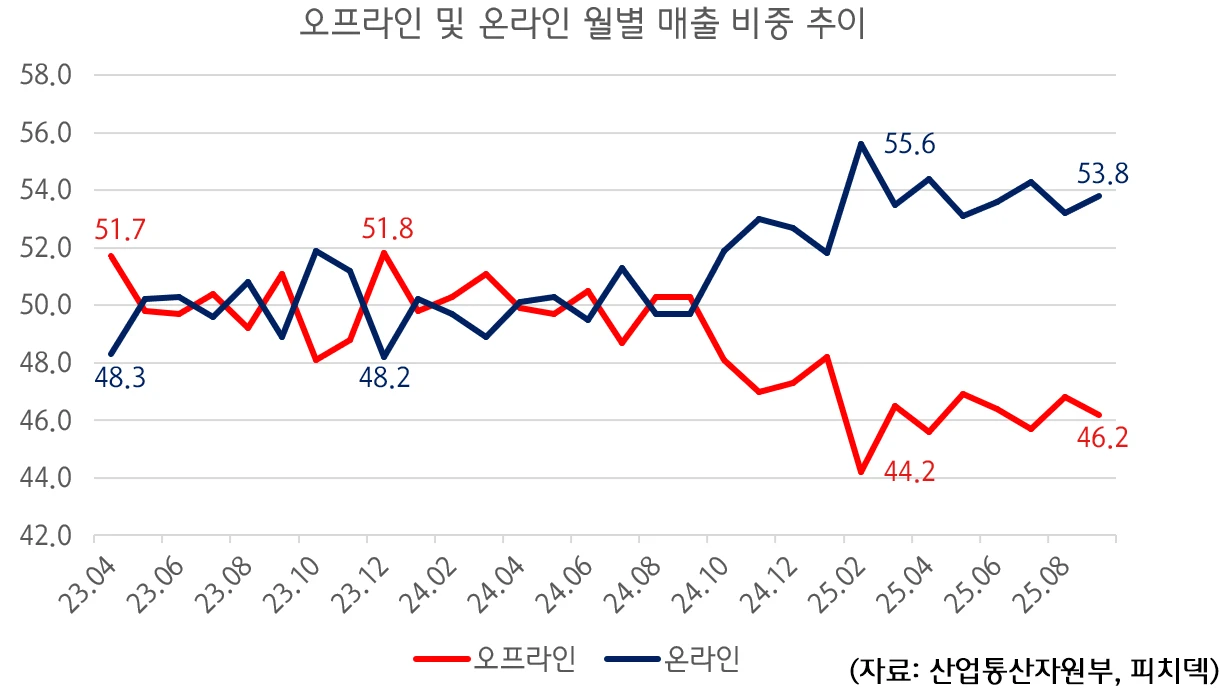
While Online Jumps 15%, Offline Barely Manages 2%
The growth gap between online and offline retail channels has now widened to an irreversible level. According to data from the Ministry of Trade, Industry and Energy, online retail sales surged by 15.0% year-on-year in 2024. In contrast, offline retail grew by merely 2.0%. Considering the inflation rate, offline retail effectively recorded negative growth.
A retail industry expert diagnosed, "Supermarkets are in a 'nutcracker' situation, caught between the proximity of convenience stores and the convenience of online shopping," adding, "Without differentiated customer experiences beyond simple product sales or innovations in delivery services, it is difficult to guarantee their survival."
Company financial data, investment reports, and startup analysis — all in one place
Explore PitchdeckCurated news, every week — straight to your inbox
Every Friday · Unsubscribe anytime