![[Eyewear Industry Analysis ①] "The 4 Major Global Eyewear Production Hubs Are a Thing of the Past"… A Market Encroached by the Dinosaur 'EssilorLuxottica'](https://d1gl51xbrxoj65.cloudfront.net/uploads/2026/01/16/1768524322958-4ham5l.webp)
A World Dominated by the Dinosaur 'EssilorLuxottica' The Korean Eyewear Industry Trapped in the OEM Pitfall
A Complete Defeat in the 'Global Brand War' A Monopoly Following the Merger of France's Essilor and Italy's Luxottica
'Sweeping' Lenses, Frames, and Distribution Networks Zeiss, Hoya, and Others Resist with Technology, While Gucci (Kering) Counters with a 'Declaration of Independence'
The modern eyewear industry goes beyond the simple manufacturing of vision correction tools; it is a 'warzone without gunfire' where massive capital, brands, and cutting-edge optical technologies are concentrated. The Daegu 3rd Industrial Complex, once called one of the 'top four eyewear production hubs in the world' where factories operated around the clock, has long since seen its glory fade. The Korean eyewear industry, which originated with the establishment of Kukje Celluloid (currently Kukje Optical) in 1946, enjoyed its prime in the 1980s, recording the second-highest global market share. Today, however, the Korean eyewear industry has been reduced to a 'sandwich' trapped between China's volume offensive and the brand power of global giant corporations.
The 'Predator of the Eyewear World' EssilorLuxottica: There Is No Competition
The topography of the global eyewear industry was completely overturned in 2018 by a historic 'big deal'. This was the emergence of 'EssilorLuxottica', born from the merger of France's 'Essilor', the world's number one spectacle lens company, and Italy's 'Luxottica', the world's number one eyewear frame company.
They are not merely the market leader. Within the industry, they are called an 'ecosystem destroyer' or a 'perfect predator'. Recording an annual revenue of 26.5 billion euros (approximately 43.5 trillion KRW) as of 2024, this dinosaur corporation has monopolized every value chain in the eyewear industry.
1. The Empire of Brands: Both 'Ray-Ban', synonymous with sunglasses, and 'Oakley', the king of sports goggles, are owned by them. That's not all. Most of the eyeglasses and sunglasses from luxury brands that decorate the first floors of department stores, such as Chanel, Prada, Burberry, Giorgio Armani, and Dolce & Gabbana, are produced in EssilorLuxottica's factories. Consumers think they are choosing from a variety of brands, but the structure is such that the money ultimately flows into one place.
2. Monopoly on Technology: They hold patents for core optical technologies, including 'Varilux', the world's first progressive lens, and 'Transitions', the byword for photochromic lenses. As Luxottica, which makes frames, merged with Essilor, which controls half of the lens market, competitors have found themselves under their influence even during the process of combining frames and lenses.
3. Dominance over Distribution Networks: They directly operate a retail distribution network spanning 150 countries, including 'LensCrafters', the largest optical chain in the US, and 'Sunglass Hut', a world-class sunglasses specialty store. They even own 'EyeMed', one of the top two vision insurance companies in the US, thereby controlling the consumer's entire pathway (Patient Journey) from vision tests to eyewear purchases.
The Survival Story of 'Related Companies' Standing Up to EssilorLuxottica
Even amidst EssilorLuxottica's solo run, there are global companies forging their own paths for survival by putting technical prowess and luxury branding at the forefront.
① 'The Pride of Optics' Zeiss and Hoya: In the lens market, Germany's Carl Zeiss and Japan's Hoya are causing cracks in EssilorLuxottica's monopoly.
Hoya: As the pride of Japanese precision optics, it holds about a 10% share in the global spectacle lens market, maintaining its second-place position. It is targeting the high-end market by integrating its technology from advanced medical devices, such as medical endoscopes, into spectacle lenses.
Zeiss: Germany's Zeiss, famous for its camera lenses, records a market share of about 3%, but its brand loyalty in the premium lens market is overwhelming. It is competing against Essilor's volume offensive with a brand image of 'ultra-precision optics'.
② 'The Counterattack of Fashion' Kering Group: The French luxury group Kering, which owns Gucci, Saint Laurent, and Balenciaga, has broken away from its past practice of granting licenses to Luxottica and others, declaring its 'independence'.
They established their own corporation, 'Kering Eyewear', and began to directly manage planning, design, and distribution. This reflects their determination not to be subordinate to EssilorLuxottica. Currently, Gucci eyewear frames hold a 7% market share, growing to a level that threatens Ray-Ban (4%) as a single fashion brand.
③ 'A League of Their Own' The Four Kings of Contact Lenses: Unlike the eyewear frame market, the contact lens market is an impregnable fortress built by American companies.
Johnson & Johnson: Spearheaded by the 'Acuvue' brand, they account for approximately 40% of the global contact lens market.
They are followed closely by Alcon (Dailies), CooperVision (Biofinity), and Bausch & Lomb, with these four companies forming an oligopoly in the global market. Blocked by their high technological barriers and brand power, Korean companies find it overwhelming to even defend the domestic market.
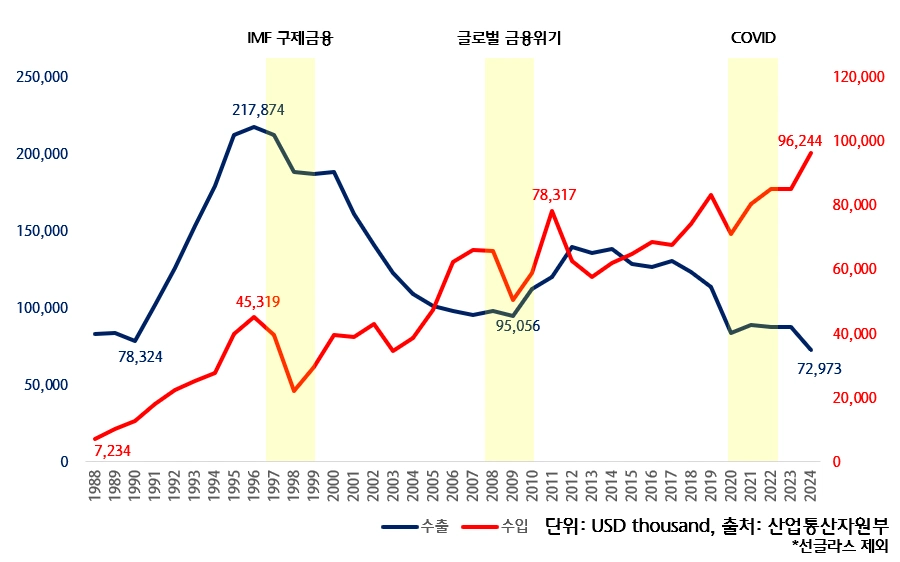
Where Has the Glory of the 'World's 2nd Largest' Korean Eyewear Industry Gone?
While global companies expanded their sizes through brands and technology, the Korean eyewear industry fell into the sweet temptation of 'OEM (Original Equipment Manufacturing)' and walked down the path of decline.
In the 1980s, Daegu, along with Belluno in Italy, Fukui in Japan, and Wenzhou in China, was considered one of the top four eyewear production hubs in the world. It enjoyed its golden age by exceeding 200 million dollars in exports in 1995, but that was exactly where it ended.
Three Decisive Fatal Moves:
① Low-price Offensive from China: In the late 1990s, when China entered the market armed with low labor costs, Korean companies tried to counter with 'price' rather than 'brand', leading to their mutual destruction. China has now become the 'world's factory', responsible for over 70% of global eyewear production.
② The Shackles of Small-scale Business: As the eyewear industry was bound to a category exclusively for small and medium-sized enterprises (SMEs), the influx of large capital was blocked. This led to a lack of R&D investment and an absence of marketing, ultimately failing to give birth to a 'K-brand' that could lead global trends.
③ Missing out on Trends: During the 'horn-rimmed glasses craze' that swept the world in the early 2000s, domestic companies specialized only in manufacturing metal frames were insensitive to market changes. Taking advantage of this gap, low-cost Chinese horn-rimmed glasses encroached even on the Korean market.
Currently, domestic house brands like Gentle Monster are performing well in the global market, capturing a 4% market share in sunglasses and keeping the spark of hope alive, but the fundamental strength of the industry as a whole remains weak.
A 200 Trillion KRW Market, Smart Glasses Are the Variable
The global eyewear market is expected to reach a scale of 172.2 billion dollars (approximately 230 trillion KRW) by 2029, growing at an annual average rate of 2.6% due to an aging population and an increase in the myopic population driven by the widespread use of smartphones.
The battlefield is now shifting to 'smart glasses'. EssilorLuxottica has partnered with Meta (Facebook) to launch 'Ray-Ban Smart Glasses', eyeing even the tech market. Will the Korean eyewear industry remain a simple subcontracting base, or will it leap forward as a high-value-added industry where cutting-edge technology and design converge? The golden time is running out.
Company financial data, investment reports, and startup analysis — all in one place
Explore PitchdeckCurated news, every week — straight to your inbox
Every Friday · Unsubscribe anytime