![[The Era of Bookstore Extinction ②] "Not Books, But Time Was Stolen"… The 3 Major Triggers That Brought the Collapse](https://d1gl51xbrxoj65.cloudfront.net/uploads/2026/01/20/1768870537869-takbk8.webp)
Coupang Logistics Service's sales rapidly grow to 3.8 trillion won
Bookstores reduced to 'showrooms' under the onslaught of 'bullet delivery'
Reading falls to 7th place in Gallup Korea survey, pushed out by hiking, gaming, and YouTube
"No time to read books" From rising rent and labor costs to serial bankruptcies of wholesalers… A 'complex crisis' suffocating from inside and out
In 2004, the second most beloved hobby of South Koreans was 'reading'. However, 20 years later in 2024, reading plummeted to 7th place, pushed out by hiking, gaming, and watching videos. The space left as books departed from people's hands was filled by smartphones, and massive logistics centers took the place of bookstores. The extinction of bookstores is not simply the result of an economic downturn. It is a 'joint work' created by the onslaught of powerful logistics capital, fundamentally altered leisure activities, and an outdated distribution structure. Based on an obtained 'Era of Bookstore Extinction' report and current industry conditions, this paper provides an in-depth analysis of the three major triggers that collapsed the bookstore ecosystem.
Trigger 1. A 'Tilted Playing Field'… The onslaught of logistics dinosaur Cou, books became 'daily necessities'
The most massive and direct cause of the bookstore crisis is the market structure reorganized around online platforms and the logistics revolution. According to data obtained by this paper, Coupang Logistics Service, established in 2018, experienced explosive growth in a short period and recorded sales of 3.8349 trillion won as of 2023. This figure far exceeds traditional logistics powerhouses Lotte Global Logistics (3.2609 trillion won) and Hanjin (2.4374 trillion won). The emergence of this 'dinosaur', which is fiercely chasing CJ Logistics, completely changed the grammar of book distribution.
Coupang, YES24, and Aladin, among others, built 'dawn delivery' and 'same-day delivery' systems that go beyond 'order today, arrive tomorrow', based on their immense capital power. Now, for consumers, books are no longer cultural products to go and pick out at a bookstore, but have been incorporated into the realm of 'daily necessities' delivered to their doorsteps with a single click, just like diapers or bottled water.
Faced with this logistics innovation, offline bookstores have been reduced to 'showrooms' for checking the lowest online prices or briefly skimming physical books. In particular, the downfall of the large bookstore Bandi & Luni's (Seoul Moongo) has significant implications. Despite having its own online mall, losing the golden time for online transition proved fatal as it fell behind e-commerce platforms like Coupang in free delivery offensives, cutthroat point accumulation competition, and the overwhelming war of delivery speed. The values of 'discovery' and 'experience', which were the essence of bookstores, were powerless in the face of the massive wave of 'convenience'.
Trigger 2. Vanished Readers… "The competitor is not the bookstore next door, but Netflix"
A more fundamental problem is the disappearance of demand. What is more terrifying than "not buying books" is "not reading books." The competitor of bookstores is no longer other nearby bookstores, but digital platforms such as Netflix, YouTube, and webtoons that monopolize modern people's time.
Gallup Korea's hobby survey results starkly show this change in social trends. Reading, which was the second most enjoyed hobby by South Koreans in 2004, was pushed down to 6th place in 2014, and dropped all the way to 7th in the 2019 and 2024 surveys. Gaming took 1st place in 2024, while exercise, hiking, and watching videos swept the top ranks.
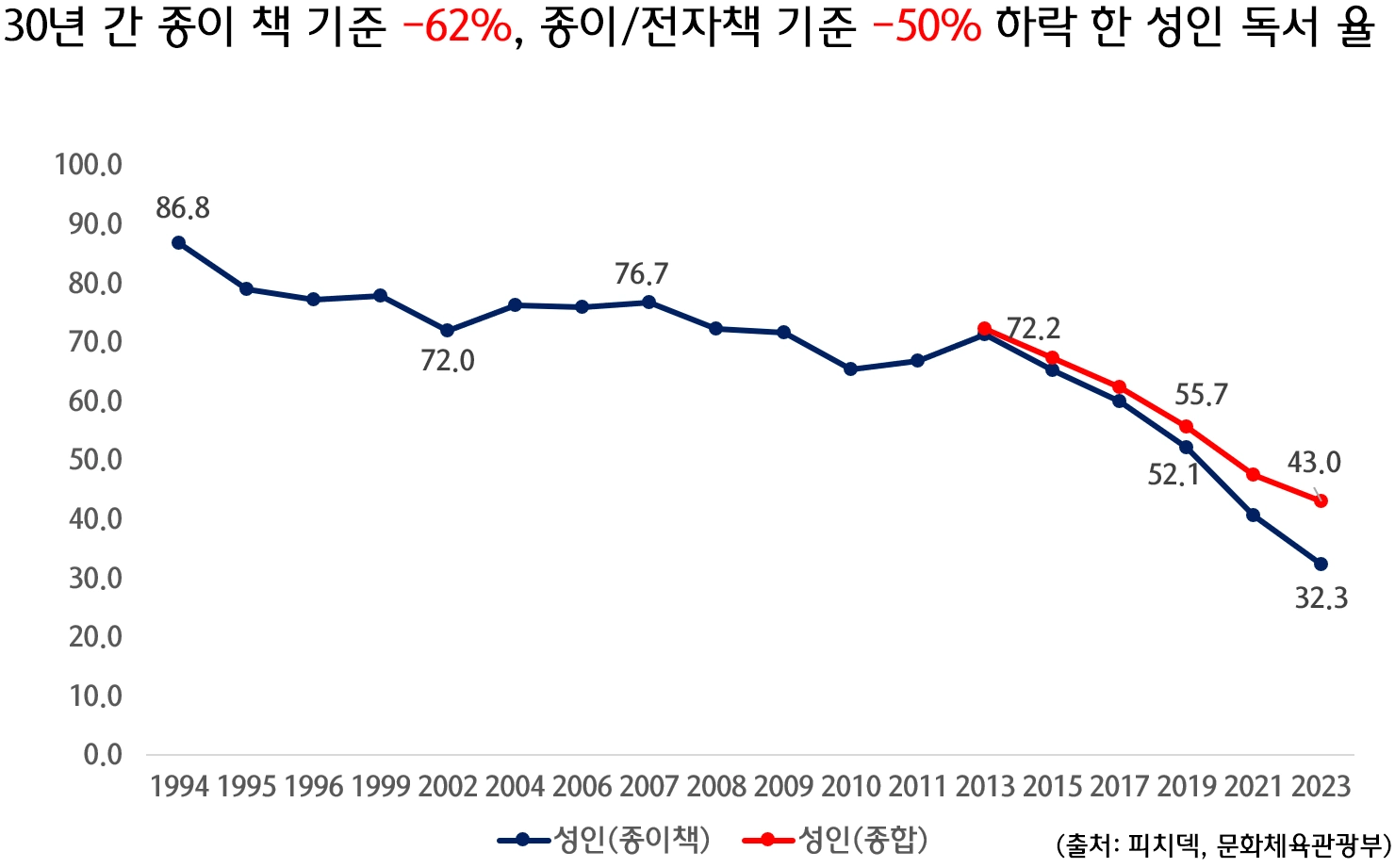
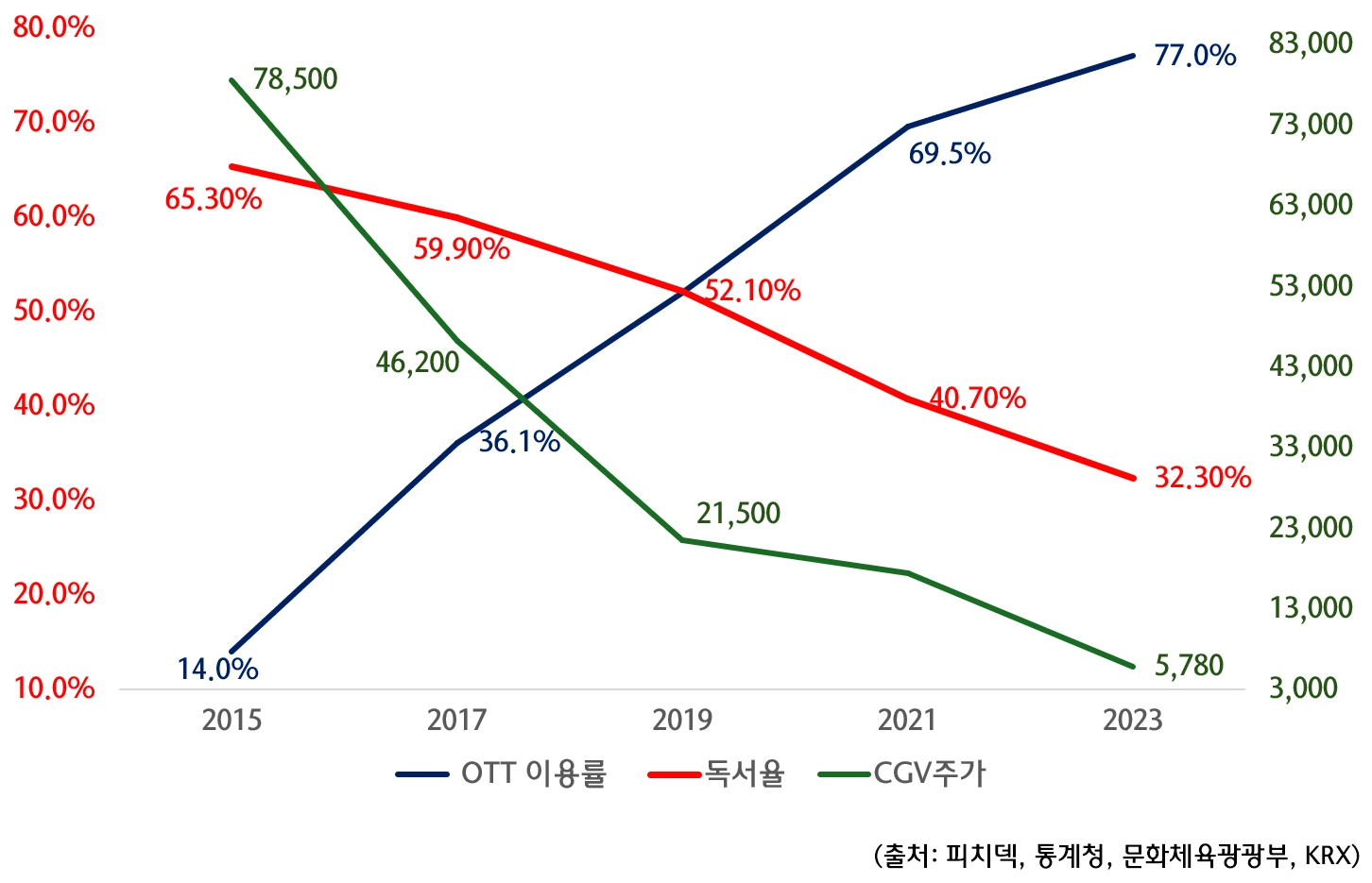
As 'Snack Culture', which provides visual stimulation and instant dopamine, dominated leisure time, reading—which requires long breaths and active thinking—was pushed to the back burner. According to the Korean Publishers Association's '2024 Publication Market Statistics', the comprehensive annual reading rate for adults in 2023 was only 48.5%. In an era where more than half of the population does not read a single book in a year, the market pie itself has shrunk.
Furthermore, the mass exodus of consumers, who felt the price burden after the implementation of the fixed book price system, to secondary markets like Aladin used bookstores also acted as a detrimental factor to the new book-centered bookstore ecosystem. An environment where one can buy "used books like new" at half price might be a blessing for consumers, but it has incited a 'self-destructive' competition that worsens the profitability of general bookstores and publishers who must adhere to fixed prices.
Trigger 3. A Broken Middle Link, Soaring Costs… Structural Collapse
The 'suffocating' phenomenon—where sales plummet while costs soar—has also driven bookstores to the edge of a cliff. Both local and large bookstores are unable to withstand the burden of rising rent and labor costs caused by minimum wage increases. The main reason why 'Gwangjang Books', a landmark in Chuncheon, and 'Bulgwang Bookstore', a long-standing fixture in Eunpyeong-gu, Seoul, disappeared into history was ultimately accumulated deficits and unbearable fixed cost burdens.
What is most serious is the internal collapse of the distribution ecosystem. The serial bankruptcy of wholesalers, the 'middle link' connecting publishers and bookstores, has suffocated the bookstore industry. Following the bankruptcy of the industry's 2nd largest player, Songin Seojeok, in 2021, the bankruptcy of Book Plus in March 2025, and the bankruptcy of Book Plus's major client Books Libro in September were predicted disasters.
Behind their bankruptcies lies the practice of 'promissory note payments' that had been rampant in the industry for decades. The method where bookstores receive books on credit and pay the sales proceeds months later with promissory notes was a lubricant that provided liquidity when the market was growing, but became a ticking time bomb causing serial bankruptcies during downturns. As cash stopped flowing due to declining sales at offline bookstores, wholesalers fell first, and a 'domino collapse' where the damages were passed entirely onto small publishers and remaining bookstores became a reality.
A Global Trend… US Bookstore Sales 'Halved' Compared to Their Prime
This phenomenon is not just a problem in South Korea. According to the obtained data, the US offline bookstore market is also showing a steep decline. According to US Census Bureau data, US bookstore sales peaked at approximately $17 billion in 2007, continuously declined, and plummeted to the $6.5 billion level in 2020. Although there was a slight rebound after the pandemic, as of 2024, it still fails to reach half the level of its prime. It is an indicator showing that offline bookstores are becoming an 'endangered species' worldwide.
The crisis of bookstores is a difficult challenge in which economic efficiency (online/logistics), lifestyle changes (digital content), and an outdated industrial structure (promissory notes/high costs) are intricately intertwined. Before the overwhelming efficiency of logistics capital, cultural spaces have lost their standing, and beneath the light of smartphones, paper books are being forgotten.
Company financial data, investment reports, and startup analysis — all in one place
Explore PitchdeckCurated news, every week — straight to your inbox
Every Friday · Unsubscribe anytime