![[Feature] 10-Year History of Unmanned Stores in Korea ②: Eating Ramen and Playing Tennis... The Evolution of Unmanned Stores Selling 'Tastes'](https://d1gl51xbrxoj65.cloudfront.net/uploads/2026/01/22/1769057106461-1nmb4c.webp)
Amazon Goes Large-Scale, Don Quijote Goes Ultra-Compact
The Global Survival Strategy is 'Hybrid' (2023-Present)
The era of 'quantitative expansion', where an unmanned cafe opened next to an unmanned ice cream shop, and an unmanned laundromat next to that, has passed. Following the endemic in 2023, unmanned stores no longer remain simply 'stores without people'. They are evolving into 'spaces of experience' where customers can solely enjoy their own tastes without feeling conscious of resident employees. While Part 1 covered the history and growth of unmanned stores, Part 2 explores future survival strategies through the 'diversification of industries' and 'sophistication' that began in 2023, as well as the latest unmanned strategies of global retail giants like Amazon and Don Quijote.
[Evolutionary Period: 2023-Present] "They Have Everything"... Into a Space of Taste and Experience
Since 2023, the keywords penetrating the unmanned startup market have been 'diversification' and 'specialization'. While the first generation primarily focused on simple retail businesses that borrowed the convenience store model, the domain is now infinitely expanding into service and experiential spaces. 'Unmanned' is no longer a term referring to a specific industry, but has established itself as the basic operating model for all offline businesses.
The most noticeable change is in 'experiential food and beverage (F&B)' stores. The 'Ramen Library', which brought instant ramen cookers—once exclusive to Hangang Park—into the heart of the city, has become a must-visit destination for teenagers and foreign tourists. This is not simply a place to purchase ramen. The act of selecting a preferred ramen from dozens of varieties, cooking it oneself, and taking proof photos has in itself become a form of 'entertainment content'.
Stores squarely targeting 'niche tastes' are also increasing. Prime examples include 'unmanned adult product stores' and 'vintage clothing shops', which capitalize on the fact that unmanned stores are actually preferred for items where an employee's gaze might feel burdensome. Consumers report high satisfaction as they can enjoy shopping free from the eyes of others. Additionally, 'unmanned pet shops', where pet food and snacks can be purchased 24/7, have established themselves as essential daily facilities in the era of 15 million pet owners. The 'claw machine arcades' of the past have made a spectacular comeback as '2nd-generation gacha shops (merchandise shops)' offering high-quality character goods like Sanrio and Chiikawa, opening the wallets of 'Kidults' with purchasing power.
The shift towards unmanned operations has also accelerated in the sports sector, where resident staff were once considered essential. In 'unmanned tennis courts' and 'unmanned table tennis venues', which surged between 2023 and 2024, machines distribute balls and count scores much like screen golf. This is the result of precisely tapping into the desires of modern individuals who want to enjoy sports alone without needing a partner. Furthermore, the void left by vanishing stationery stores in front of schools and copy shops in university districts is being replaced by 'unmanned stationery stores' and 'print cafes', which are even fulfilling infrastructure functions for local communities.
Global Trend ①: Amazon's Reflection "Small Unmanned Stores Failed... Large-Scale Hybrids are the Answer"
While Korea focuses on content diversification, 'economies of scale' and 'hybrid' formats have emerged as key topics in the United States, an advanced retail market. The world's largest e-commerce company, Amazon, recently made significant revisions to its offline strategy. It abandoned its long-cultivated small unmanned store strategy and pivoted toward overwhelmingly large-scale stores.
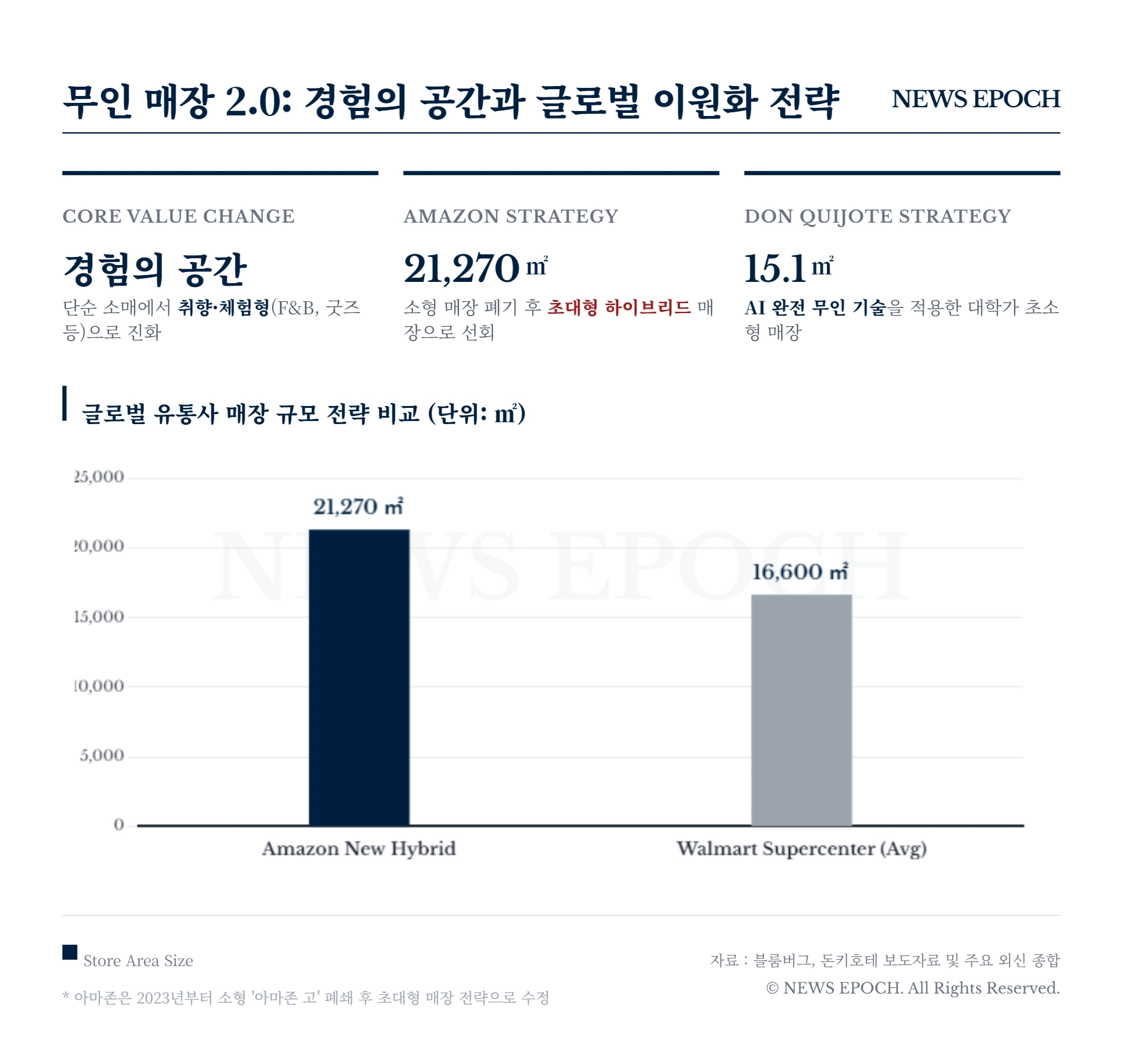
According to major foreign media outlets such as Bloomberg, Amazon has massively closed down its technology-flaunting small unmanned convenience stores, 'Amazon Go' and '4-Star', since 2023. Instead, the company decided to build a massive standalone store measuring 21,270 square meters (approx. 6,400 pyeong) in Orland Park, Illinois, USA. This scale far exceeds the average area of competitor Walmart's Supercenters (approx. 16,600 square meters).
The reason for Amazon's failure was clear. Rather than the novel technology of having no checkout counters (Just Walk Out), what consumers truly wanted was the essence of retail: a 'diverse product assortment' and 'low prices'. Consequently, Amazon adopted a 'hybrid hub' strategy, combining the display of tens of thousands of products, including fresh food and clothing, in the front of the new store, with an automated fulfillment center that instantly processes online orders in the back. The company redirected its unmanned technology away from customer touchpoints and focused it on logistics efficiency instead.
Global Trend ②: Don Quijote's Innovation "AI Ultra-Compact Stores Penetrating University Districts"
In contrast, Japan's large general merchandise store 'Don Quijote' has made a bold move with the exact opposite approach: 'ultra-compact technology stores'. Don Quijote announced that it will open its first unmanned store, 'Campus Donki', measuring 15.1 square meters (approx. 4.5 pyeong), inside the Neyagawa Campus of Osaka Electro-Communication University on July 1.
The core of this store lies in rigorous 'efficiency' and 'security'. Instead of open access, it introduced a system that requires customers to scan a QR code from the LINE mini app to enter, fundamentally preventing any concerns about theft. Inside the store, AI cameras and weight sensors on each shelf are installed to automatically recognize the items a customer picks up and process the payment. It is a 'fully unmanned' system that eliminates even the barcode scanning process, tailored for university students who find self-checkout counters at convenience stores cumbersome. Through this, Don Quijote plans to resolve its severe labor shortage and dominate niche markets such as university districts and office buildings, where large-scale stores cannot be established.
Over the past 10 years, unmanned stores have rapidly evolved from 'a means to save labor costs' into 'spaces that create a new consumption culture'. The current trend in the domestic market shows that while 'Unmanned' has established itself as a fixed operational method, the industries and content filling these spaces continue to change.
Experts advise, "The success of future unmanned business startups will depend on what differentiated experiences they can offer to customers while increasing operational efficiency through technology, as seen in the cases of Amazon and Don Quijote." The era of opening a store relying solely on a single CCTV camera is over. Now, the era of 'Smart Unmanned 2.0', where content and technology are intricately combined, is unfolding.
Company financial data, investment reports, and startup analysis — all in one place
Explore PitchdeckCurated news, every week — straight to your inbox
Every Friday · Unsubscribe anytime