![[Burger Industry Check-up ①] 4 Trillion Won 'Burger Economy', Beyond the Warring States Period to an 'M&A Battleground'](https://d1gl51xbrxoj65.cloudfront.net/uploads/2026/01/27/1769482184100-55e9e9.webp)
'Lone Growth' in the Food Service Industry Driven by the Surge in Single-person Households and Delivery… The Food Service Industry is Now an M&A Battlefield
The topography of the South Korean food service market is changing. While the total food service industry has exceeded 191 trillion won, the hamburger market has entered the 'major leagues' by forming a market size of approximately 4 trillion won (industry estimate) as a single item. Hamburgers, once dismissed as 'fast food', have now evolved beyond a 'simple meal' into a massive 4 trillion won market where 'gourmet' and 'cost-effectiveness' coexist.
Opening of the 4 Trillion Won Era for the Hamburger Market
According to data from the Korea Agro-Fisheries & Food Trade Corporation and related industries, the size of the domestic food service industry (restaurants and drinking places) market in 2023 was tallied at approximately 191.7413 trillion won. Among this, the restaurant sector accounts for about 159 trillion won, and the drinking and beverage places sector accounts for about 32.7 trillion won.
Within this enormous market, the advancement of the hamburger market is unrivaled. The domestic hamburger market size estimated by the industry is around 4 trillion won, which corresponds to about 2% of the total food service market and about 2.5% within the restaurant sector. While the proportion may seem small in terms of figures, the fact that it has formed a 4 trillion won market as a single menu category suggests that the status of hamburgers within the food service industry has been elevated to the mainstream.
From 'Matdona' to 'Five Guys'… The Warring States Period of Burgers
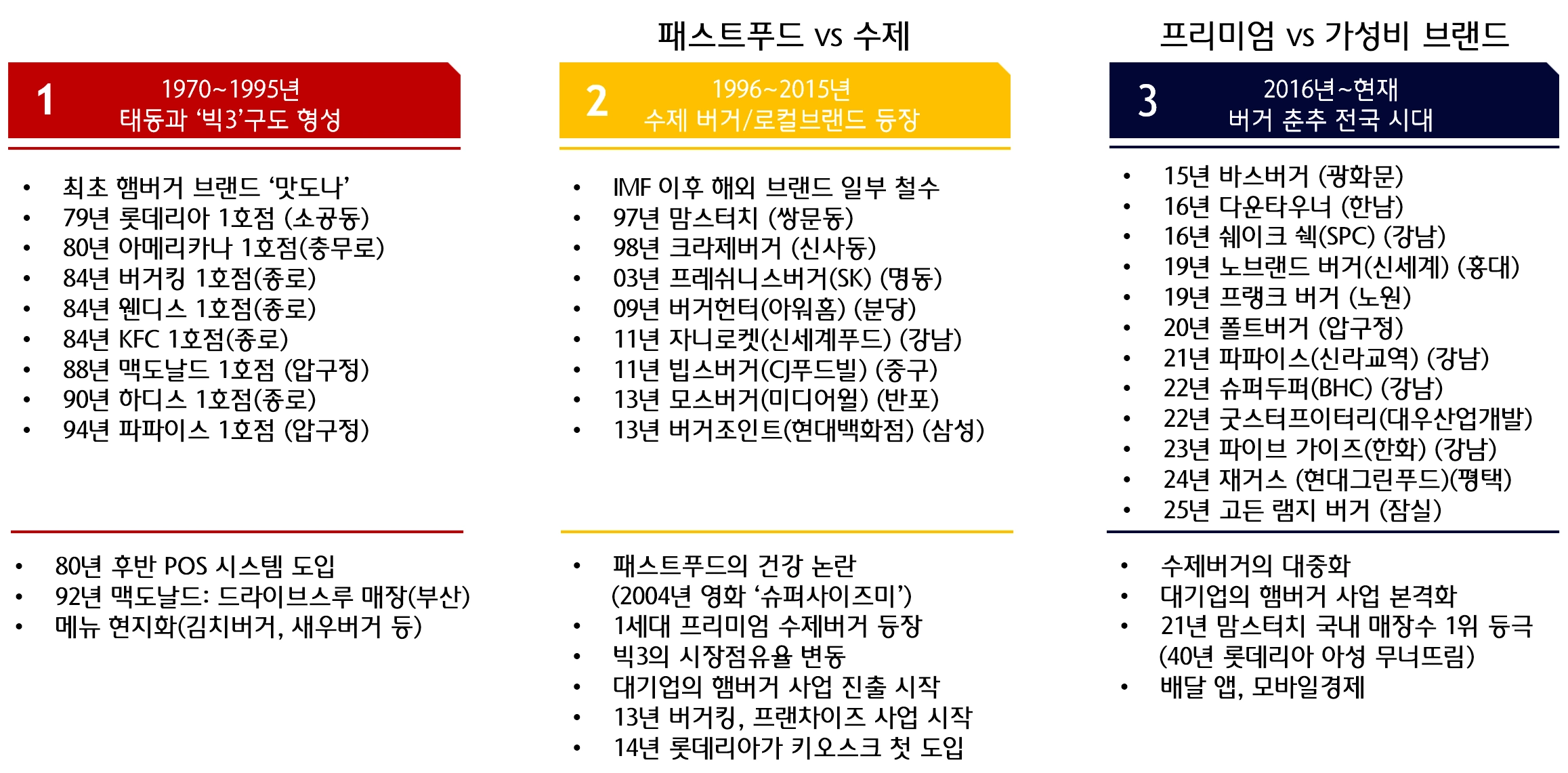
The domestic hamburger market has evolved in three stages along with the flow of the times.
① Birth and Formation of the 'Big 3' Structure (1970~1995): Starting with the first Lotteria branch (Sogong-dong) in 1979, Burger King and KFC landed in 1984, followed by McDonald's in 1988, opening the golden age of fast food. During this period, the 'Big 3 (Lotteria, McDonald's, Burger King)' led the market.
② Emergence of Handmade Burgers and Local Brands (1996~2015): Native brands such as Mom's Touch in 1997 and Kraze Burger in 1998 appeared, and the handmade burger market sprouted alongside the well-being trend. Entering the 2010s, large conglomerates expanded the market by venturing into the hamburger business.
③ The Warring States Period of Burgers (2016~Present): The introduction of 'Shake Shack' by SPC Group in 2016 served as a signal flare for the premium burger war. Subsequently, with the successive emergence of 'No Brand Burger (cost-effectiveness)', 'Five Guys (ultra-high price)', and 'Gordon Ramsay Burger', the market became polarized into 'premium' and 'cost-effective' while simultaneously entering a 'Warring States Period' of infinite competition.
Analysis of the Report Cards of the 4 Major 'Burger Dinosaurs'
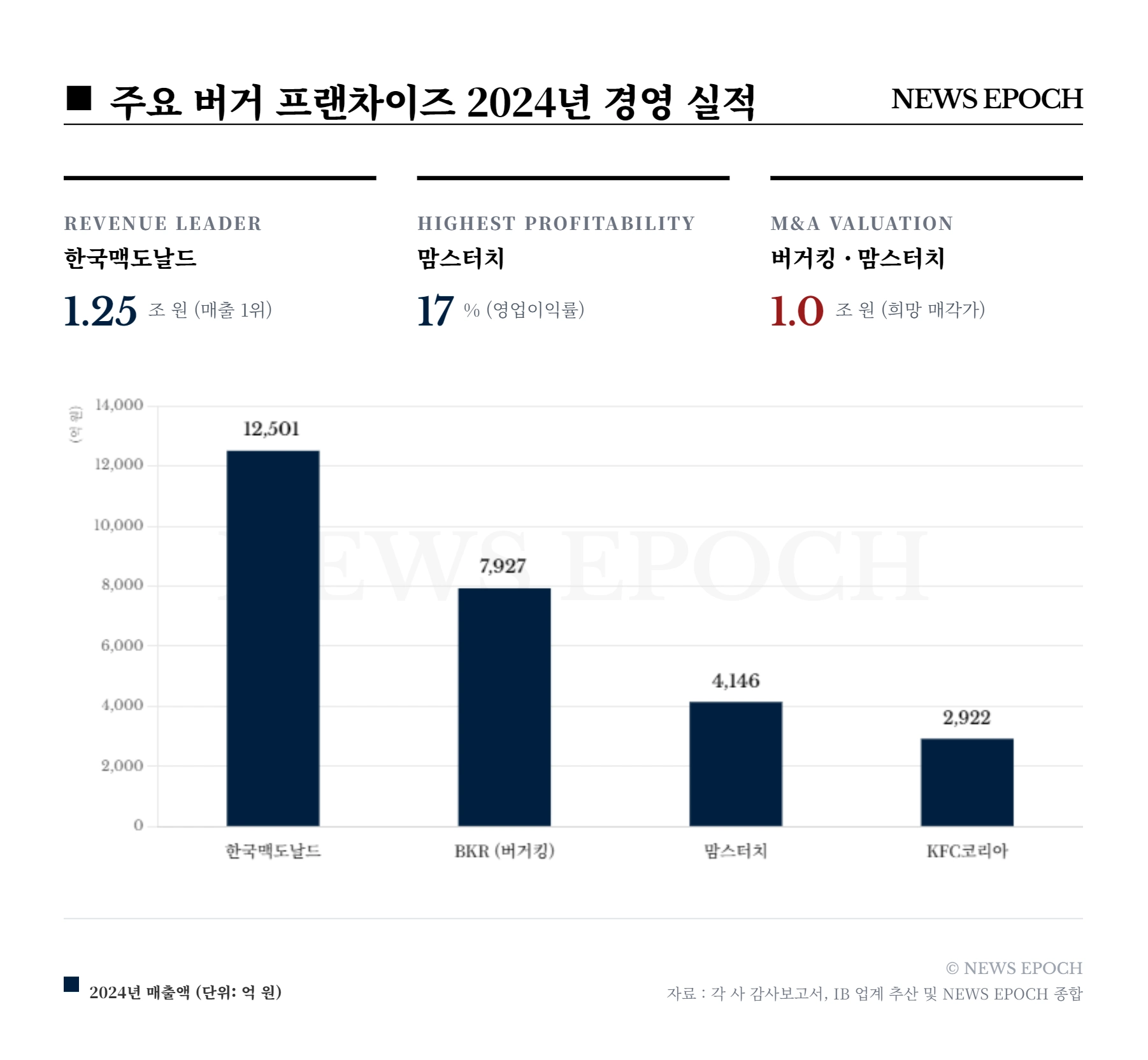
Amid fierce competition, the report cards of major hamburger brands are showing mixed results. Synthesizing data from Pitch Deck and others, the recent financial flows and issues of the four major companies are as follows.
BKR (Burger King): Burger King, whose major shareholder is the private equity fund Affinity Equity Partners (AE), achieved external growth from about 678.4 billion won in sales in 2021 to the level of about 792.7 billion won in 2024. However, its operating profit margin has repeatedly fluctuated since recording in the 10% range in 2022. It is currently pursuing a sale with a valuation of around 1 trillion won, but is experiencing difficulties due to the aftermath of high interest rates.
Mom's Touch: The protagonist of the 'Thigh Burger' myth, Mom's Touch boasts overwhelming profitability. Sales surged from 301.1 billion won in 2021 to 414.6 billion won in 2024, and its operating profit margin reaches the 17% range. After its acquisition by KL& Partners, it executed a voluntary delisting and is currently in the process of resale with a target asking price of 1 trillion won.
McDonald's Korea: It ranks at the very top of the industry in terms of sales volume. Sales jumped from 867.8 billion won in 2021 to 1.2501 trillion won in 2024. Its operating profit margin had recorded negative figures (-1.8%~-3.2%) for several years before turning to a surplus based on operating profit at 0.9% in 2024, but improving profitability remains a task. It recently faced a new phase as the Qatari enterprise 'Kamal Al Mana' was selected as a strategic partner (acquiring operational rights).
KFC Korea: Profitability has been unstable amid frequent changes in ownership (Doosan→CVC→KG→Orchestra PE→Carlyle). It is improving in both sales and profit margin, going from 209.9 billion won in sales in 2021 to 292.2 billion won in sales and a 5.6% operating profit margin in 2024. Currently, the Carlyle Group is proceeding with final approval procedures to acquire it for approximately 200 billion won.
The 'M&A Frenzy' Sweeping the Food Service Industry
Since the COVID-19 pandemic (2020), the food service industry has become a battleground for M&As (Mergers and Acquisitions). Private equity funds (PEFs) have actively purchased franchises with strong cash-generating capabilities. Major examples include ▲ A Twosome Place (Carlyle Group) in 2021 ▲ Outback Steakhouse (BHC Group) in 2021 ▲ KFC Korea (Orchestra PE) in 2023 ▲ Mega Coffee (Premier-Bora TR) in 2024 ▲ Compose Coffee (Jollibee Foods) in 2024. Notably, in 2024, the M&A market heated up with the conclusion of deals such as the sale of McDonald's Korea operational rights, Mad for Garlic (Immanuel Corporation), and Downtowner (Salady, Highland Equity Partners).
The food service categories targeted for M&A are also diversifying rather than concentrating on a specific category, including coffee (Hollys, Terarosa, etc.), pizza (Mr. Pizza, Banolim Pizza, 59 Rice Pizza, etc.), and dining (Outback Steakhouse, Mad for Garlic, etc.). However, it is noteworthy that most of the acquirers are private equity funds rather than food service companies.
The Era of 7.8 Million Single-Person Households… The Twin-Engine Growth of 'Delivery' and 'Dining Out'
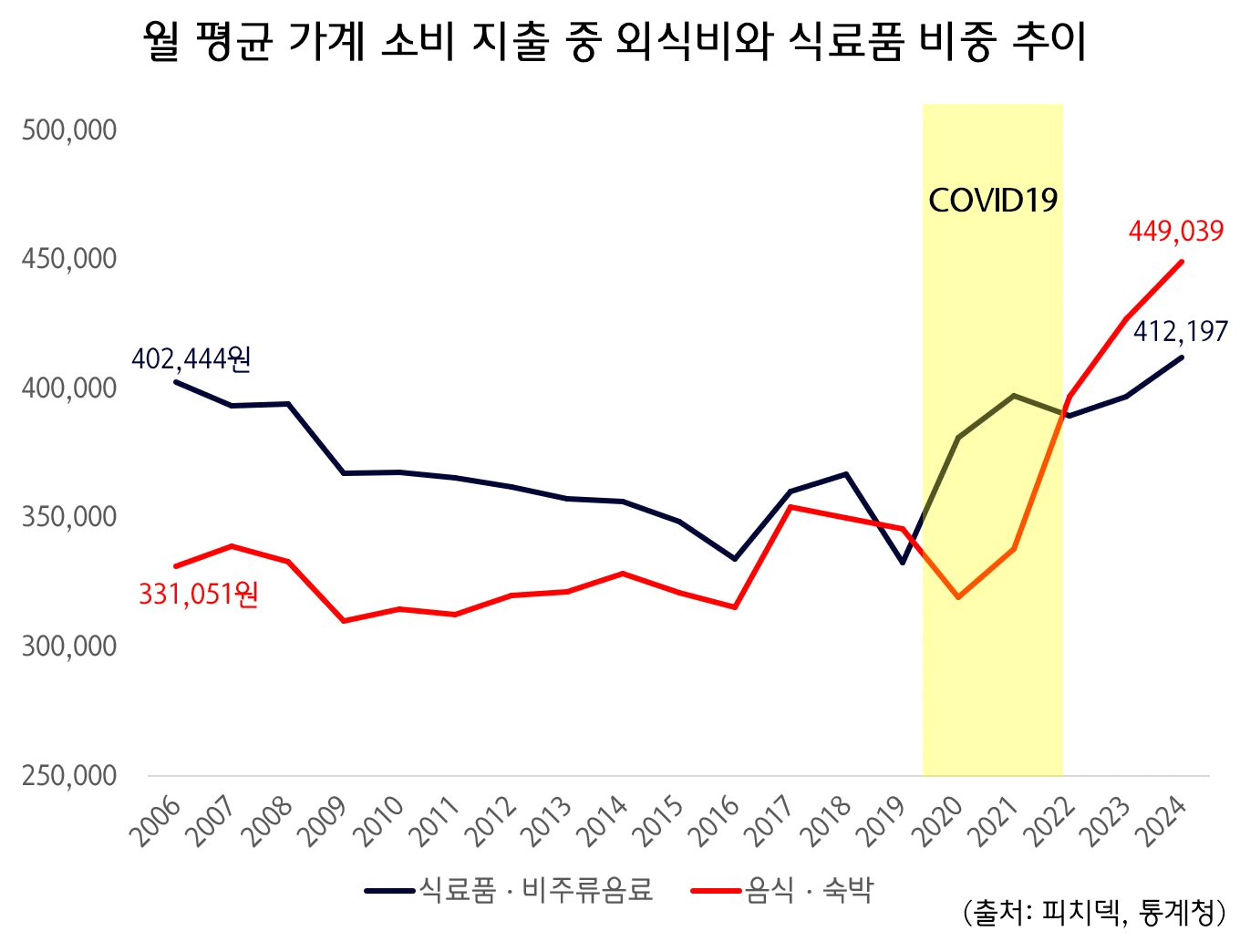
The structural background for the growth of the hamburger market lies in the 'explosive increase in single-person households'. According to Statistics Korea, single-person households surged by 50% from 5.2 million households in 2015 to approximately 7.82 million households in 2023. In contrast, households of four or more people decreased by 23%. The increase in single-person households looking to easily resolve meals on their own is serving as a strong support base for hamburger demand. Added to this, the proportion of dining out expenses and groceries within average monthly household consumption expenditures was reversed during the COVID period.
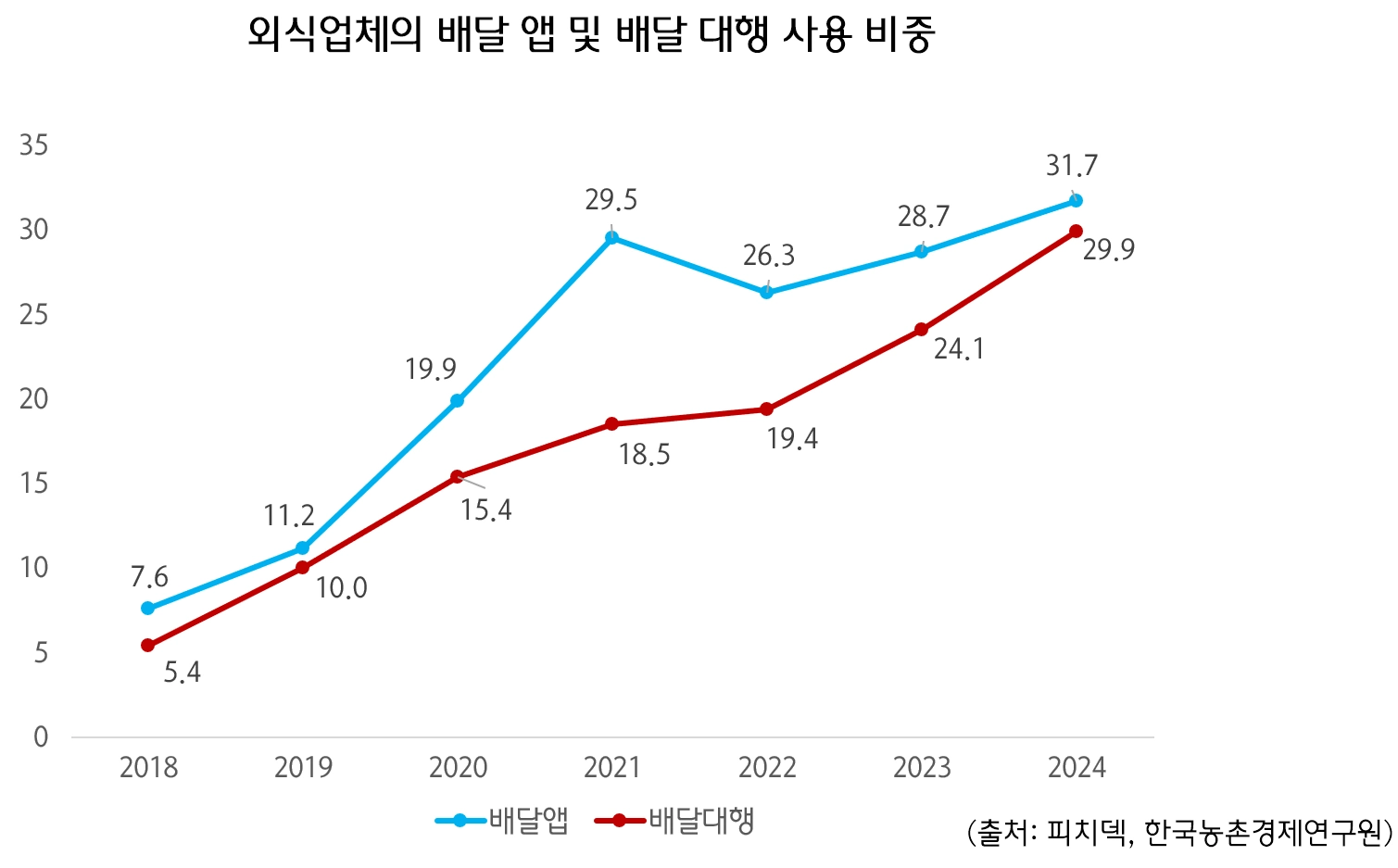
The growth of the delivery market has expanded the territory of the hamburger industry. The proportion of food service businesses using delivery apps surged more than fourfold from 7.6% in 2018 to 31.7% in 2024. The utilization rate of delivery agency services also increased from 5.4% to 29.3% over the same period. In particular, hamburgers are considered a delivery-friendly menu item along with chicken and pizza. According to a survey by the Korea Rural Economic Institute, among delivery app users, the delivery app utilization proportion for the hamburger/pizza/sandwich sector stands at 85.1%, overwhelmingly surpassing other sectors. The trend of consumers reducing home-cooked meal consumption and increasing dining out (an increase in average monthly dining out expenditures) is also a positive sign.
'Who' Eats Them and 'Where'… People in Their 20s and 30s · Income Group of 2-4 Million Won per Month
As a result of data analysis, the core consumer base of the hamburger market is clear. Households of those 'in their 30s or younger', 'college graduates or higher', and with an 'average monthly income in the 2-4 million won range' are the main force of hamburger dining out. They are characterized by being sensitive to cost-effectiveness and trends, and being proficient in using delivery apps. Conversely, preference appears relatively low among the high-income bracket (6 million won or more) or the elderly population, suggesting the importance of targeted marketing.
The online food service market grew from a scale of 183.3 billion won in January 2017 to approximately 3.4228 trillion won (forecast) as of June 2025, growing a whopping 18 times in just 8 years. The compound annual growth rate (CAGR) reaches 41.6%. However, since the transition to Living with COVID-19, the growth trend has been slowing down. The explosive growth rate that initially reached 75% has recently stabilized in the 5% range. This means that the market has entered a mature phase, foretelling that brand differentiation and profitability management, rather than simple 'quantitative expansion', will now become the keys to survival.
Company financial data, investment reports, and startup analysis — all in one place
Explore PitchdeckCurated news, every week — straight to your inbox
Every Friday · Unsubscribe anytime