![[K-Beauty Matrix] While 4,500 Amorepacific Employees Earned 120 Billion Won, 130 Goodai Global Employees Earned 140 Billion Won](https://d1gl51xbrxoj65.cloudfront.net/uploads/2026/01/28/1769577584151-obd3q.webp)
Amorepacific & LG Household & Health Care, factory operation rate at 19%, cosmetics turn to deficit... The counterattack of 'heavy assets'
Goodai Global achieves an operating profit margin of 43.4%... Paradigm shift from 'manufacturing' to 'planning'
Restructuring of traditional companies and high efficiency of emerging companies... Victory and defeat decided by capital efficiency
"120 billion won made by 4,560 employees and 140 billion won made by 63 employees." The gap in productivity revealed in the 2024 settlement data forced a highly intensive structural improvement across the entire industry. Change was not an option but a necessity. In the second half of last year, while traditional powerhouses such as Amorepacific and LG Household & Health Care initiated large-scale restructuring, unable to bear the 'weight' of bloated organizations and manufacturing facilities, emerging companies like Goodai Global rewrote record-breaking performances with light organizations and data-driven planning capabilities. This is not a simple change in rankings, but a decisive flare signaling that the source of value creation in the industry has shifted from 'manufacturing' to 'data'.
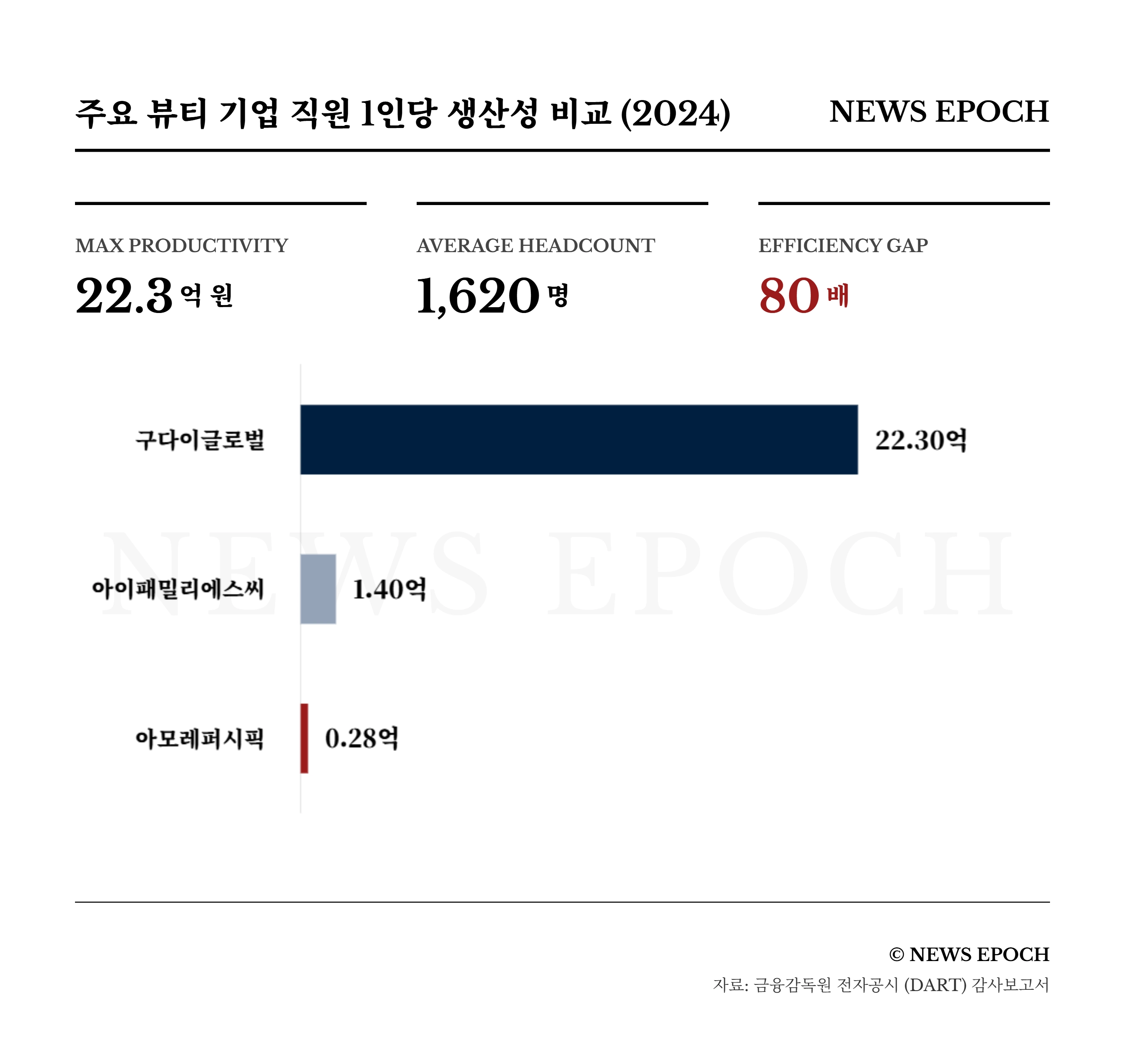
Per capita operating profit of 28 million vs. 2.23 billion... The reality of the 80-fold productivity gap
Domestic No. 1 Amorepacific's non-consolidated operating profit in 2024 was 127.9 billion won, and the number of employees at the time (December) was 4,560. The productivity per employee is only about 28 million won. This is because the vast workforce and organization built during the high-growth period in the past acted as a fixed cost burden in the low-growth phase. Thousands of employees are deployed in management and sales, but efficiency has dropped, and ultimately, the large-scale voluntary retirement carried out at the end of last year was an inevitable choice to improve this low-efficiency structure.
On the other hand, Goodai Global, the creator of 'Beauty of Joseon', generated an operating profit of 140.6 billion won with only 63 employees as of December 2024. The per capita productivity reaches a staggering 2.23 billion won. This essentially means that one Goodai Global employee has done the work of 80 Amorepacific employees. This overwhelming difference in efficiency originated from the 'presence or absence of a factory'. Goodai Global transformed its manufacturing costs into a variable cost structure by outsourcing all production (ODM) without building a factory. Instead, by concentrating its core competencies on product planning and data analysis, it created enormous added value even with a small number of elite personnel.
Operation rate drops to 19.1%... Profitability damaged by fixed cost burden
For traditional companies, factories are no longer 'assets' but 'liabilities'. The operation rate of Amorepacific's Shanghai factory in China in the third quarter of 2025 was only 19.1%. This means that 8 out of 10 lines have come to a halt. The factory has stopped, but depreciation and maintenance costs are causing daily cash outflows. This leads to an increase in the cost of sales ratio, becoming the main culprit eroding profitability. As the demand for low-to-mid-priced brands in the Chinese market plummeted, the local production base lost its utility value, and the cost of maintaining it continues to be incurred.
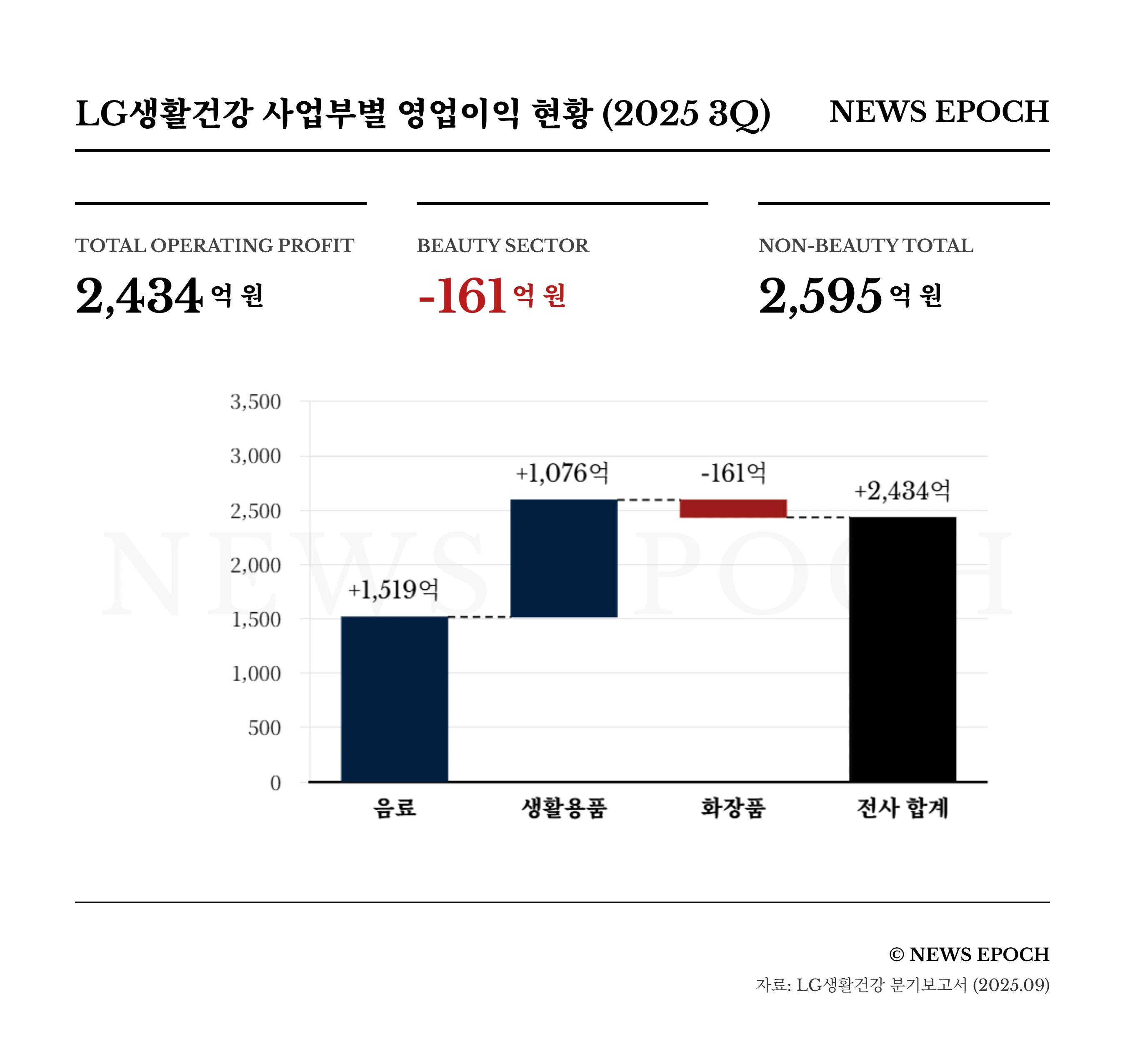
LG Household & Health Care also recorded an operating loss of 16.1 billion won in its beauty business division on a cumulative basis in the third quarter of 2025. This was due to the sluggish Chinese sales of the 'Whoo' brand combined with the financial difficulties of 'The Avon Company', which was acquired to expand into the North American market. As the cosmetics business turned to a deficit, it was none other than the beverage division that defended the company-wide performance. Without the 151.9 billion won surplus earned from Coca-Cola and others, LG Household & Health Care would have faced a company-wide deficit crisis. A profit structure in which a cosmetics company maintains its business with profits from the beverage sector is continuing.
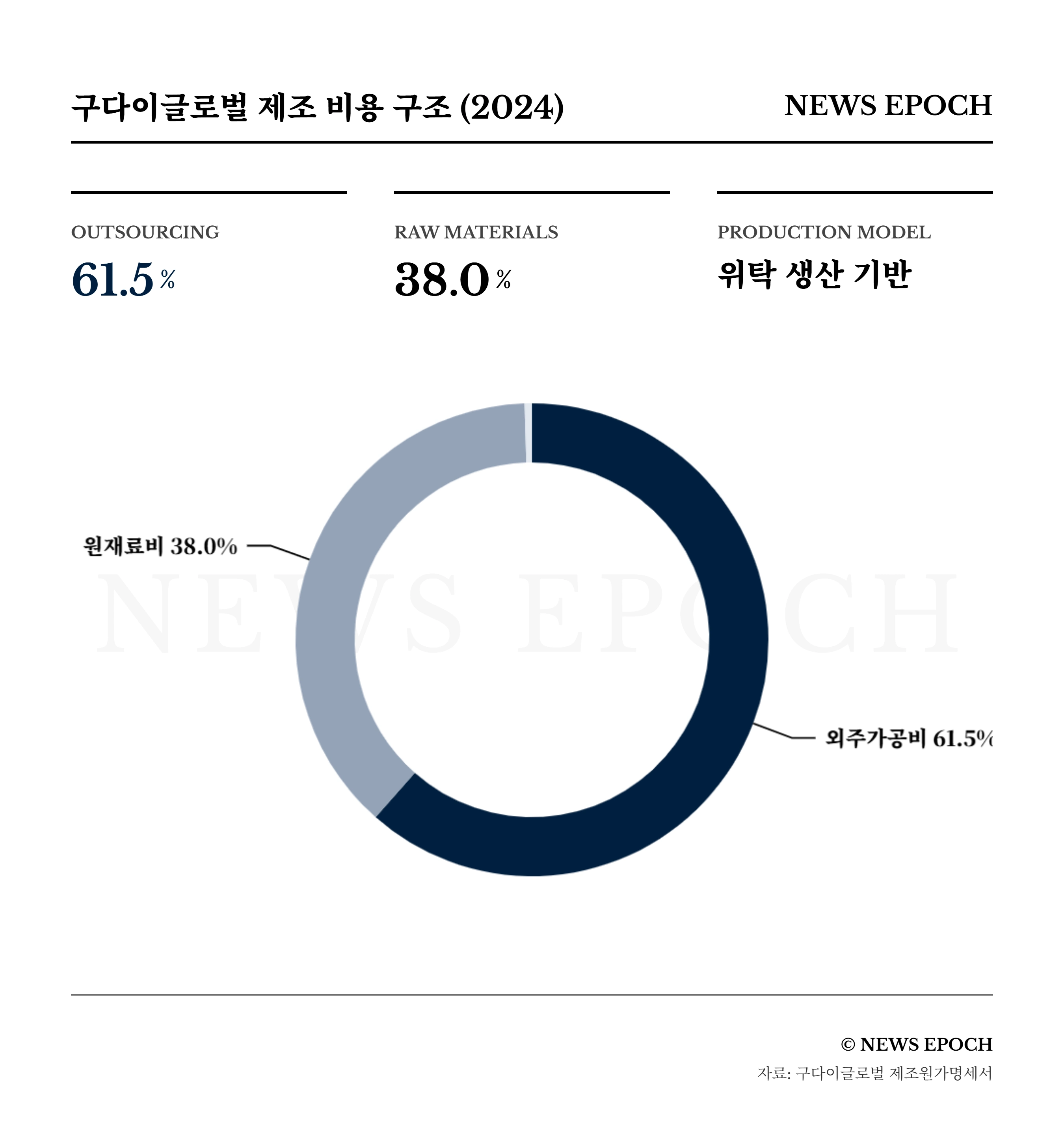
61.5% allocated to outsourcing costs... Achieving 43.4% profit margin centered on variable costs
In contrast, Goodai Global recorded sales of 323.7 billion won and an operating profit of 140.6 billion won in 2024, achieving an operating profit margin of 43.4%. It broke through the 'magic 40%' barrier, which is considered nearly impossible in the manufacturing industry. The secret is thorough 'outsourcing'. According to the statement of cost of goods manufactured, the company spent 75.9 billion won, or 61.5% of total manufacturing costs, on outsourced processing costs, perfectly controlling fixed costs. Thanks to the '0 won' investment in factory equipment, the cash earned could be accumulated entirely as profit or reinvested in acquiring promising companies like TIRTIR and Craver.
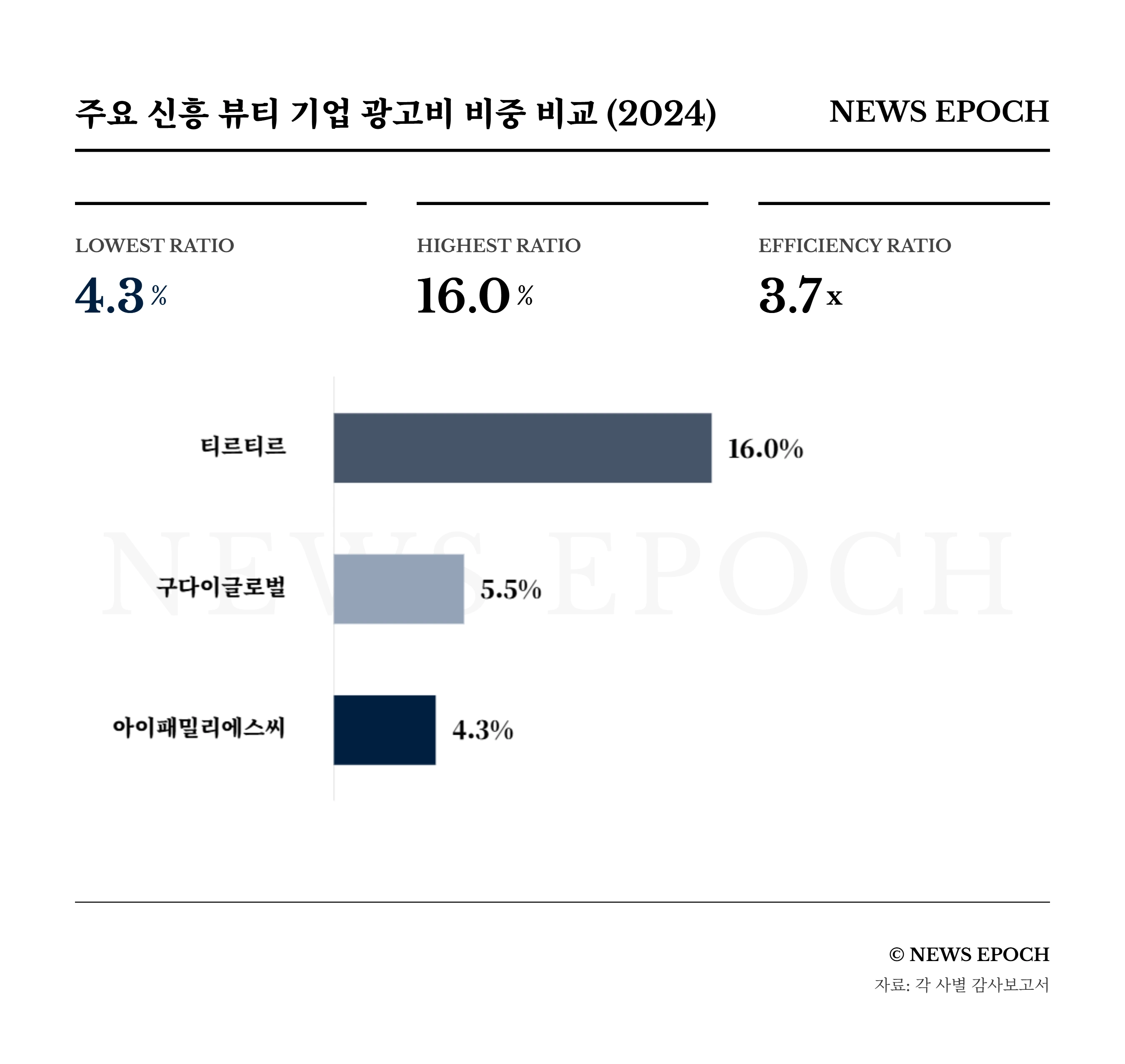
Differentiation among emerging companies also appeared in marketing strategies. iFamilySC (rom&nd) recorded an operating profit margin in the 16% range even while using only 4.3% of its sales for advertising and promotional expenses. This is the result of highly efficient marketing utilizing fandoms and short-form content. On the other hand, TIRTIR, which was acquired by Goodai Global in 2024, chose aggressive expansion by spending 16.0% of its sales on advertising expenses. This shows that emerging companies have built 'high-efficiency models' in their own ways, such as maximizing profits by minimizing capital input (Capex/Marketing) or securing market share through bold investments.
Shift in the axis of industrial added value... From 'manufacturing capabilities' to 'data planning power'
The 2024 beauty market was dominated not by 'economies of scale' but by 'economies of speed'. While Amorepacific and LG Household & Health Care underwent the painful surgery of voluntary retirement to reduce their heavy bulk, Goodai Global and iFamilySC agilely responded to market changes with their light bulk and rapidly encroached on the market. Now, the market does not ask 'who is the older brand'. It asks 'who generates profits lighter and faster'.
The future hegemony of K-beauty depends on who moves lighter and faster. The era of a heavy manufacturing base is setting, and the era of a light data base has opened. This is not a simple ranking change, but a clear signal that the target chosen by capital has changed. Whether traditional companies will succeed in improving their constitution after painstaking restructuring, or whether emerging companies will completely replace the void, the structural reorganization of the industry has just begun.
Company financial data, investment reports, and startup analysis — all in one place
Explore PitchdeckCurated news, every week — straight to your inbox
Every Friday · Unsubscribe anytime