![[K-Beauty Matrix] "Overwhelming Scale" Cosmax vs. "Overwhelming Substance" Kolmar Korea... Who Looked Further Ahead in the Cosmetics Golden Age?](https://d1gl51xbrxoj65.cloudfront.net/uploads/2026/01/30/1769776918418-7f8yp.webp)
The Dilemma of the No. 1 Player Exceeding KRW 1.3 Trillion in Revenue... Surging Orders, Retreating 'Efficiency'
The Meaning of the KRW 170 Billion Liquidity Gap... Cosmax Trapped in the 'High-Mix Snare,' Kolmar Korea Completes 'Vertical Integration'
Divergent Choices Amidst an Unprecedented Boom: 'Market Share Defense' or 'Overwhelming Profitability'?
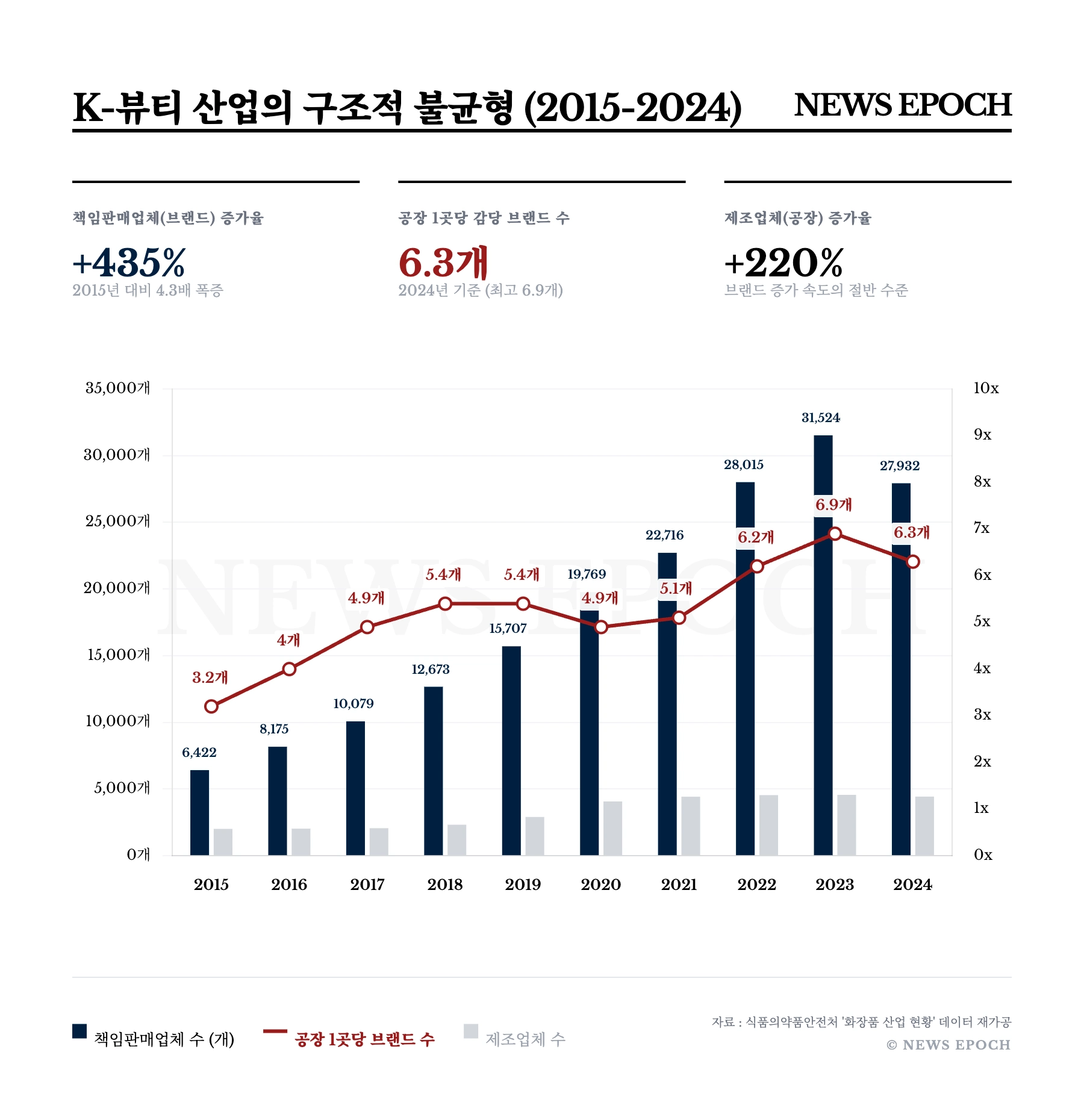
"The value-added of K-Beauty has completely shifted from 'brands' to 'manufacturing platforms.'" While thousands of indie brands engage in fierce survival competition for an operating profit margin of just over 3%, the ODM (Original Design Manufacturing) companies that monopolize their production have accumulated massive capital while enjoying the structural growth of the market. When brands rely on the uncertain 'intangible asset' of marketing, ODMs have built an industrial moat with the certain 'tangible assets' of production facilities and formulation data.
However, even in the midst of an unprecedented boom, the No. 1 and No. 2 players in the industry faced different strategic choices. While passing through the same super cycle, one side defended its expanding market share through bold borrowing, while the other focused on preempting the future value chain based on overwhelming profitability. Cosmax, which achieved KRW 1.3 trillion in revenue, and Kolmar Korea, which recorded an operating profit margin of 13.8%. We examine the financial situations of the two companies that chose different growth strategies amidst an all-time boom.
The Flood of 'Brands without Factories'... ODMs Hold Absolute Initiative
The current K-Beauty boom is thoroughly based on the ODM system. It is an era where anyone with ideas and marketing skills can become a cosmetics CEO without a factory. This has accelerated the so-called 'separation of manufacturing and sales,' where manufacturing and sales functions are strictly divided. Behind the establishment of an efficient division of labor system in which brand companies focus on consumer experience and market pioneering lies the immense technical dominance of the manufacturers. In fact, ODM companies own everything from the formulations—the core of the products—to production facilities and quality control data. Although brand companies hold marketing rights, the structure is such that manufacturers hold the 'physical substance' and 'source technology' of the products. Thanks to these structural characteristics, ODM companies have gone beyond being simple subcontractors. In a virtuous cycle where a brand's success immediately leads to an expansion of manufacturing volume, ODM companies have positioned themselves as the 'core infrastructure' and platforms that most stably enjoy the growth of the K-Beauty market, regardless of the rise and fall of individual brands.
Moreover, this dominance is becoming even more solid due to the 'Lock-in Effect' (irreplaceability). Even if a brand company tries to change factories to lower manufacturing costs, the transfer is impossible because the ODM company holds the product's unique sensory, fragrance, and formulation data. Ultimately, as a brand grows, its dependence on partner companies increases exponentially, acting as a powerful moat that allows ODM companies to escape fierce unit price competition and secure a stable operating profit margin (OPM). It is no coincidence that Kolmar Korea and Cosmax recorded their highest-ever performances in 2024; rather, it is a signal announcing the completion of this structural winner-takes-all system.
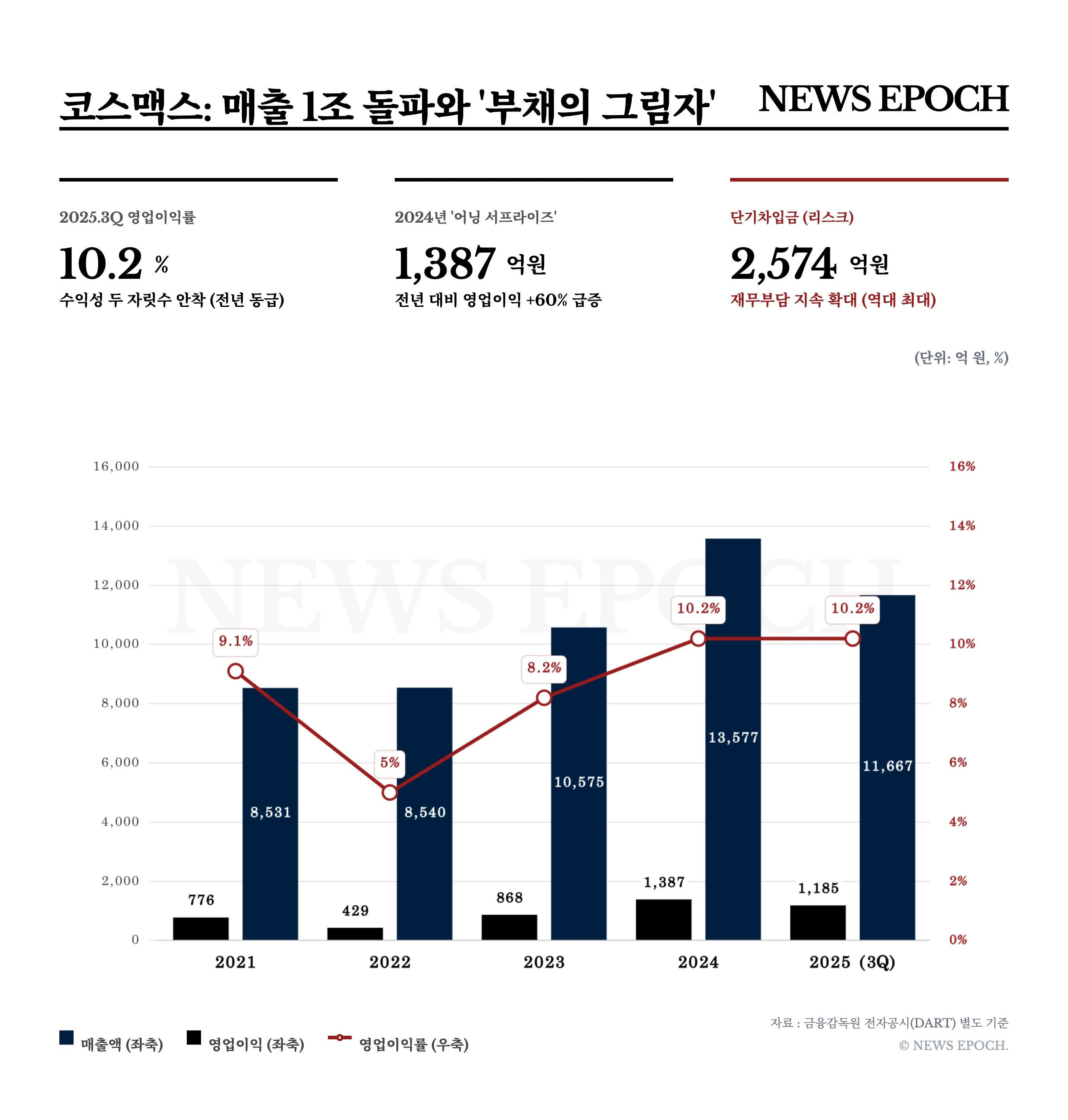
The Task of the No. 1 in Revenue... "Orders Are Fragmented and Costs Have Increased"
Cosmax achieved a standalone revenue of KRW 1.3576 trillion (+28%) in 2024, reaching the peak of its top-line growth. However, behind this scale expansion remained the task of 'manufacturing process overload' due to a rapid increase in client companies. This is because the client portfolio rapidly diversified in the process of aggressively attracting new indie brands, thereby adding to the management costs.
The problem arose here. As the customer base broadened, the order units became fragmented, and profitability improvement was delayed as the dilemma of 'high-mix, low-volume production'—which requires frequent changes to factory lines—overlapped. In fact, this rigidification of the cost structure had a direct impact on cash flows. To respond to the surging orders, massive funds were invested in the pre-securing of raw and subsidiary materials and inventory management, which was reflected in a scorecard of KRW -13.1 billion in operating cash flow (OCF) for 2024.
Ultimately, Cosmax increasing its short-term borrowings to KRW 257.4 billion (+KRW 52.2 billion) is interpreted not as a simple liquidity crisis, but as a phase of enduring the 'operating costs' required to maintain an overwhelming market share. This is exactly why the market is paying more attention to confirming its future 'margin recovery' and 'profit stamina' rather than its top-line growth.
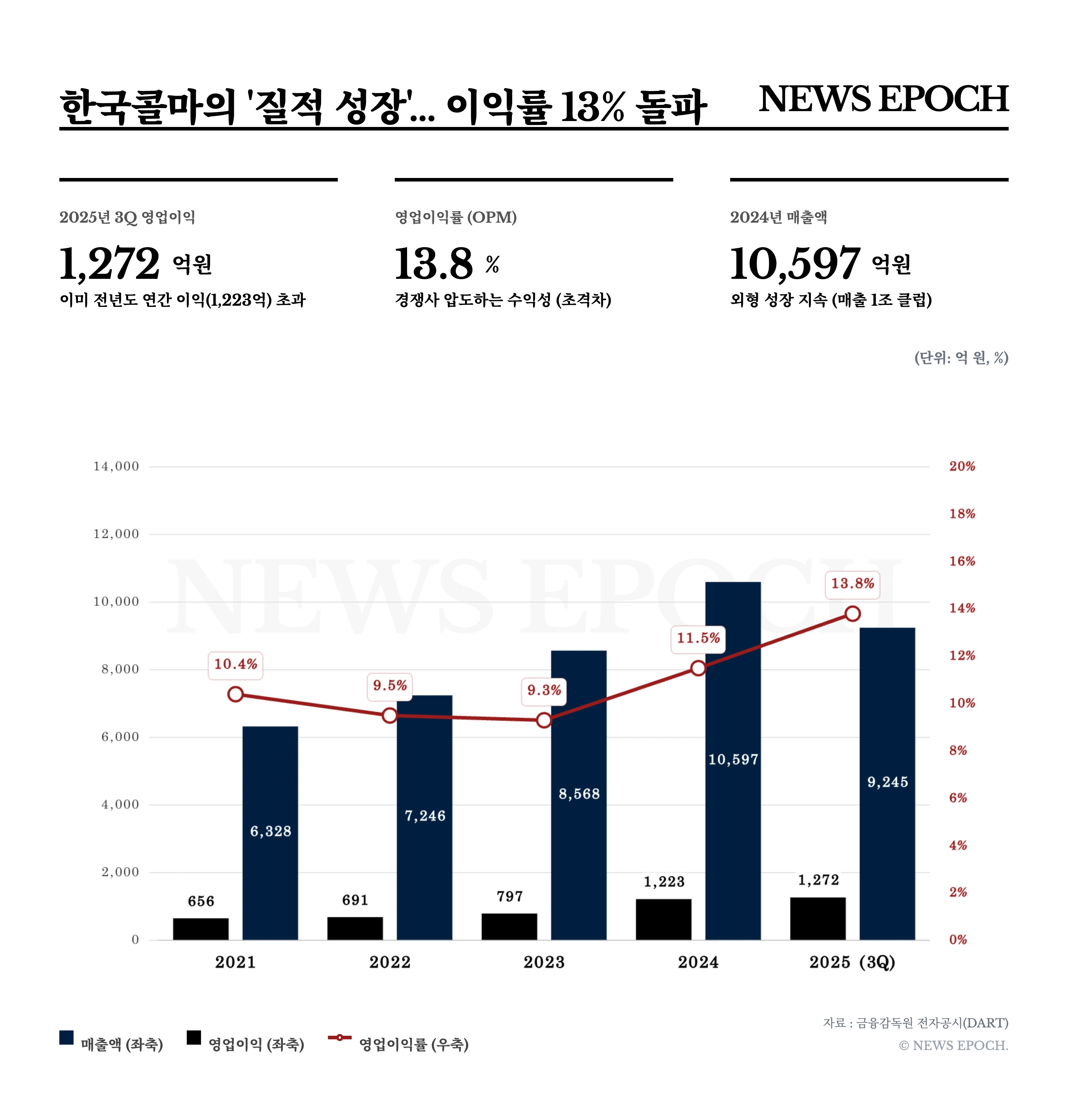
Kolmar Korea's Efficient Management... "Bought the Future with a 13.8% Margin"
On the other hand, Kolmar Korea focused on 'substantive growth centered on profitability.' It expanded its scale by recording a standalone cumulative revenue of KRW 924.5 billion in the third quarter of 2025, and above all, it achieved overwhelming profitability that surpasses the common sense of the manufacturing industry with an operating profit margin of 13.8%. This profitability became the source of solid cash flows. With the abundant cash generated from operations, Kolmar Korea exhibited the leeway to boldly reinvest in future value chains, such as its North American production base, even after repaying KRW 55 billion in short-term borrowings.
The pinnacle of this efficient management was revealed in the acquisition of H&G's cosmetics business division (KRW 19.5 billion) executed on January 30, 2026, through its subsidiary Kolmar UX. H&G was a core partner to the extent that Kolmar Korea paid it KRW 32.5 billion (51% of related-party purchases) on a cumulative basis by the third quarter of 2025, but at the same time, it was also a channel through which margins leaked outside the group. This acquisition represents the 'internalization of costs' and the final touch of vertical integration, wholly attributing the manufacturing margins previously paid to partner companies back into the group. Having proven its structural improvement with a 712% surge in net profit in 2024, Kolmar Korea has now established an unrivaled position as a 'complete entity that has perfected both a high-profit structure and a value chain.'
Cosmax Burdened with the Task of 'Profitability Recovery' vs. Kolmar Korea Securing Both 'Expansion and Stability'
For Cosmax, 2025 was a year focused on normalizing the 'production overload' that became burdensome due to the rapidly increased number of client companies. While the issue of delayed listing for its Chinese holding company 'Cosmax East' remains, the payment guarantee balance of approximately KRW 870 billion provided to its global corporate entities is still a factor of financial burden. The absorption and merger of its subsidiary 'Artlab' carried out in November 2025 also bears the strong nature of a desperate measure to control decentralized costs and defend profitability, rather than a simple top-line expansion.
Ultimately, the K-Beauty super cycle simultaneously presented companies with the two conflicting tasks of 'overwhelming market share' and 'profitability.' The solutions to this diverged starkly. Kolmar Korea preempted the 'future' of the North American value chain and H&G with abundant liquidity, while Cosmax defended the 'present' of a massive market share with tremendous leverage.
The competitive grammar of the cosmetics industry has now been completely reshaped from 'who sells more' into a battle of 'who allocates capital more efficiently.' Of the two companies that have written different growth equations amidst an unprecedented boom, future market valuations will coldly prove who looked further ahead.
Company financial data, investment reports, and startup analysis — all in one place
Explore PitchdeckCurated news, every week — straight to your inbox
Every Friday · Unsubscribe anytime