![[Meat Industry Review ①] The Paradox of an Era Eating More Meat Than Rice... Why the Meat Distribution Industry is Groaning](https://d1gl51xbrxoj65.cloudfront.net/uploads/2026/02/10/1770699223178-m7cijo.webp)
- Meat consumption per capita at 60kg, surpassing rice (56.4kg) for the first time... The market is growing, but the industry is in an 'ice age'
- Wholesale market at 14 trillion won, retail at 20 trillion won... A '1% margin war' unfolding within a massive market
- The trap of 'high volume, low margin' that even Cargill and Tyson couldn't escape... "Simply reducing distribution stages is an illusion"
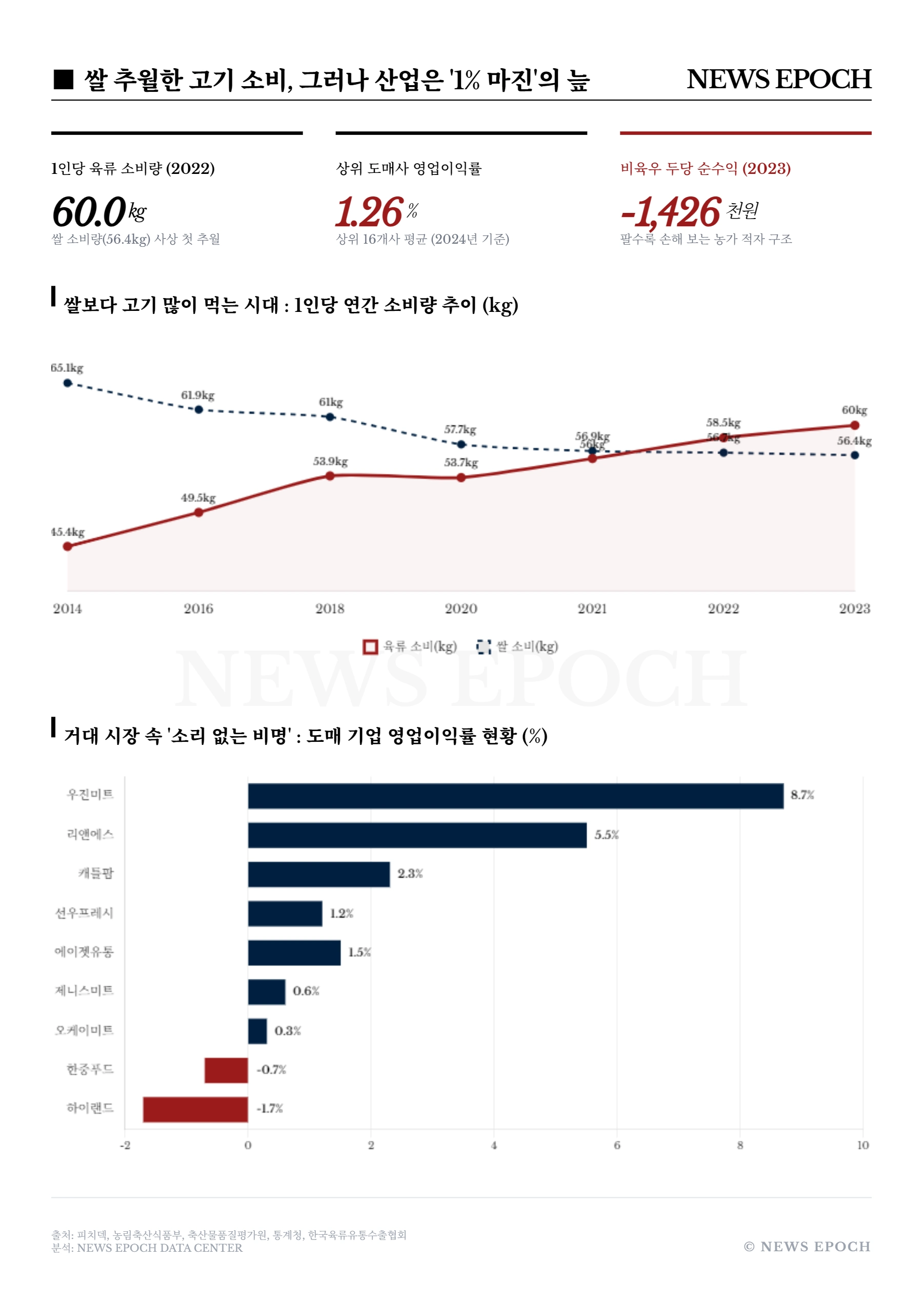
The master of the Korean dining table has changed. As of 2022, the annual meat consumption per capita recorded 60.0kg, surpassing the consumption of the staple food, rice (56.4kg), for the first time in history. The 'era of eating more meat than rice' has truly arrived, but ironically, the industrial field supplying the meat is experiencing an unprecedented crisis. Although consumption has increased, the fear of a chain of bankruptcies is spreading due to an anomalous structure where it is difficult for everyone from producers to distributors to make a profit.
◇ The fall of once-prosperous food tech... Meat market becomes a 'graveyard' for startups
Recent news of successive bankruptcies and sales of meat distribution startups proves the structural difficulty of this industry. 'Gogi Now' (closed in June 2024) and 'Meat Q Delivery' (closed in 2023), which promoted fresh distribution, folded their services, and 'Meat Run Lab' went bankrupt in 2023. '6gram', which once drew attention for its innovative D2C (Direct to Consumer) model and boasted an enterprise value of 20 billion won, was sold in 2022, and even 'Plating Corporation', which acquired it, suffered the humiliation of being sold for around 500 million won after a rehabilitation process.
◇ The screams of farms... -1.6 million won per cow, "The more you sell, the more you lose"
The situation for farms at the very bottom of the industry is miserable. According to Statistics Korea data, as of 2024, the net profit a farmer makes when shipping one beef cattle (meat cow) is estimated at minus 1,614,000 won. Breeding cows are also expected to see a deficit of 1,115,000 won, and dairy bulls (beef cattle) are seeing losses exceeding 1,800,000 won per head. Only pigs (finishing pigs) are generating a marginal surplus of 32,000 won per head.
As deficits continue, the number of farms is plummeting. In the past, even if the number of farms decreased, large farms increased their breeding herds and endured through 'economies of scale', but recently, even the total number of bred animals is on a downward trend. While the domestic supply base is shaking, imported meat is quickly filling the void. Beef import volume surged by nearly 50% from about 290,000 tons in 2015 to 440,000 tons (estimated) in 2024.
◇ The reality of the 14 trillion won wholesale market... A '1% margin' battlefield
Then, are the wholesalers, the backbone of distribution, making money? As of 2023, the domestic beef (Hanwoo + imported) wholesale market is estimated to be about 14.3 trillion won, and the retail market 20.8 trillion won. Looking at the wholesale stages, out of the 14.3 trillion won market, Hanwoo accounts for about 8.7 trillion won, and imported beef accounts for about 5.6 trillion won. This massive volume passes through an average of three wholesale stages before flowing into butcher shops (3.7 trillion), large discount stores (4.1 trillion), and general restaurants (2.1 trillion).
The problem is profitability. The average operating profit margin of the top 16 domestic meat wholesalers is a mere 1.2%. Sunwoo Fresh, a large company with 470 billion won in sales, recorded a 1.2% profit margin, and OK Meat, with 340 billion won in sales, recorded 0.3%, engaging in a literal 'squeezing a dry towel' kind of competition. Due to the nature of the wholesale business where product differentiation is difficult, there is no other way to survive except through a strict 'high volume, low margin' strategy.
◇ The 'trap of low margins' that even global giants Cargill and Tyson couldn't escape
This low-margin structure is not a situation unique to South Korea. Looking at the report cards of global meat companies, you can see how difficult this market is worldwide.
• Cargill: The overall net profit margin of Cargill, one of the world's top four grain companies and a meat giant, is around 1.5% in 2024. The profit margin for its Animal Nutrition and Protein (ANP) division is also estimated at 6~8%.
• Tyson Foods: Tyson Foods, the largest meat processing company in the US, is also recording operating losses in its beef and pork divisions or barely avoiding a deficit. The profit margin for its entire meat segment is estimated to be in the 1.3% range.
• JBS: The beef division profit margin of JBS, the world's largest livestock company, also only fluctuates between 1% and 8% by region.
Ultimately, the meat distribution business is inherently a 'heavy' industry where it is difficult to dramatically increase the profit margin no matter how large the scale grows.
◇ The trap of 48% distribution costs... "Direct transactions are not a silver bullet"
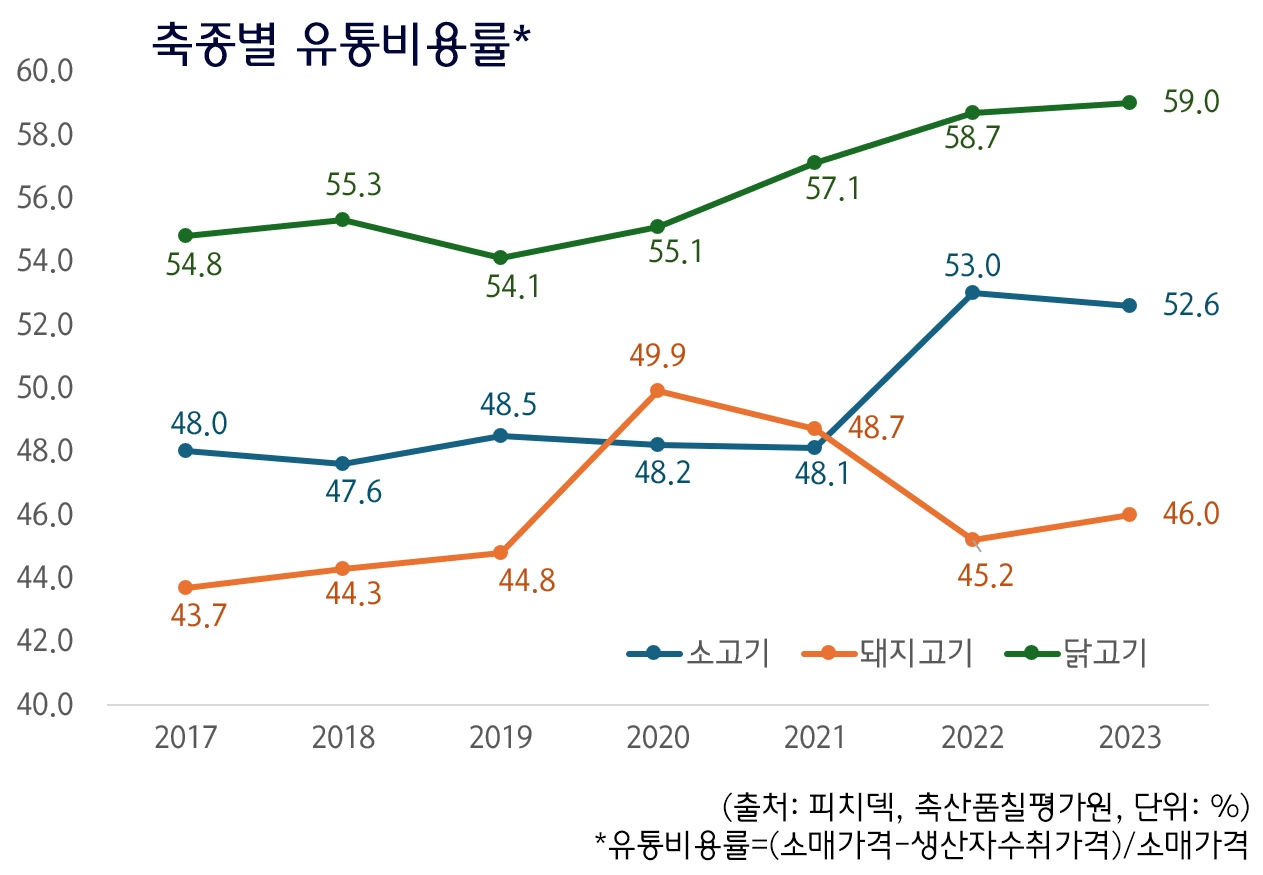
Consumers often ask, "The price of cattle at the source is falling, so why do restaurant meat prices stay the same?" Statistically, the distribution cost rate for beef reaches about 48%. This means half of the consumer price goes to distribution costs.
Many startups jumped into direct transactions (D2C) eyeing this '48% margin.' They calculated that they could generate massive profits if they reduced the complex three stages of wholesale. However, experts point out that this is an 'optical illusion.'
"While the wholesale stage adds an average margin of 5~15%, invisible costs are hidden in the retail stage," they explained. At least 5% or more is lost to 'yield loss,' where weight decreases during the process of trimming fat and bone from the meat, and the 'disposal rate' due to shelf-life issues. If cold chain (refrigerated distribution) costs, rent, and labor costs are deducted from this, the actual net profit drops to single digits.
Existing wholesalers have played the role of a 'hub' by dividing large quantities of meat by cuts, distributing them to the right places such as butcher shops, restaurants, and cafeterias, and managing inventory. If startups try to internalize this function through direct transactions, logistics and inventory management costs increase exponentially, leading them into the 'paradox of direct transactions,' which is actually less efficient than the existing distribution network.
◇ Winner's curse, or a cursed industry?
In the end, the meat distribution market is a market close to 'perfect competition' where anyone can enter, but no one can easily make money. You cannot survive simply by reducing distribution stages, and you can only survive the 1% margin war by achieving overwhelming economies of scale or accomplishing 'vertical integration' that encompasses feed, breeding, slaughtering, processing, and distribution.
Taking advantage of the shaken domestic production base, imported meat is rapidly encroaching on the market. Beef import volume surged from about 290,000 tons in 2015 to about 440,000 tons in 2024. Industry experts point out that structural improvement across the entire value chain is urgent, stating, "If we fail to reduce costs by innovating the distribution stages, a structure where both producers and consumers suffer will become entrenched."
Company financial data, investment reports, and startup analysis — all in one place
Explore PitchdeckCurated news, every week — straight to your inbox
Every Friday · Unsubscribe anytime