![[Meat Industry Check ②] "A Trap of Innovation, or a Predicted Failure?"... The Fall of 'Ultra-Fresh' Jeongyookgak and the Winner's Curse](https://d1gl51xbrxoj65.cloudfront.net/uploads/2026/02/25/1771986952565-4scbkg.webp)
- Slashed from the verge of a 410 billion won unicorn to 93 billion won... The 'valuation collapse' triggered by the Chorocmaeul acquisition
- A structure that generates losses the more it sells... An abnormal financial statement with a product cost rate of 119% and SG&A expenses of 68%
- A fatal blunder choosing horizontal expansion into the 'red ocean' with Coupang and Kurly instead of vertical integration
- "Negative enterprise value, liquidation value is higher"... Harm extends to farming households due to payment delays amid M&A struggles
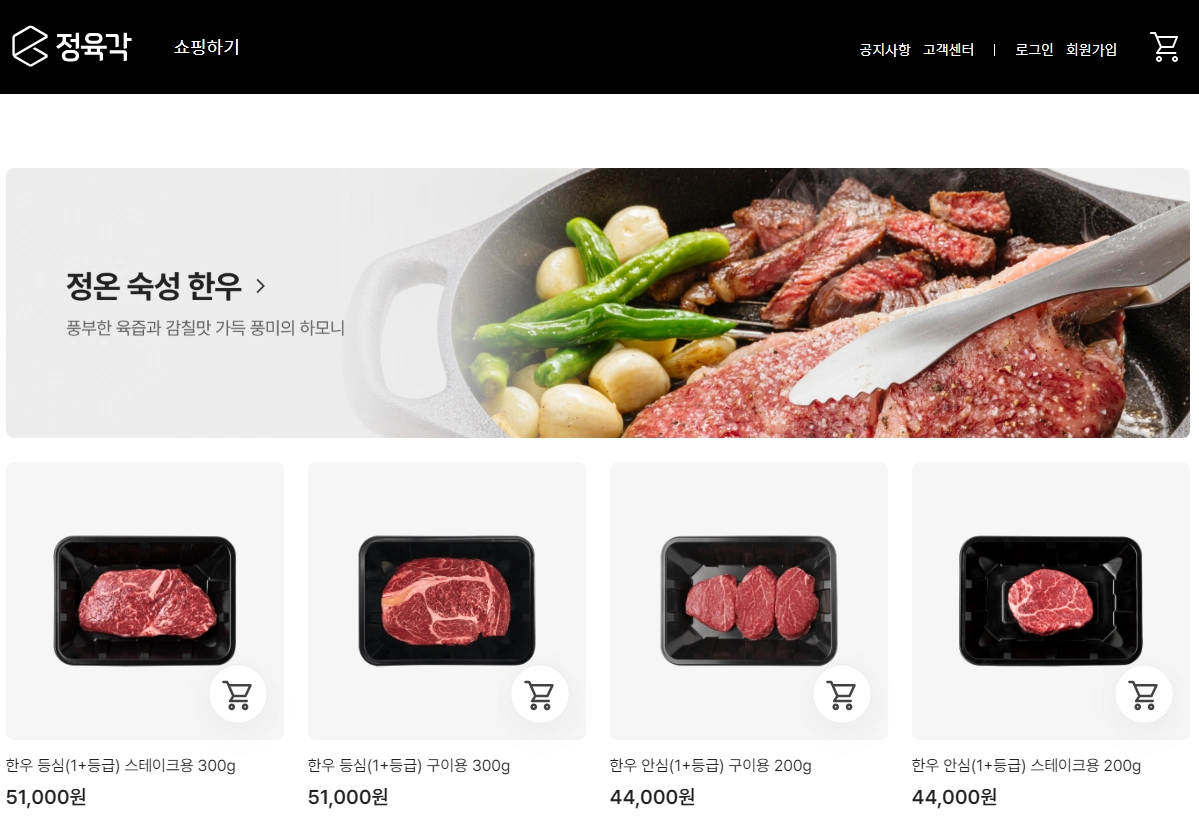
[Source: Jeongyookgak website]
As examined in Part 1, the meat distribution industry is a fierce and barren industry where players fight over margins of 1 to 2%, despite its massive external size. Into this heavy market, the company that emerged with the weapon of 'ultra-freshness within 4 days of slaughter' and IT technology, rapidly rising as a promising food-tech startup, is 'Jeongyookgak'.
However, the current state of Jeongyookgak is disastrous. In 2022, it aggressively expanded its size by acquiring the organic food distributor 'Chorocmaeul' for 90 billion won, but eventually faced the tragedy of both companies filing for corporate rehabilitation (receivership) with the court in July 2024. While the market evaluates this as a typical 'winner's curse', an analysis of Jeongyookgak's financing process and financial statements reveals that this is closer to a predicted disaster born of 'structural insolvency in the main business' and 'strategic misjudgment', rather than a simple merger and acquisition failure.
◇ Valuation plummeted from 410 billion won to 93 billion won... The full story of the 'all-in' acquisition
Looking at the details of Jeongyookgak's investment attraction before and after acquiring Chorocmaeul, it is starkly revealed how the unreasonable expansion damaged the company's value.
According to Pitchdeck's data, in September 2021 (Series C), Jeongyookgak attracted 44 billion won in investment from prominent venture capitals (VCs) including Capstone Partners, Premier Partners, Stonebridge Ventures, Mirae Asset Venture Investment, and Atinum Investment. The estimated enterprise value recognized at this time was around 195.7 billion won, and the company focused on enhancing its meat processing capabilities by investing approximately 31 billion won of these funds to purchase the land and buildings for the Gimpo factory.
The atmosphere reached its peak in the first half of the following year, 2022 (Series D). It attracted an additional 39 billion won in investment from Korea Development Bank, Atinum Investment, Capstone Partners, and others, causing its estimated enterprise value to soar to an impressive 414.5 billion won. It seemed on the verge of joining the ranks of a 'pre-unicorn'.
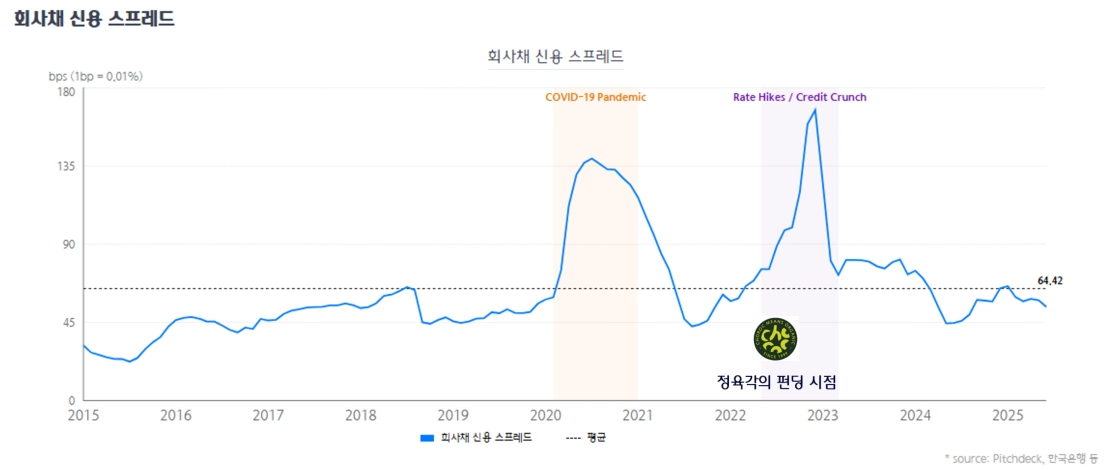
However, the situation sharply reversed in the second half of 2022 as it pursued the acquisition of Chorocmaeul. Jeongyookgak sought funding to acquire Chorocmaeul, but faced extreme difficulties in attracting investment due to the coinciding trend of interest rate hikes and a credit crunch environment. When funding was blocked, Jeongyookgak resorted to the desperate measure of drastically lowering its enterprise value. Only after slashing its estimated enterprise value from the 410 billion won range just months prior to 93 billion won—a staggering one-fourth of its former level—was it able to receive an injection of 8 billion won in funds from existing investors such as Capstone Partners, Korea Development Bank, and Atinum Investment.
Unable to pay the 90 billion won acquisition cost with investment funds alone, Jeongyookgak eventually pushed through the unreasonable acquisition by drawing in over 30 billion won in short-term borrowings (loans) from Shinhan Capital and others. Ultimately, moving into 2023, Jeongyookgak's ratio of short-term borrowings to sales rose to 182%, and the ratio of long-term borrowings to sales surged to 75%, reaching a level where it became difficult to repay the borrowings even with its revenue, let alone generate profit. At the time, its dependency on borrowings was 151%, and its current ratio was 1.9%.
◇ "The more it sells, the more it loses"... The abnormal cost and expense structure hidden behind innovation
The startup industry analyzes that trouble started when Jeongyookgak embraced Chorocmaeul, but in reality, Jeongyookgak's main business (meat D2C) was already sounding serious alarm bells prior to the acquisition.
One must look at Jeongyookgak's income statement to understand this structure. As of 2021, when the factory began full-scale operations, Jeongyookgak's 'cost of goods sold ratio for manufactured products' reached a staggering 119.9%. This means that for every 10,000 won of directly processed meat sold, 11,990 won was spent on costs alone, creating a structure where losses piled up the more they sold. Although it lowered the cost ratio to the 80% range in 2023 and 2024, this was merely the result of drastically reducing the proportion of self-processed products that yielded no margin and roughly doubling the proportion of 'merchandise sales' by purchasing and selling finished goods from outside, ultimately failing in fundamental cost control.
The fatal failure in cost control is also painful. In the meat distribution industry, which competes on single-digit profit margins, selling, general, and administrative (SG&A) expenses are like a company's lifeline. For example, large meat wholesaler 'Sunwoo Fresh' maintains an SG&A ratio around 38%, whereas Jeongyookgak's SG&A ratio wildly fluctuated between an astonishing 48% and 68%.
Comparing the number of employees reveals the bare face of this inefficiency even more clearly. While Sunwoo Fresh, which generated massive sales of 490 billion won as of 2024, has 136 employees, Jeongyookgak had 271 employees—double that number—while generating a mere 28 billion won in sales. It claimed to reduce distribution stages and innovate by incorporating IT technology, but in reality, it operated the company with a much more reckless and inefficient structure than existing traditional distributors.
◇ Fatal strategic blunder: Choosing 'horizontal expansion' instead of 'vertical integration'
The card Jeongyookgak pulled out when it hit the limits of growth was the acquisition of Chorocmaeul, but this was a fatal blunder based on a complete misjudgment of the industry's value chain characteristics.
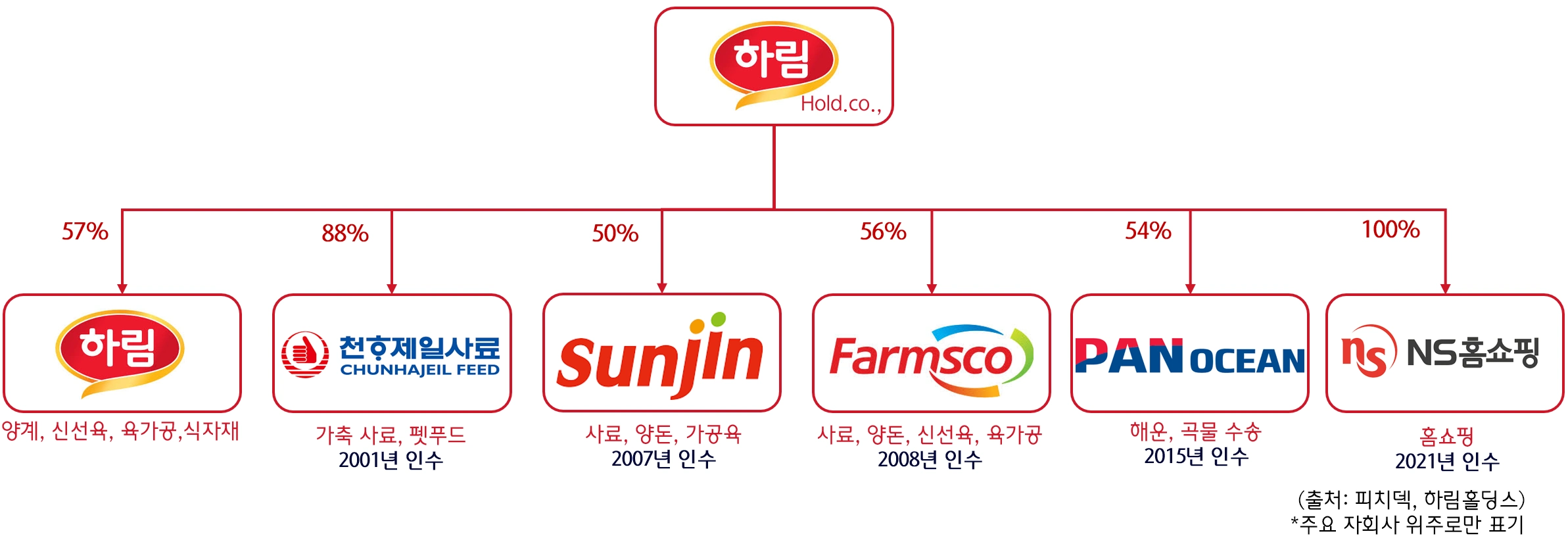
Companies that survived and generated large profits in the low-margin meat distribution industry chose 'vertical expansion' without exception. For example, Harim, famous for chicken, reduced costs by achieving perfect vertical integration encompassing feed (Farmsco), livestock, slaughtering, processing, and distribution, extending even to logistics (Pan Ocean) and home shopping channels. Sunwoo Fresh also grew into a 490 billion won company by dominating the value chain top-to-bottom, from raw meat imports to meat processing, home meal replacements (HMR), B2B, and offline butcher shop franchises.
However, Jeongyookgak chose 'sideways (horizontal)' rather than up and down (vertical). It expanded its scope beyond its main business of meat distribution into the 'online and offline grocery (comprehensive fresh food)' market. The problem is that this market is a complete red ocean where giants equipped with massive capital and logistics networks, such as Coupang, Market Kurly, SSG, Oasis, and Hansalim, are fighting a bloody battle. For Jeongyookgak, which was generating losses because it could not control costs even in its main business of single-item (meat) distribution, creating synergy in the comprehensive food market—which requires the inventory management of tens of thousands of products and a highly difficult logistics system—may have been a near-impossible challenge from the start.
◇ Even M&A remains in the fog... A grim assessment that "liquidation value is greater than going-concern value"
Unable to withstand debts and interest expenses approaching 100 billion won, Jeongyookgak and Chorocmaeul are ultimately going through corporate rehabilitation procedures side by side. They are struggling to find a new owner through an M&A before the rehabilitation is approved, but even this is a thorny path.
Recently, KK Holdings, a company based in the Daegu and Gyeongbuk region, emerged as an acquisition candidate, but ultimately withdrew the acquisition due to disagreements with the creditor group and aspects of a management rights dispute surrounding the demand for Jeongyookgak CEO Kim Jae-yeon's resignation. Afterward, it switched to a public sale to find a new owner, but the situation is not easy amid a harsh winter for the distribution industry, where even Homeplus is failing to find a buyer.
What is even more painful is the result of the accounting firm's due diligence. According to a recent investigation report, Chorocmaeul's 'going-concern value' was calculated to be a negative (-) 23.4 billion won, whereas the 'liquidation value' left when closing its doors and disposing of assets was estimated at 16.1 billion won. This is tantamount to a grim death sentence declaring that immediate liquidation is more economically beneficial than keeping the company alive and operating it.
In the meantime, only innocent victims are increasing. The settlement of Chorocmaeul's supply payments, which used to be completed within 15 to 30 days in the past, has been delayed for up to 60 days as management difficulties compounded after the acquisition by Jeongyookgak, putting fresh produce farmers and suppliers—who deal with short shelf lives and require upfront contract payments—under severe financial pressure and the risk of serial bankruptcies.
The fall of Jeongyookgak throws a heavy warning to the startup industry. It vividly shows the disastrous end that is inevitable for a company that turns a blind eye to the basics of fundamental cost control and profitability creation in the industry, while being buried in seemingly glamorous 'IT-based innovation' and hundreds of billions of won in book-value valuation.
Company financial data, investment reports, and startup analysis — all in one place
Explore PitchdeckCurated news, every week — straight to your inbox
Every Friday · Unsubscribe anytime