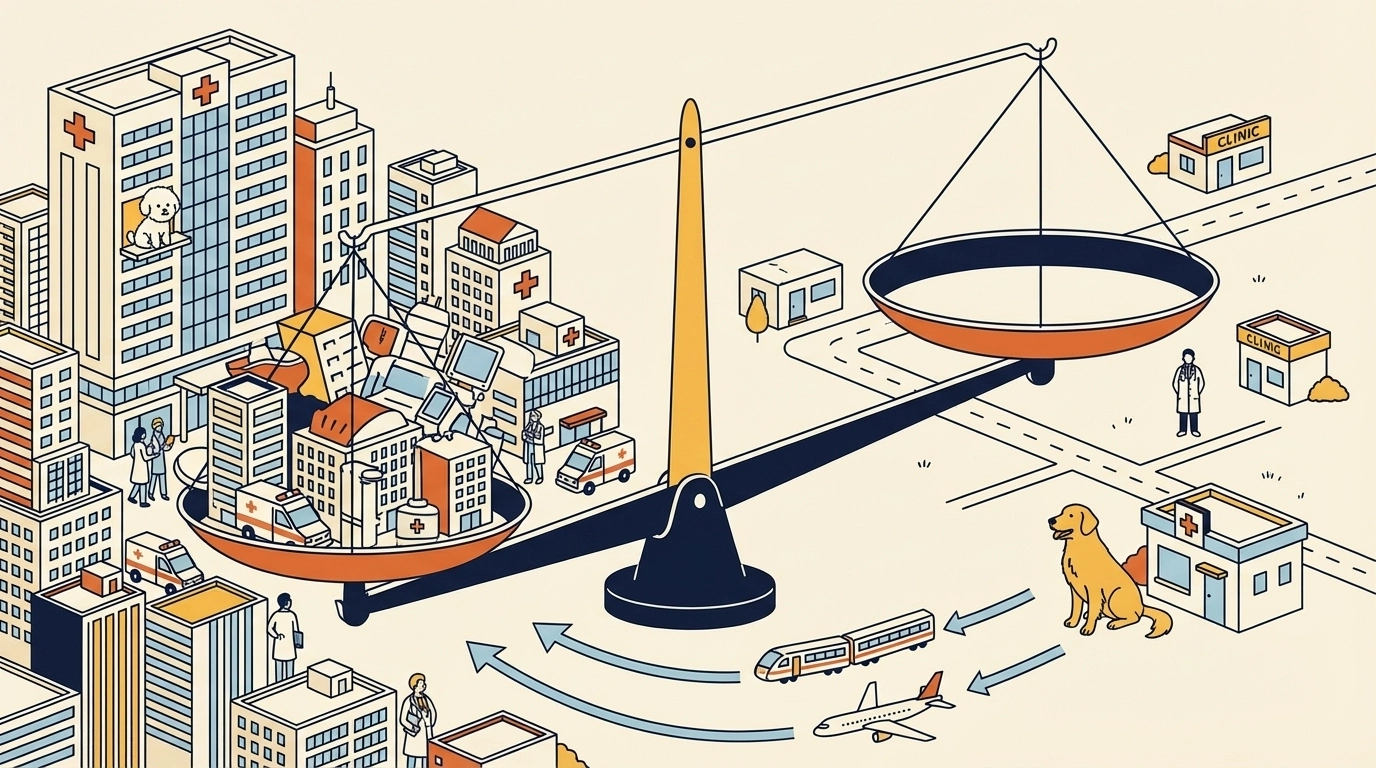
Out of 47 tertiary general hospitals, 14 are in Seoul, while Gyeongbuk, Jeju, and Sejong have 0
5 cities, counties, and districts have fewer than 30 medical institutions; Ulleung-gun has 0 general clinics
59 nursing hospitals nationwide have no registered doctors
The 79,587 healthcare institutions nationwide are not distributed proportionally to the population. Concentrated areas have become even more concentrated, while empty areas have become emptier.
A comprehensive analysis of the Health Insurance Review & Assessment Service (HIRA) registration data makes the outlines clear. Where the overcrowded and empty areas are — this map also serves as a blueprint of the market for investors looking into telemedicine, digital healthcare, and the nursing care industry.
Gangnam-gu 3,110, Ulleung-gun 8 — A 389-fold Difference
The area with the most medical institutions nationwide is Gangnam-gu, Seoul (3,110 locations, 7,418 doctors). It has a full-set structure equipped with 2,129 clinics, 2 general hospitals, and 2 tertiary general hospitals. Even combining the 2nd place Seocho-gu (1,589 locations) and 3rd place Songpa-gu (1,320 locations) cannot surpass Gangnam-gu alone.
At the opposite end is Ulleung-gun. It has 8 registered medical institutions and 20 doctors. 5 public health posts are operated by nursing staff without assigned doctors, and the only facility where doctors practically reside is the Ulleung-gun Health Center & County Hospital (18 doctors). There is 1 dental clinic and 1 traditional Korean medicine clinic each, but there is not a single general clinic (internal medicine, surgery, etc.). The gap in the number of medical institutions between Gangnam-gu and Ulleung-gun is 389 times.
This is not just a problem for Ulleung-gun. There are 5 cities, counties, and districts (si/gun/gu) nationwide with fewer than 30 medical institutions, including Yeongyang-gun (21 locations, 15 doctors), Yanggu-gun (24 locations, 43 doctors), Yangyang-gun (26 locations, 19 doctors), and Ongjin-gun in Incheon (27 locations, 47 doctors). The reality is that receiving specialized medical care in these areas requires a 1 to 2-hour drive.
47 Tertiary General Hospitals, Seoul Takes 30%
There are only 47 tertiary general hospitals nationwide that treat severe diseases. Of these, 14 (30%) are in Seoul, and the number of tertiary general hospital doctors assigned to Seoul is 10,573, accounting for 46% of the 22,865 tertiary general hospital doctors nationwide. There are 6 in Gyeonggi-do, 5 in Daegu, and 4 in Busan, but there is not a single tertiary general hospital in Gyeongbuk, Jeju, or Sejong.
The fact that there are no tertiary general hospitals in Gyeongbuk is significant. Gyeongbuk ranks 4th nationwide with 104 nursing hospitals and is a region with a high proportion of elderly population. Elderly patients progressing to severe conditions must travel to Daegu to receive tertiary general medical care. The same goes for Jeju. While 10 nursing hospitals are in operation, there are 0 tertiary general hospitals, so severe patients must travel by air to hospitals on the mainland.
1,298 Nursing Hospitals, The Shadow of an Aging Population
There are 1,298 nursing hospitals nationwide. Gyeonggi-do has the most with 273 (21%), followed by Busan with 151 and Gyeongnam with 113. Seoul comes in 5th with 102, which seems to reflect a pattern where Seoul's elderly population moves to nursing hospitals in Gyeonggi-do when they reach a stage requiring care.
The problem is that there are 59 nursing hospitals with not a single registered doctor. There are 16 in Gyeonggi-do, 8 in Busan, and 6 in Gyeongnam. Nursing hospitals have a doctor placement standard under the Medical Service Act (1 doctor per 80 inpatients), but having facilities with 0 doctors based on HIRA registration data suggests the possibility of staffing vacuums or delayed registration. Either way, it raises questions about the quality of medical care for elderly patients.
The Meaning of 79,587 Locations — A Market Where Overcrowding and Vacuums Coexist
There are a total of 166,395 doctors registered across 79,587 locations nationwide. The average number of doctors per facility is 2.1, but this average creates an optical illusion that places Gangnam-gu (2.4 doctors per facility) and Ulleung-gun (2.5 doctors per facility) on the same line. The 20 doctors in Ulleung-gun result in a high facility average because 18 of them are concentrated in a single health center & county hospital, while the remaining 7 locations have only 2 doctors in total.
Looking by cities and provinces, Seoul (19,734 locations, 46,822 doctors) and Gyeonggi (18,122 locations, 36,954 doctors) account for 48% of the facilities and 50% of the doctors nationwide. Although it is a result of the population concentrated in the Seoul metropolitan area, the concentration of medical infrastructure in the two regions of Seoul and Gyeonggi is at a similar level to the population ratio, yet there is a significant qualitative gap. High-level medical facilities such as tertiary general and general hospitals are concentrated in the metropolitan area, creating an imbalance that is invisible through mere institution counts.
The Vacuum is the Market
The 2.6-fold gap between the 2,129 locations in Gangnam-gu and the 825 locations in Gangwon-do; Gyeongbuk, Jeju, and Sejong with 0 tertiary general hospitals; and 59 nursing hospitals operating without doctors. On top of the map drawn by this data, the markets for telemedicine, remote monitoring, and AI diagnostic assistance overlap. While building new medical institutions takes years, digital infrastructure penetrates first in places without physical hospitals.
Remote treatment platforms connecting medical vacuum areas with Gyeonggi-do, where 1,298 nursing hospitals are concentrated, and video consultation systems linking severe patients in Gyeongbuk and Jeju—which lack tertiary general hospitals—with mainland specialists. As the polarization of medical infrastructure worsens, the TAM (Total Addressable Market) for companies filling that gap expands. What the data from the 79,587 locations points to is not 'where there are many hospitals,' but 'where there are no hospitals.'
This article was written by News Epoch by securing and analyzing the Health Insurance Review & Assessment Service (HIRA) healthcare institution status data through The Proxy collection pipeline.
The HIRA data is based on facilities registered as health insurance healthcare institutions, and does not include unregistered facilities or non-reimbursement specialized clinics. The number of doctors is based on HIRA registration and may differ from the actual resident staff. Data baseline: Collected in April 2026.
Company financial data, investment reports, and startup analysis — all in one place
Explore PitchdeckCurated news, every week — straight to your inbox
Every Friday · Unsubscribe anytime