![[Data Pick] Where Do the CEOs of Startups That Received Over 10 Billion Won in Investment Live? (2)](https://d1gl51xbrxoj65.cloudfront.net/uploads/2026/06/02/1780375811261-j1g35k.webp)
In our previous analysis, we confirmed down to the *dong* (neighborhood) level that the residences of CEOs of invested unlisted companies are concentrated in a narrow area centered around Gangnam and Seocho. This time, we go one step deeper. Not neighborhoods, but 'apartments'.
The subjects are over 2,100 incumbent CEOs of unlisted companies that have raised a cumulative amount of 10 billion won or more. Among the 1,830 CEOs whose apartment complexes were identified, about 1 in 8 (12%) live concentrated in just twenty buildings. And those twenty locations are divided into three distinct categories.
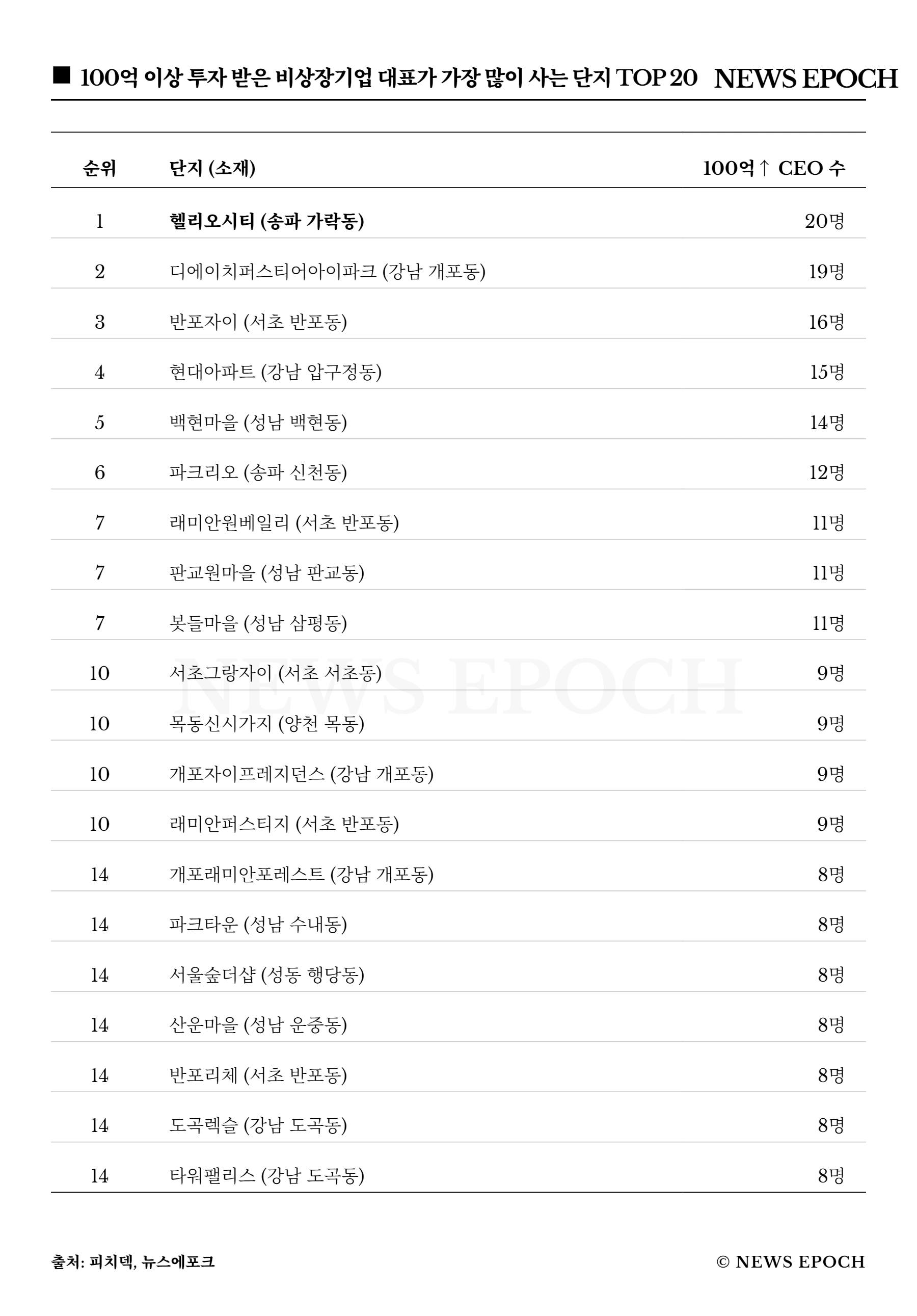
Interestingly, this leaderboard actually underestimates the density of specific neighborhoods. For example, 75 CEOs from the 10 billion won club live in Banpo-dong, Seocho-gu, and they are scattered across as many as 24 different complexes, not just one or two. 44 people are concentrated in four landmarks such as Banpo Xi, Raemian One Bailey, Raemian Firstige, and Banpo Riche, while the remaining 31 are spread across Acro River Park, Raemian One Pentas, and THE H Banpo La Class. This means that the neighborhood of Banpo itself is a 'collection of prestigious newly built complexes.'
Emerging Capital Heading Towards Large-Scale Newly Built Complexes
Taking the TOP spot was neither Apgujeong nor Hannam, but large-scale newly built complexes with move-ins after the 2010s. The 1st place, Helio City, is a 9,510-household scale complex that began move-ins in December 2018, and is the largest single residential complex in Korea, reconstructed from the Garak Siyoung Apartments. The 2nd place, Gaepo THE H Firstier I'Park, is a new construction with 6,702 households that began move-ins in 2023, and Banpo Raemian One Bailey, Jamsil Parkrio (2008), and Gaepo Xi Presidence are all also relatively new buildings.
Looking into the figures makes this trend even clearer. The CEOs living in these newly built complexes are the youngest, with a median age of 48, and have the highest median cumulative fundraising amount at 37 billion won. This means that the youngest founders who have attracted the largest amounts of money are heading to the newest buildings. It can be interpreted as the result of a combination of spacious floor plans, abundant community facilities, and the timing of entry made possible when supported by cash liquidity.
Traditional Assets Remaining in Prestigious Older Complexes
That does not mean traditional prestige has disappeared. The 4th place Apgujeong Hyundai Apartment (15 people) is a representative older complex built in the 1970s and 80s, but it still maintains a top rank. The same applies to Dogok Rexle and Tower Palace in Dogok-dong, Gangnam (8 people each).
However, the underlying texture is different. The median cumulative fundraising amount for residents in this group of prestigious older complexes was 20.8 billion won, the smallest among the three categories. This means that an 'address' in a prestigious complex does not directly translate to maximum fundraising. It is the point where the generational intersection of Korean capital occurs, with longtime first-generation wealthy individuals and emerging startup CEOs mixing in the same complex, but the center of gravity is clearly shifting toward newer constructions.
Pangyo's Own 'Villages'
The clearest change emerged from places outside of Gangnam. The number of 10 billion won club CEOs living in Seongnam City (Bundang and Pangyo) reaches 192, and about 80 of them reside in 'Village' branded complexes such as Baekhyun Village, Pangyowon Village, Botdeul Village, and Sanun Village. In the TOP 20 alone, five Pangyo and Bundang complexes were included.
Compared to the previous article ([Data Pick] Deep Dive into the Residences of 2,684 Listed Company CEOs… 1st Place Apartment is 'Dogok-dong Tower Palace', Emerging Wealthy Neighborhoods 'Pangyo and Suji' Also Show Strong Advancement | News Epoch | News Epoch), which showed the main residences of incumbent listed company CEOs were Tower Palace and Hyundai Apartment in Gangnam-gu, Banpo Xi and Raemian Firstige in Seocho-gu, and Hannam The Hill in Yongsan-gu, the residential apartments of unlisted company CEOs turned out slightly different.
These Pangyo and Bundang residents had a median age of 54, the highest among the three categories, and their median fundraising amount was 29.1 billion won, positioned between the newly built and older complex groups. This means that instead of tech capital being absorbed into Gangnam, Seoul, it is forming its own residential cluster centered around Pangyo Techno Valley. It represents a self-sufficient capital sphere distinct from Gangnam, where the corporate building (Pangyo) and residence (Pangyo villages) are completed within a single area.
Not Gangnam nor Pangyo, The Third Zone called Seongsu
Lastly, there is one more noticeable signal. It is Seongdong-gu. 69 CEOs from the 10 billion won club live in Seongdong-gu, and 28 of them reside in Seongsu-dong. Seoul Forest The Sharp (Haengdang-dong), which made it to the TOP 20, is its base. As the D Tower and Seongsu-dong areas emerge as a hub for fledgling IT and content companies, a 'work-life proximity urban cluster', lacking both Gangnam's formality and Pangyo's self-sufficiency, is establishing itself as a third alternative. The scale does not yet reach that of Gangnam or Pangyo, but it is noteworthy as a new coordinate targeted by young startup capital.
Recalling that Songdo-dong, Incheon, rose to 5th place in the data of listed company CEOs, it is interesting to note that Seongsu, currently considered the hottest place in South Korea, has emerged as a residence for startup-centered unlisted companies.
Even going down to the apartment or building level rather than the dong unit, the conclusion was not vastly different. The residences of CEOs of invested unlisted companies are not randomly scattered, but noticeably concentrated in just over twenty complexes. However, the texture within is not uniform. Even if the company attracts a large amount of investment funds, one can observe emerging capital heading to large-scale newly built complexes, traditional assets remaining in prestigious older complexes on a smaller scale, tech capital establishing its own sphere in Pangyo, and a movement toward Seongsu.
Of course, this is merely a distribution of residences, and does not mean that living in a certain complex brings more investment. However, we hope you view this for interest, as it is the first case to confirm through data which areas the CEOs of invested companies in Korea currently prefer to reside in, and how that center of gravity is shifting from older complexes to newer ones, and spreading from Gangnam to Pangyo and Seongsu.
Company financial data, investment reports, and startup analysis — all in one place
Explore PitchdeckCurated news, every week — straight to your inbox
Every Friday · Unsubscribe anytime