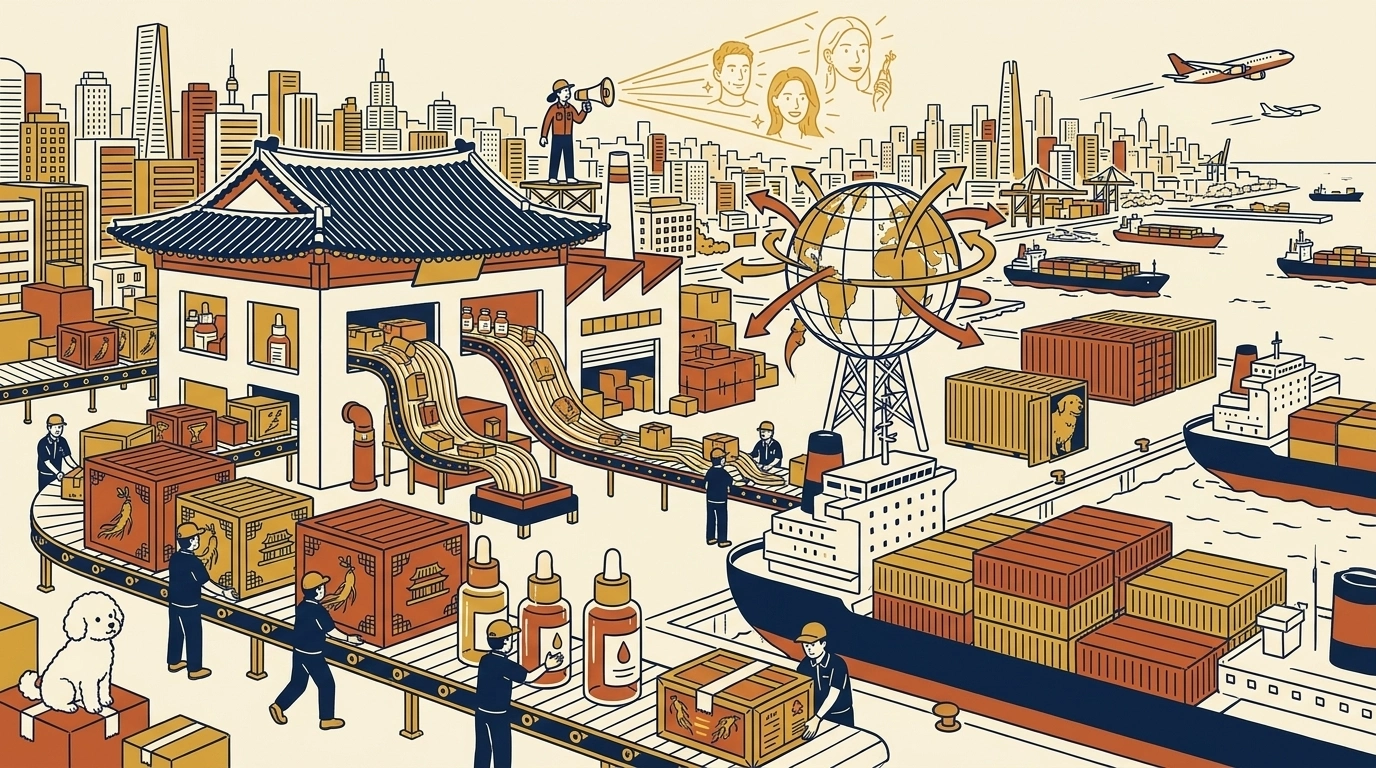
The sales of K-Secret, which were 2.34 billion won in 2023, jumped to 8.13 billion won in 2024 and 42.6 billion won in 2025. It increased 18.2 times in just two years. Last year's operating profit was 10.22 billion won, and net profit was 8.42 billion won. The operating profit margin also rose from 3.9% to 24%.
The turning point in performance coincides with the launch of the 'SEOUL 1988' product line. As retinal serum began to sell overseas, they expanded influencer marketing and broadened their sales channels beyond Amazon to large offline retailers.
'SEOUL 1988' Gaining Traction Overseas First
K-Secret, led by CEO Jung Gu-yoon, is a company engaged in cosmetics manufacturing, distribution, and e-commerce. The corporation was established in 2020 and has about 60 employees. The company introduces the brand launch point as 2019. Its flagship product, 'SEOUL 1988', was launched in January 2024. The representative product is a serum containing 2% retinal liposome and 58% black ginseng extract. Since then, it has expanded its product line to include eye creams, essences, creams, cleansing products, and sunscreens.
The reason for including 'SEOUL' in the product name is clear. It is to let overseas consumers recognize that it is a Korean cosmetic product just by looking at the name. The company explains that while '1988' does not mean the Seoul Olympics itself, it symbolizes the period when Seoul began to become globally known. K-Secret did not directly manage Amazon sales from the beginning. As products distributed through resellers climbed the sales rankings without any particular large-scale advertising, the company expanded its Amazon operating regions to the US and Europe. As of August 2026, the US Amazon shows the representative retinal serum as a product that has sold more than 3,000 units in the past month. The company stated that this product was also selected for Amazon's Choice.
Advertising Expenses Increased 10-Fold After Confirming Response
Once product responses emerged, K-Secret accelerated its marketing. Advertising and promotional expenses increased 10.5 times from 640 million won in 2024 to 6.76 billion won last year. The proportion of advertising expenses in sales also rose from 7.9% to 15.9%. Out of the 10.09 billion won increase in selling and administrative expenses last year, 6.12 billion won was for advertising and promotional expenses. Over 60% of the increase was spent on advertising.
At the center are influencers. K-Secret directly seeks out influencers on TikTok, Instagram, and YouTube to convey product ingredients and brand stories. The company's recruitment materials state that it has collaborated with more than 3,000 influencers worldwide so far. It is not an approach of unconditionally joining hands just because someone has many followers. The company explains that it first looks at whether they can weave the stories of retinal, black ginseng, and 'SEOUL 1988' into content. The strategy is to accumulate user reviews from overseas influencers and consumer reviews, linking them to Amazon purchases. It was not disclosed which advertisements generated how much sales. However, in the year when an additional 6.12 billion won was spent on advertising, sales increased by 34.47 billion won. During the same period, exports and Amazon sales also grew together. It is clear that marketing and sales growth moved in the same direction.
Even so, it is hard to attribute last year's growth entirely to word-of-mouth. Out of every 100 won in sales, about 16 won was spent on advertising. It is closer to growing the sales volume by focusing advertising spending on the product response that appeared overseas first.
Cost Ratio Created the 10.2 Billion Won Profit
Despite advertising expenses increasing more than 10-fold, K-Secret generated an operating profit of 10.22 billion won last year. The decisive factor in increasing profits was the cost ratio. In 2024, when selling 100 won worth of products, about 72 won went to costs. Last year, this ratio dropped to about 48 won. Accordingly, the gross profit margin rose from 27.9% to 52.3%.
On the other hand, the ratio of SG&A expenses, which includes advertising and labor costs, increased from 24% to 28.3%. SG&A expenses lowered the profit margin, but the drop in the cost ratio more than offset that burden. This is why the operating profit margin rose by 20.1 percentage points. It is possible that the unit manufacturing cost decreased as production volume increased, or that the proportion of high-margin products and sales channels grew. The method of transaction with overseas subsidiaries or distribution companies may also have changed. The exact reason can only be known if the cost per product and distribution channels are disclosed.
Therefore, the number to look at first in this year's performance is the gross profit margin rather than advertising expenses. Even if sales continue to increase, if the 52.3% recorded last year is not maintained, the growth rate of operating profit could slow down.
Financial Statement Exports at 22.2 Billion Won, Company Announcement at $20 Million
Last year's export sales were 22.25 billion won, a 3.3-fold increase from 6.69 billion won the previous year. This accounts for 52.2% of total sales. A slightly different number appears in the company's materials. K-Secret introduces that it achieved $20 million in exports by entering 40 countries, including North America and the Commonwealth of Independent States (CIS), in 2025. Applying an exchange rate of 1,400 won per dollar equates to about 28 billion won, which is about 5.7 billion won more than the export sales on the financial statements.
The company also stated that its 2025 sales, including those of its overseas subsidiaries, exceeded 50 billion won. One cannot simply add the overseas subsidiary sales to the domestic corporate sales of 42.6 billion won. This is because if the domestic corporation supplied products to the overseas subsidiary, the same sales could be recorded once on both sides. It has also not been confirmed whether the $20 million in exports is based on customs clearance performance or includes sales from overseas subsidiaries.
Half of Total Assets is Inventory
As sales surged, products were also secured in large quantities. Inventory assets increased from about 6 million won at the end of 2024 to 6.52 billion won at the end of last year. This is 48.7% of total assets worth 13.39 billion won. Products purchased last year are estimated at about 26.86 billion won. Of this, 20.34 billion won of sold products were reflected as costs, and the remaining 6.52 billion won was recorded as inventory. Based on last year's cost of goods sold, this amounts to about four months' worth of volume.
If sales continue to grow, the previously secured inventory will turn into this year's sales. Conversely, if the pace of sales slows down, there will be a burden of discounting or disposal. In this case, the significantly heightened gross profit margin from last year could also drop again. Cash and cash equivalents increased from 100 million won to 4.21 billion won. Short-term borrowings stand at 270 million won, which is less than the cash on hand. Total equity also increased from 310 million won to 8.73 billion won.
There were no changes in capital stock and capital surplus. Last year's net profit of 8.42 billion won was entirely accumulated in retained earnings. There are no traces of increasing capital through external capital increases or paying out profits as dividends. Liabilities amount to 4.66 billion won. Among these, unpaid corporate taxes are 2.04 billion won, and accrued expenses are 1.47 billion won. Last year, net income before corporate tax was 10.33 billion won, and corporate tax expense was 1.91 billion won, resulting in an effective corporate tax rate of 18.5%.
Will Online Success Continue Offline?
K-Secret is expanding its sales channels offline starting this year. Costco in the US is selling the representative retinal serum as a two-pack bundle. The company stated that entry into Ulta in the US has also been confirmed. In Europe, it has expanded its distribution network to Rossmann, DM, and Douglas, and to Boots in the Middle East. Domestically, it is selling eye cream in some offline Olive Young stores. These sales channels increased significantly after last year's settlement of accounts. While not a factor explaining the 2025 performance, it is an indicator to judge this year's growth trend.
K-Secret has identified products that generated a response overseas and boldly invested advertising expenses to grow sales. Now, it must sell the 6.52 billion won worth of inventory piled up last year at full price and expand the popularity of 'SEOUL 1988' to other products. Whether the success that started on Amazon and social media will lead to repeat orders at offline stores such as Costco and Ulta is expected to determine their next performance.
Company financial data, investment reports, and startup analysis — all in one place
Explore PitchdeckCurated news, every week — straight to your inbox
Every Friday · Unsubscribe anytime