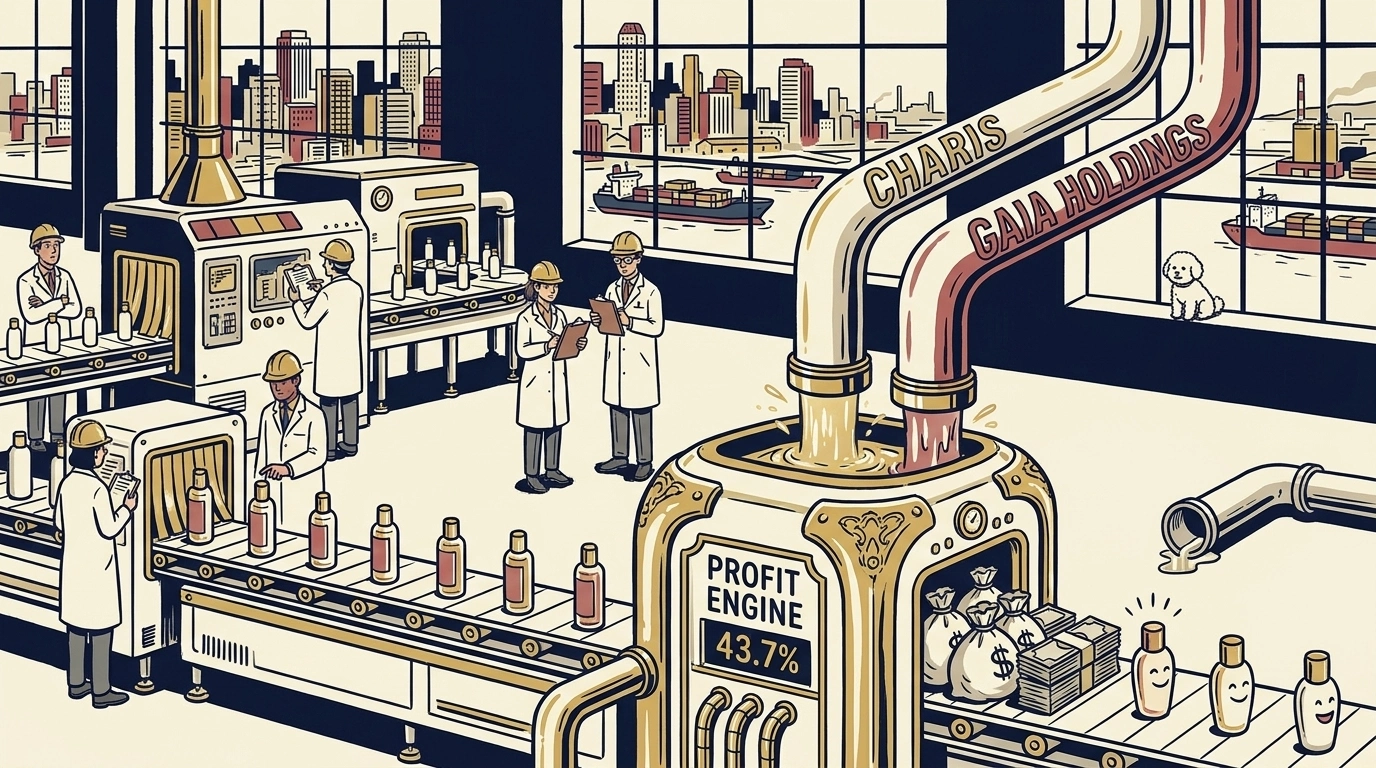
A cosmetics manufacturer whose name is unfamiliar to consumers generated nearly 50 billion won in operating profit last year. It is Hansol Life Science, a cosmetics OEM/ODM company with its headquarters and factory in Seongnam. Hansol Life Science's 2025 revenue was 111.31 billion won, a 91.9% increase from 58 billion won the previous year. Operating profit jumped 148.3% from 19.58 billion won to 48.63 billion won, and net income also increased from 17.05 billion won to 38.9 billion won.
The operating profit margin rose from 33.8% to 43.7%. This means that out of every 100 won in revenue, about 44 won remained as operating profit. Although simple comparisons are limited due to differences in consolidated, separate, and accounting standards, this is exceptionally high considering that the operating profit margins of listed cosmetics ODM companies such as Cosmax and Kolmar Korea are generally 8 to 13%. It also significantly exceeds the 23.9% operating profit margin of brand company APR last year.
Last year, domestic cosmetics exports reached a record high of 11.4 billion dollars, up 12.3% from the previous year. As overseas sales of K-beauty brands increase, OEM and ODM companies that develop and produce the products are growing together.
Revenue Doubled, SG&A Expenses Increased by 8%
The background to Hansol Life Science's operating profit margin rising by nearly 10 percentage points can be seen in its cost structure. The gross profit margin increased by 2.7 percentage points from 50.4% in 2024 to 53.1% last year. In contrast, the proportion of selling, general and administrative (SG&A) expenses to revenue dropped by 7.3 percentage points from 16.7% to 9.4%. Most of the 9.9 percentage point increase in the operating profit margin resulted from the effect of a reduced SG&A burden.
While revenue increased by 91.9%, SG&A expenses only rose 8.2% from 9.66 billion won to 10.46 billion won. Salaries processed as SG&A expenses were similar, going from 4.33 billion won to 4.32 billion won. Total salaries, combining manufacturing and research and development sectors, increased by 11.5% from 7.11 billion won to 7.93 billion won. The pace of cost increases, including personnel, fell significantly short of the revenue growth rate.
Therefore, it is difficult to see last year's profitability improvement as the result of a sudden, significant drop in manufacturing costs. The impact of a lowered fixed cost burden as production volume increased using existing personnel and equipment was much greater.
Disclosed Affiliate Revenue Alone Reached 101.6 Billion Won
However, it is difficult to view Hansol Life Science's performance simply as a general case of cosmetics ODM growth. This is because most of its revenue was generated from affiliates. Major related-party revenue disclosed in the audit report is 39.44 billion won from Charis and 62.19 billion won from Gaia Holdings. Revenue from these two companies alone amounts to 101.63 billion won, accounting for 91.3% of total revenue.
The audit report limits this table to 'significant business transactions.' Revenue from other affiliates, such as KOS International, which has 1.16 billion won in trade receivables, was not separately listed. The actual proportion of affiliate revenue is likely higher than 91.3%.
Calculating based only on the two disclosed companies, affiliate revenue increased by 54.85 billion won, from 46.78 billion won in 2024 to 101.63 billion won last year. During the same period, the company's total revenue increase was 53.31 billion won. Revenue excluding affiliates, calculated inversely, actually decreased from 11.22 billion won to 9.68 billion won.
A similar structure is evident in trade receivables. Out of 13.77 billion won in trade receivables at the end of last year, receivables from affiliates such as Charis, Gaia Holdings, and KOS International accounted for 12.33 billion won, or 89.5%. This means that the affiliate distribution network is dictating Hansol Life Science's production volume and performance.
Largest Client is Gaia Holdings, Charis is a Multi-Level Marketing Company
The audit report classifies Charis as a company with the 'same largest shareholder' as Hansol Life Science. Charis is a multi-level marketing company that operates the cosmetics brand Renecell. It is registered as a multi-level marketing business with the Fair Trade Commission (FTC), and its FTC-tallied 2025 revenue was 86.83 billion won, ranking 10th among all such companies. Unlike general retail distribution, multi-level marketing has a structure where sponsorship allowances paid to salespersons are included in the product price and distribution margin. The fact that Charis operates such a sales network is a point to consider when examining Hansol Life Science's high manufacturing margins.
However, it cannot be concluded that the multi-level marketing structure directly created Hansol Life Science's 43.7% operating profit margin. This is because the product supply price between affiliates, the salesperson allowance borne by Charis, and the final consumer retail price have not been disclosed. How profits were distributed between the manufacturer and the distributor requires further verification.
An even larger client is Gaia Holdings. While 55.9% of Hansol Life Science's revenue came from this company, its specific business details and final sales regions have not been confirmed. At the end of 2024, Gaia Holdings' trade receivables stood at 7.22 billion won, and at the same time, Hansol Life Science's USD-denominated trade receivables were 7.23 billion won.
Finished Goods Inventory Up 12 Times... Valuation Losses Also Occurred
Along with the expansion in production, inventory also increased rapidly. At the end of last year, inventory assets stood at 11.34 billion won, a 3.2-fold increase from 3.52 billion won the previous year. Among this, finished goods accounted for 87% of the total inventory at 9.89 billion won. Compared to the previous year's finished goods inventory of 840 million won, it has swelled by about 12 times in just one year. Finished goods inventory is equivalent to about 69 days' worth based on last year's cost of sales. These may be volumes produced in advance in anticipation of expanded affiliate sales, but if the sales pace of the distribution network is slower than expected, it could lead to discounts or additional valuation losses. The inventory risk has partially materialized. The company recognized 228 million won in inventory valuation losses last year. The accumulated valuation allowance is 390 million won. Although it is not yet significant compared to the total inventory, given that the finished goods inventory has increased substantially over a short period, it is necessary to monitor the pace of depletion going forward.
The company is also proceeding with a factory expansion. The audit report lists a deposit guarantee of 630 million won related to the licensing of the Seongnam factory expansion. Land, buildings, and machinery have been acquired, and construction-in-progress assets have also increased. This can be seen as an effort to increase production capacity under the judgment that the expansion of affiliate orders will continue.
40.8 Billion Won in Cash... 17 Billion Won in Interim Dividends Since 2022
The financial condition is stable. Cash generated from operating activities was 36.68 billion won, and cash and cash equivalents increased to 40.82 billion won. Total assets stand at 93.51 billion won, and total equity is 80.97 billion won. There are no borrowings, and the debt-to-equity ratio remains at just 15.5%.
Dividends also continued. The interim dividends resolved by Hansol Life Science from 2022 to last year total 17 billion won. The dividend paid in cash last year was 9.23 billion won, consisting of a 2025 interim dividend of 5 billion won and unpaid dividends at the end of the previous term of 4.23 billion won. According to the audit report, Lee Jin-ki is the largest shareholder holding a 50% stake. Former CEO Shin Hyung-seok holds 27.5%, CEO Kim Young-rae, who was appointed this February, holds 20.5%, and other shareholders hold 2%.
Calculated according to stake ownership, out of the 5 billion won interim dividend resolved last year, the share of the largest shareholder Lee Jin-ki is 2.5 billion won before taxes. Former CEO Shin Hyung-seok receives 1.375 billion won, CEO Kim Young-rae 1.025 billion won, and other shareholders 100 million won. Simply calculating the 9.23 billion won cash payout, which includes the unpaid portion from the previous term, using the same ownership ratios, yields 4.615 billion won, 2.538 billion won, 1.892 billion won, and 185 million won, respectively.
Hansol Life Science is an example of an unheralded manufacturer generating profits on par with brand companies amidst the K-beauty boom. At the same time, rather than being an ODM company that evenly grew its independent clientele, it is closer to a company that grew alongside a specific affiliate's distribution network.
When judging future performance, it is highly likely that the sales of Charis and Gaia Holdings will be more crucial variables than the overall K-beauty market. The exact role of Gaia Holdings, transaction prices between affiliates, and the pace of depleting the significantly increased finished goods inventory must be verified before last year's 43.7% operating profit margin can be viewed as the new standard.
Company financial data, investment reports, and startup analysis — all in one place
Explore PitchdeckCurated news, every week — straight to your inbox
Every Friday · Unsubscribe anytime