![[Price Tag of Content: Music] "Bought at 17,000 won, sold at 5,000 won"… Conclusion of NHN's 11-Year Investment in Bugs](https://d1gl51xbrxoj65.cloudfront.net/uploads/2026/01/16/1768538720992-yphf4d.webp)
NHN Ends 11-Year Journey with Sale of Bugs... Simple Return at -70%
Averaged Down After Aggressive Acquisition in 2015, But... Real Loss Estimated at 120 Billion Won Including Opportunity Cost
New Owner is Aerospace Parts Maker NDT Engineering... Concerns over 'Backdoor Listing and Financial Money Games'
NHN has put an end to its 11-year journey with its music platform subsidiary, NHN Bugs. On the surface, it cited 'reorganization of non-core businesses' and 'securing new growth engines', but examining the data beneath reveals it as a sale bearing a massive loss.
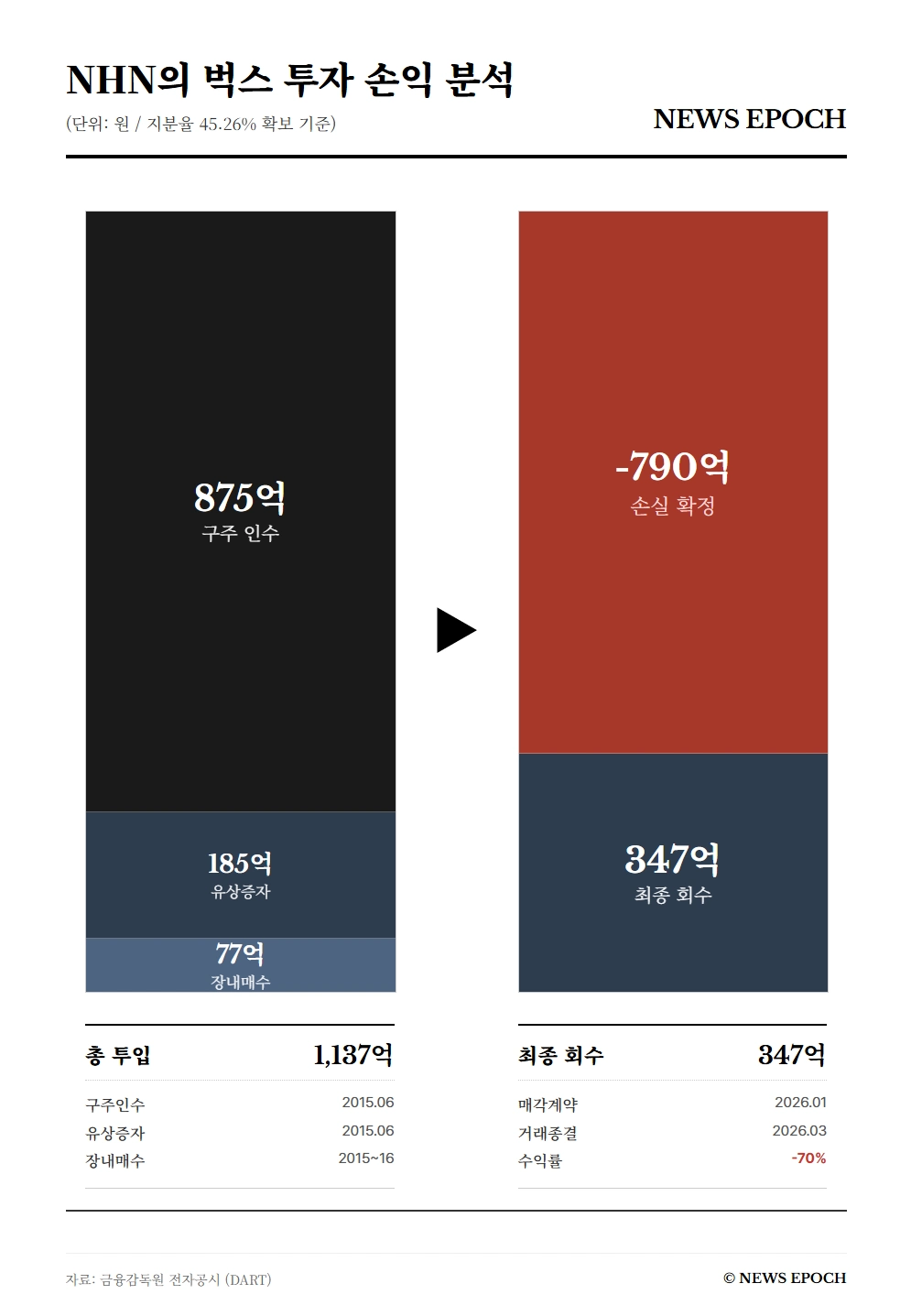
On the 15th, NHN announced that it will sell its entire 45.26% stake (6,711,020 shares) in NHN Bugs to NDT Engineering and three others for 34.7 billion won. The selling price per share is 5,170 won.
The market interprets this sale as an inevitable choice for NHN to secure financial soundness. However, a reverse calculation of NHN's investment details from the time of acquisition in 2015 based on data shows a high likelihood that this transaction will be recorded as an exit strategy that cost a substantial amount, beyond a simple business reorganization.
Crunching the Numbers... A Scorecard of 'Minus 70%'
In June 2015, NHN (then NHN Entertainment) became the largest shareholder of Bugs by acquiring old shares from Neowiz Holdings and participating in a third-party allotment capital increase. It is estimated that they subsequently lowered their average purchase price to the 16,900 won range by conducting on-market purchases to defend their management rights during a period of stock price decline. Nevertheless, there remains a massive gap with the current selling price of 5,170 won.
Even by simple calculation, a loss of about 11,700 won per share is incurred, which corresponds to about -70% in terms of return on investment. Comparing the total sale proceeds (34.7 billion won) with the past invested principal (about 113.7 billion won), NHN has effectively confirmed a book loss of about 79 billion won through this transaction.
A further issue is the opportunity cost incurred by having funds tied up for a long time. Simply converting this by assuming a conservative compound annual return of 3%, the stock price corresponding to the break-even point (BEP) for NHN exceeds 23,000 won. Applying this standard, it can be interpreted that the actual economic loss from this sale approaches 120 billion won.
Why Now? The Wave of Foreign Platforms and the 'TiMef' Butterfly Effect
The background behind NHN having to shake off Bugs while bearing such a massive loss lies in the intersection of a structural defeat in the music market and an internal financial crisis within the group.
As the landscape of the music market shifted from 'paid subscriptions' to a YouTube-based 'combination of video and music', the ground for Bugs to stand on rapidly narrowed. In particular, domestic platforms like Bugs carry a rigid high-cost structure where they must pay about 65% of their revenue as copyright fees according to the Ministry of Culture, Sports and Tourism's collection regulations. The more they sell, the margin the platform takes is only 35%, making it difficult to secure profitability.
In fact, according to major data from sources like Mobile Index, while YouTube Music has solidified its number one position in Korea (exceeding a 40% market share) by overtaking Melon, Bugs has been completely pushed out of the top 5, losing its presence. Its market share has shrunk to the 1% range (estimated for 2025), and the platform, whose 'economy of scale' collapsed due to a sharp drop in monthly active users (MAU), is no longer a cash cow for the group but has changed into a structure that solely generates fixed cost burdens every year.
In a situation where competition is intensifying and margins are slim, the wave of offensives from foreign platforms represented by YouTube Music's 'free offensive' and Spotify's 'unrivaled curation capabilities' shook Bugs' revenue model to its roots. Ultimately, from NHN's perspective, Bugs became a 'high-cost, low-efficiency' asset akin to pouring water into a bottomless pitcher, unable to guarantee future growth any longer.
The decisive blow was the 'TiMef (Tmon-WeMakePrice) crisis' that occurred last year. As the core affiliate NHN Payco took on a massive 100 billion won scale of unrecovered receivables, expanding losses across the group, securing cash liquidity emerged as the top priority at the group level. Consequently, the sale of Bugs is interpreted as an 'exceptional measure' at the group level to "sell all assets that can be cashed immediately, no matter the loss."
Main Business in Deficit, Assets Sold... Background of NDT's Acquisition of Bugs
NDT Engineering, the prospective new owner, is a company that manufactures aircraft parts and non-destructive testing equipment, having almost no business connection to a music platform. Nevertheless, the reason the market interprets this acquisition as a financial transaction rather than a simple cross-industry combination lies in NDT's financial structure.
NDT recorded an operating deficit in its main business in 2024, but boosted its net income with a disposal gain of about 15.8 billion won secured by selling all of its core asset, land. In essence, it defended its performance through asset securitization rather than by improving profitability in its main business.
The notable point is that the cash secured in this way was intensively injected into acquiring Bugs rather than expanding the main business. According to the disclosed contract, the number of shares NDT is acquiring is 2,069,401 shares (13.96%), and the acquisition cost is about 10.7 billion won, an amount where most of the available cash secured through the asset sale is being utilized.
However, NDT opted for a consortium approach instead of a sole acquisition. Out of the total 45.26% acquired stake, NDT's stake is only 13.96%, with the remaining 31.3% being divided among the 'Green Harbor & Bugs Investment Partnerships No. 1~3'. This low stake for the largest shareholder is the background against which concerns about future management stability are raised.
Evaluations in the market also suggest that this ownership structure is similar to the form observed in acquisitions for financial investment purposes. In particular, as it includes investment partnerships that are not specially related to NDT, it is pointed out that the possibility of massive stock dumping cannot be ruled out if moves to realize profits emerge during future stock price fluctuation phases.
Employee Reduction and Deficit Expansion... The Current State of Bugs
The management situation of the acquired company, NHN Bugs, is not easy either. This is because both the workforce and growth engines, which are the core assets of an IT platform company, appear to have shrunk simultaneously. Looking at the employment status, the number of employees at Bugs, which reached about 150 in early 2023, decreased to the level of 60 as of November 2025. With more than 60% of the workforce departing in just over two years, the capacity for service advancement and new investments has also been significantly contracted.
Performance is also showing a clear downward trend. Bugs' revenue decreased from 65.8 billion won in 2022 to 52.0 billion won in 2024, and during the same period, net income swung from a surplus of 2.5 billion won to a deficit of 12.6 billion won. This is interpreted as the result of the weakened economy of scale following the decline in users acting as a burden on overall performance.
However, there is also a noticeable point in the financial structure. Despite recording large deficits, Bugs' cash and cash equivalents stood at about 13.4 billion won at the end of 2024, a significant increase compared to the previous year (7.4 billion won). This is understood to be the effect of past asset sales and the accumulation of internal reserves. From the perspective of the acquirer, NDT, it is also mentioned that such cash assets held by Bugs may act as a factor partially buffering the initial burden of acquisition funding.
The 11-Year Journey Comes to an End, and the Steps That Follow
For NHN, this sale was a process of settling past strategic judgments and an exit strategy accompanied by substantial costs. For Bugs, it became a starting point where uncertainty about its future management direction has increased while welcoming a new owner.
Expectations for business synergy are limited given that a manufacturing company with no experience in the entertainment industry has stepped up as the largest shareholder. Some in the market are discussing the possibility of a backdoor listing utilizing Bugs or a financial exit scenario. In particular, there are observations that they might embark on a recovery after reevaluating the corporate value in the short term by combining an aerospace theme using the music platform as a medium. The fact that the acquisition group includes multiple investment partnerships with private equity characteristics alongside NDT adds weight to this interpretation.
The acquisition of Bugs, which was carried out in the past with the goal of leaping forward as a 'comprehensive content platform', has wrapped up after 11 years, leaving behind tens of billions of won in book losses and exceeding 100 billion won in real economic losses. NHN secured 34.7 billion won in liquidity through this sale, but it is evaluated as a desperate measure given that the available alternatives were limited in a situation where financial burdens had accumulated. The market's attention is now focused on how NHN will allocate the secured funds to core businesses such as AI, cloud, and gaming.
Company financial data, investment reports, and startup analysis — all in one place
Explore PitchdeckCurated news, every week — straight to your inbox
Every Friday · Unsubscribe anytime