![[In-Depth] "Bank balance of 8.27 million won"... 'Barrier-Free' Amuse, the wall of reality that good intentions could not handle](https://d1gl51xbrxoj65.cloudfront.net/uploads/2026/01/21/1768986763217-mok7v.webp)
'High-cost structure' that 'good intentions' could not handle, the lonely exit of a 1st generation social venture
Plummeting 1 year after hitting a revenue peak of 1.8 billion won... Recording an operating margin of -60% in 2024
Losses inevitable for investors like Hyundai Dream Tour and Yoonmin Foundation... Decision for 'simplified bankruptcy'
Launched in 2016 under the banner of 'travel for the disabled and the elderly,' Amuse (Amuse Inc.) has gone bankrupt 9 years after its establishment. Advocating as Korea's first 'Barrier-free' travel agency, it received market attention, but ultimately failed to overcome the limitations of a business structure without guaranteed profitability and was declared bankrupt by the court.
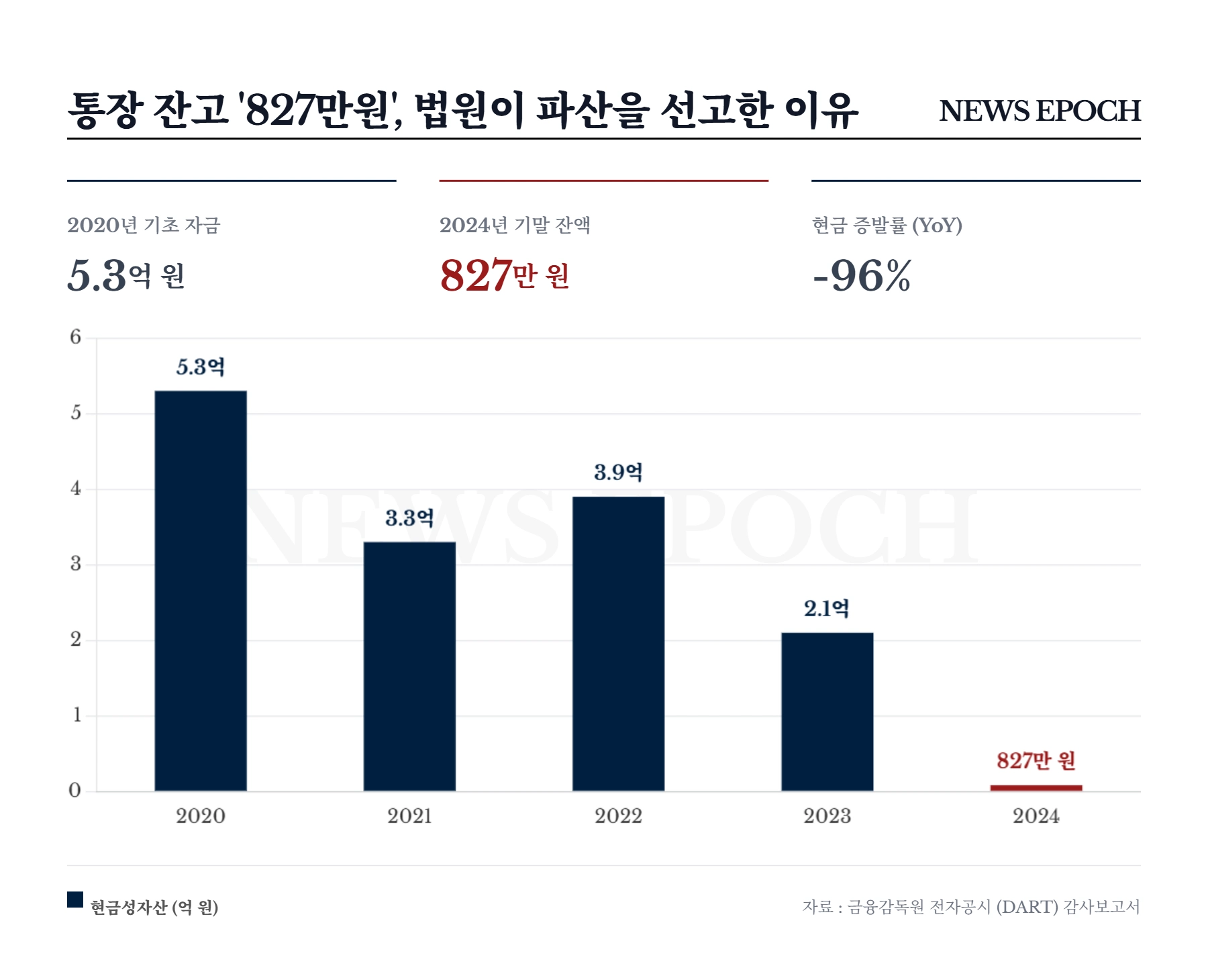
On January 16, the 18th Division of the Seoul Bankruptcy Court (Presiding Judge Yang Min-ho) declared bankruptcy for Amuse and decided the case as a 'simplified bankruptcy.' Simplified bankruptcy is a procedure that takes place when a debtor's total assets are less than 500 million won, meaning the company's remaining assets are virtually exhausted. Indeed, a financial statement analysis revealed that as of the end of 2024, the cash and cash equivalents held by Amuse were a mere 8.27 million won. The cash reserves, which amounted to 520 million won in 2020, had evaporated by more than 98% in just four years.
Confident of "3 billion won revenue target"... Outward growth only increased the deficit
Amuse was the only domestic travel agency to acquire 'B-Corp', a global eco-friendly and social enterprise certification, and won the Minister of SMEs and Startups Award (2018), having its social value recognized. In an interview with a startup specialty magazine in September 2023, CEO Oh Seo-yeon expressed her ambition, saying, "We will achieve 3 billion won in revenue and lead the growth in scale."
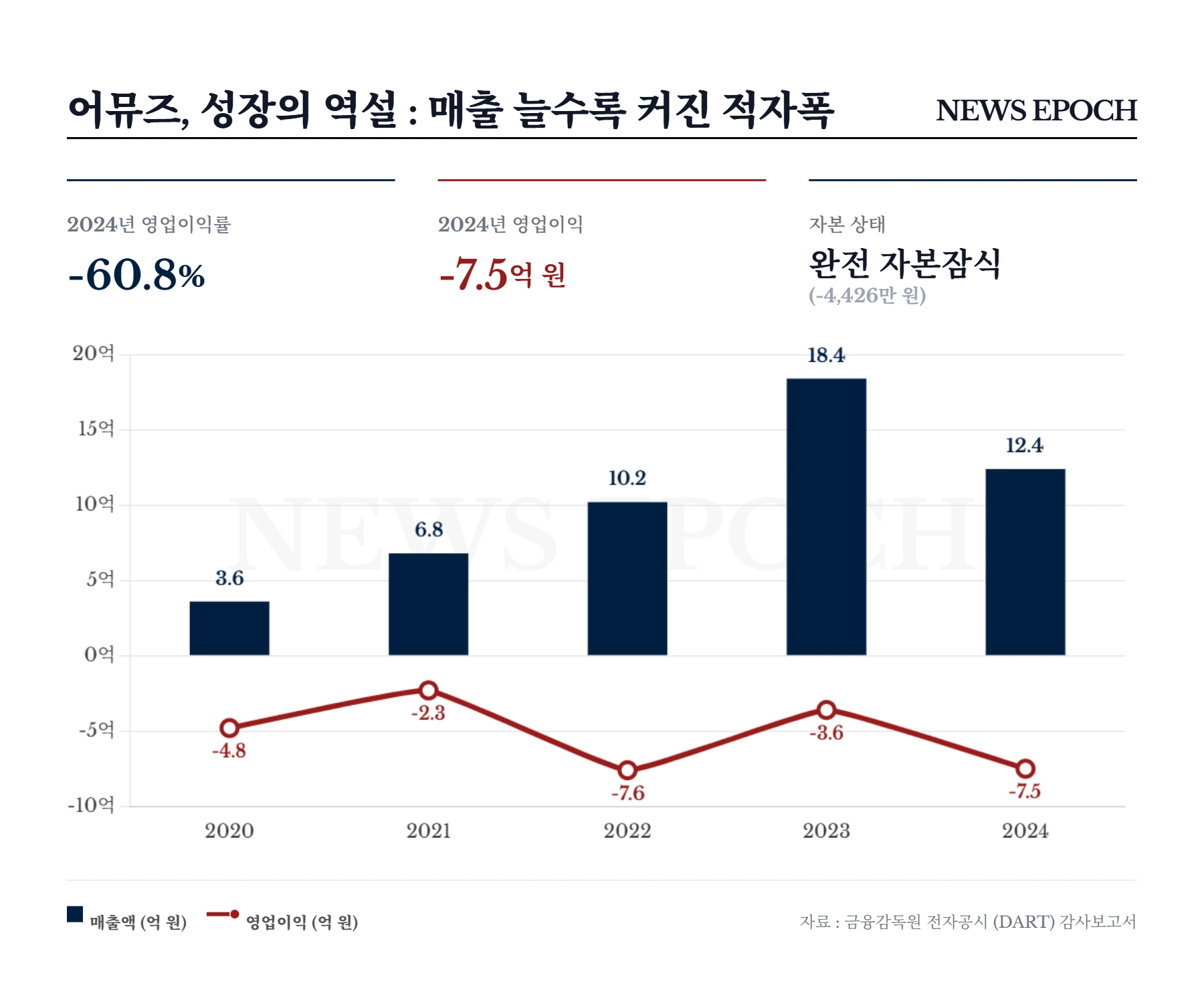
However, the actual financial scorecard was far from the target. In 2023, Amuse recorded revenue of 1.84 billion won, an 80% growth compared to the previous year, but an operating loss of 360 million won occurred as selling and administrative expenses (SG&A) amounting to 2.2 billion won were injected to achieve this.
The net income of 53 million won recorded at the time is also difficult to see as an improvement in the profitability of the main business. This is because non-operating income of about 440 million won was generated on the financial statements, creating a structure that offset the operating loss. The fact that the proportion of labor and fixed costs increased, such as the number of employees growing to a maximum of 17 during this period, is also analyzed as a factor that aggravated the financial burden.
The swamp of structural deficit where selling more leads to losses
Amuse's management crisis stemmed from an internal 'high-cost, low-efficiency structure' rather than external shocks. The situation worsened further in 2024. In the aftermath of cuts in public budgets, revenue plummeted to 1.239 billion won, but the cost structure did not improve.
In particular, the phenomenon of concentration on major revenue sources aggravated management instability. Looking at Amuse's revenue breakdown as of 2023, its dependence on public and non-profit institutions, such as the Korea Tourism Organization (29.13%), public interest corporation GKL Social Contribution Foundation (24.65%), and Seoul Metropolitan Government (14.44%), reached about 70%.
Such a business structure centered on public services (B2G) has the limitation of high revenue volatility depending on budget allocations and low margin rates. It was insufficient to cover the high fixed costs of 'care travel,' which requires specialized vehicles and professional support personnel. As a result, the deficit in 2024 more than doubled compared to the previous year to 754 million won, and the operating margin against revenue recorded -60.8%. An unsustainable profit structure where 60 million won of debt accumulates every time 100 million won worth of products are sold had become entrenched.
Total capital impairment... Investor recovery uncertain
Continuous operating losses rapidly depleted the company's liquidity. Annual cash flow indicators clearly show the severity of the financial crisis the company went through. Cash and cash equivalents, which were 526 million won at the end of 2020, plummeted every year, leaving only 8.27 million won right before bankruptcy. It was at a level where it could not even cover the office rent, let alone the salaries of 4 employees.
The company had already exhausted all of its capital stock (117.32 million won) and fallen into a state of 'complete capital impairment' with total equity of -44.26 million won. Accordingly, the recovery of investments by CEO Oh Seo-yeon (85.23%) and early investors such as Hyundai Dream Tour(5.84%), Yoonmin Creative Investment Foundation(5.69%) has become virtually impossible
Amuse's bankruptcy declaration throws a heavy topic on 'sustainability' to the social venture industry. The social value of returning the right to travel to marginalized groups in tourism, such as the disabled and the elderly, was clear, but it reaffirmed the harsh reality that a company cannot survive if a business model to support this is absent. Amuse's challenge, which has pioneered the 'Barrier-free' market for 9 years, ultimately came to a halt before the limitations of capital to sustain its ideals in reality.
Company financial data, investment reports, and startup analysis — all in one place
Explore PitchdeckCurated news, every week — straight to your inbox
Every Friday · Unsubscribe anytime