![[Exclusive] 'Maseong Tteokbokki' Receives Court's Comprehensive Ban Order... Caught in a 'Growth Trap'?](https://d1gl51xbrxoj65.cloudfront.net/uploads/2026/01/27/1769524147874-mou9p.webp)
The snack franchise enterprise 'Maseong Co., Ltd. (brand name Maseong Tteokbokki)', which had been showing a steep growth trend through a strategy of entering special commercial districts such as subway stations and large hypermarkets, has eventually come to undergo the court's restructuring procedures. Although it succeeded in external expansion by achieving annual sales of 9.4 billion KRW as of 2024, it has faced a typical 'Black-ink Bankruptcy' crisis where cash in the company's treasury has dried up.
The Seoul Bankruptcy Court decided and publicly announced a comprehensive ban order against Maseong Co., Ltd. on January 23. This is a measure taken as the company applied to the court for the initiation of corporate rehabilitation procedures, which means freezing the company's assets so that creditors cannot carry out compulsory executions, such as provisional seizures or handing them over to auctions, until the court makes a formal decision to initiate the procedures. It is interpreted that the court set up such a defensive shield to prevent the loss of assets essential for corporate operation due to reckless collections by creditors, and to explore the possibility of rehabilitation.
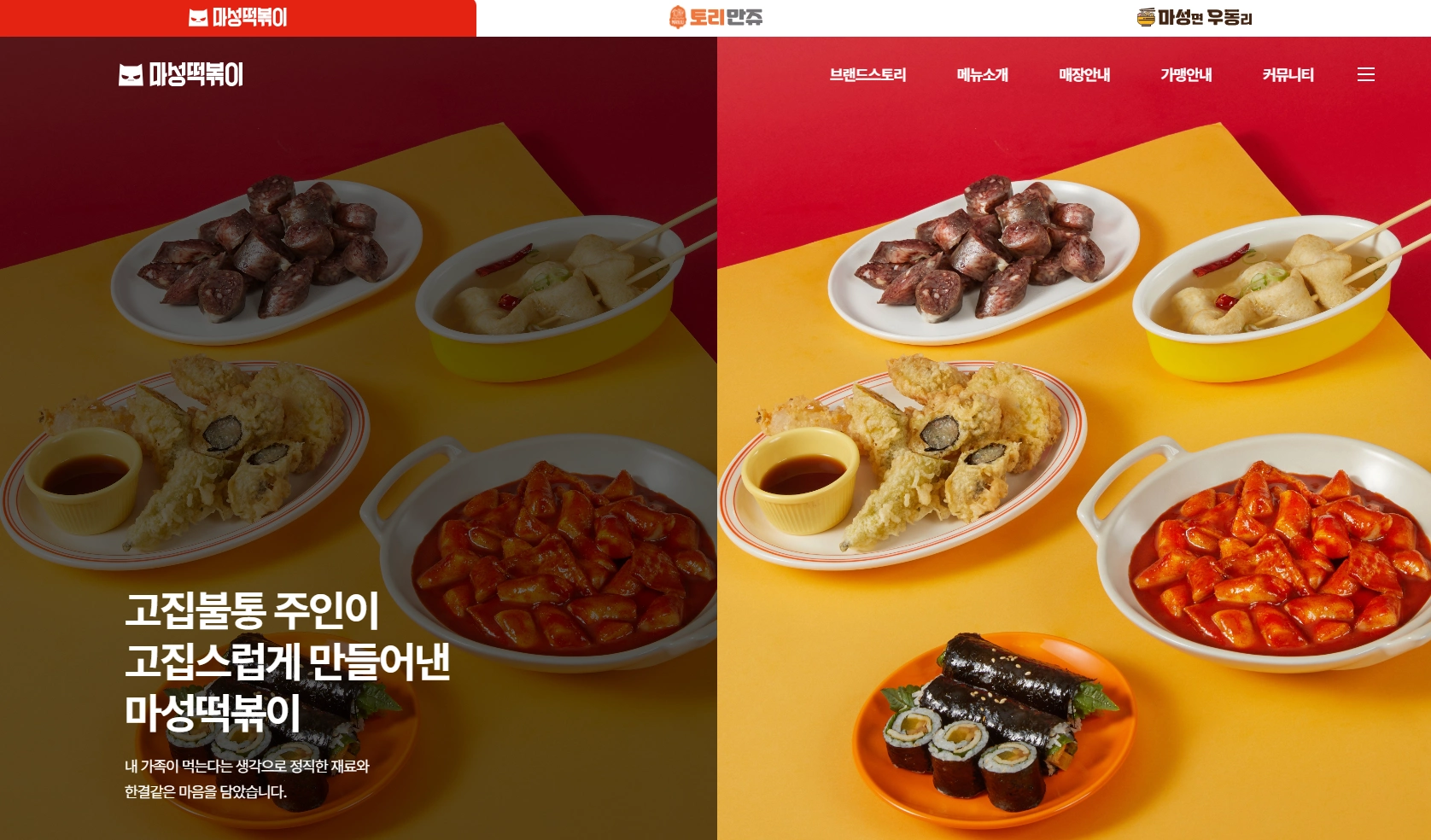
(Source: Maseong Tteokbokki Website)
Maseong, Which Targeted the 'Niche Market', Has Its Wings Broken Despite Attracting Investment
Founded in 2015, Maseong is a franchise enterprise that operates brands such as 'Maseong Tteokbokki', 'Tori Manju', and 'Maseongmyeon Udongni'. They have solidified their position with a niche market strategy of intensively targeting special commercial districts with a daily floating population of more than 80,000, such as subway stations, large hypermarkets, department stores, and rest areas, avoiding the already saturated road shop commercial districts.
In 2022, it even heralded a second leap forward by announcing the news that it had attracted a strategic investment of 3 billion KRW from Blue Central, a private equity fund (PEF) management company specializing in consumer goods and contents. However, behind the splendid news of attracting investment and the sales growth graph, a severe liquidity crisis was coiled up.
In-Depth Financial Analysis: Made a Profit but No Money? The 'Growth Trap'
As a result of an in-depth analysis of Maseong's 2024 financial statements and management data, the company was caught in the swamp of a typical 'working capital management failure'.
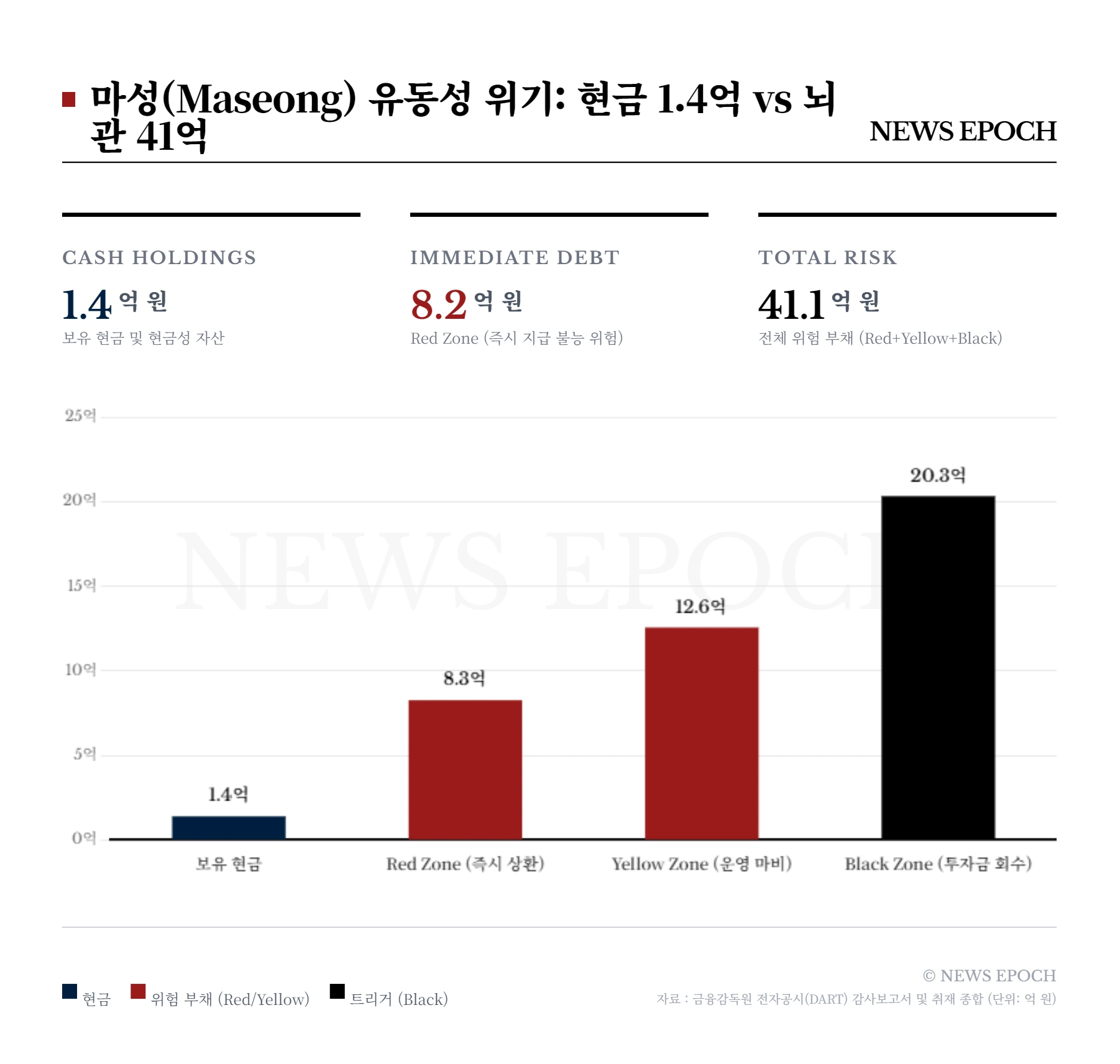
Maseong recorded sales of 9.4 billion KRW in 2024, starting with sales of 1.6 billion KRW in 2021, and generated an operating profit of 340 million KRW on the books. On the surface, it looked like a growing blue-chip company. However, looking closely at the financial statements, the situation was serious. The 'cash and cash equivalents' held by the company was only a mere 140 million KRW. This means that a company with nearly 10 billion KRW in sales has only slightly over 100 million KRW of money available to use right away.
All the money was tied up in inventory and accounts receivable. On the statement of financial position, inventory assets surged to 2.8 billion KRW, and trade receivables that had not yet been collected despite selling goods amounted to 1 billion KRW. In other words, about 3.8 billion KRW in funds had been locked up for operating activities. Normally, when a company grows, trade receivables and inventory increase together, but in the case of Maseong, it was caught in a 'Growth Trap' where the speed of cash collection could not keep up with the speed of expenditure. A vicious cycle structure became entrenched, in which the more goods sold, the more cash became deficient.
External Funds That Became 'Poison'
The external investment funds brought in to overcome the cash shortage also ultimately became poison. Maseong stated that it had attracted an investment of 3 billion KRW, but on the statement of financial position, about 2 billion KRW of this is identified as funds of a debt nature (estimated to be CB) that are obligated to be repaid.
If it were a pure equity investment (Equity), there would be no problem not paying dividends when the company is struggling, but funds of a debt nature (Debt) are different. As financial soundness deteriorated, it is also possible that investors pressured for early repayment based on an 'event of default (EOD)' clause. Even without the event of default clause, funds of a debt nature are money that must be repaid someday, and in the face of 2 billion KRW of such type of funds, the cash reserve of 140 million KRW was useless.
Decisive Trigger: Provisional Seizure Risk Such as Accounts Payable, Guarantee Deposits Received
The most urgent problem is the extreme imbalance between the cash the company holds and the short-term debts it must repay immediately. According to the statement of financial position as of the end of 2024, the 'cash and cash equivalents' held by Maseong is merely about 140 million KRW. On the other hand, deposits received, accrued expenses, and short-term borrowings, whose payment timing is difficult to delay, are identified as amounting to about 826 million KRW.
Besides this, accounts payable and guarantee deposits received, which are classified as current liabilities on Maseong's financial statements, are about 806 million KRW and about 450 million KRW respectively, bringing the total debt in this area to about 1.256 billion KRW.
Accounts payable include various payments incurred during operating activities, such as advertising expenses and service fees, in addition to material costs. If payments to business partners are delayed, there is a high risk that it will lead to a suspension of goods supply or refusal of services, paralyzing the operating activities themselves. In addition, the guarantee deposits received amounting to about 450 million KRW are estimated to be deposits entrusted by franchisees or agency owners, and this is a 'detonator' that could be flooded with lawsuits for return requests or applications for provisional seizure if financial instability of the head office is detected.
Future Outlook: Rehabilitation or Liquidation
With this comprehensive ban order, Maseong will be able to catch its breath for the time being, escaping from the pressure of creditors and the threat of compulsory execution. The court plans to determine whether to initiate rehabilitation procedures by considering whether continuing business to pay off debts is more advantageous to creditors than liquidating the company to distribute its assets (going concern value versus liquidation value).
Company financial data, investment reports, and startup analysis — all in one place
Explore PitchdeckCurated news, every week — straight to your inbox
Every Friday · Unsubscribe anytime