![[K-Beauty Matrix] "Even if nothing is left, we cannot leave CJ Olive Young"... An 'inevitable gateway' for success](https://d1gl51xbrxoj65.cloudfront.net/uploads/2026/01/29/1769677045099-xugdw9.webp)
CJ Olive Young records an operating profit margin of 12.7% in 2024... An unrivaled profit structure that breaks common sense in the retail industry
93.6% of net income returned to shareholders... A financial strategy evolved into a group cash cow instead of reinvestment
The majesty of a 90% market share that wiped out competitors... Brand companies' "expensive but certain" threshold for growth
"Even if we give up half of our revenue, it's a profitable business as long as we can secure a shelf at CJ Olive Young." These grumbling voices from K-beauty brand officials symbolically show where power is concentrated in the current beauty market. CJ Olive Young shattered records with 4.8 trillion won in revenue and 607.6 billion won in operating profit in 2024. While Amuse, covered in Part 1, struggled with a 2.9% operating profit margin, the distributor CJ Olive Young retained 12.7%, more than four times that amount. This profit structure, where brands do the hard work and distributors reap the practical benefits, has now become the industry standard.
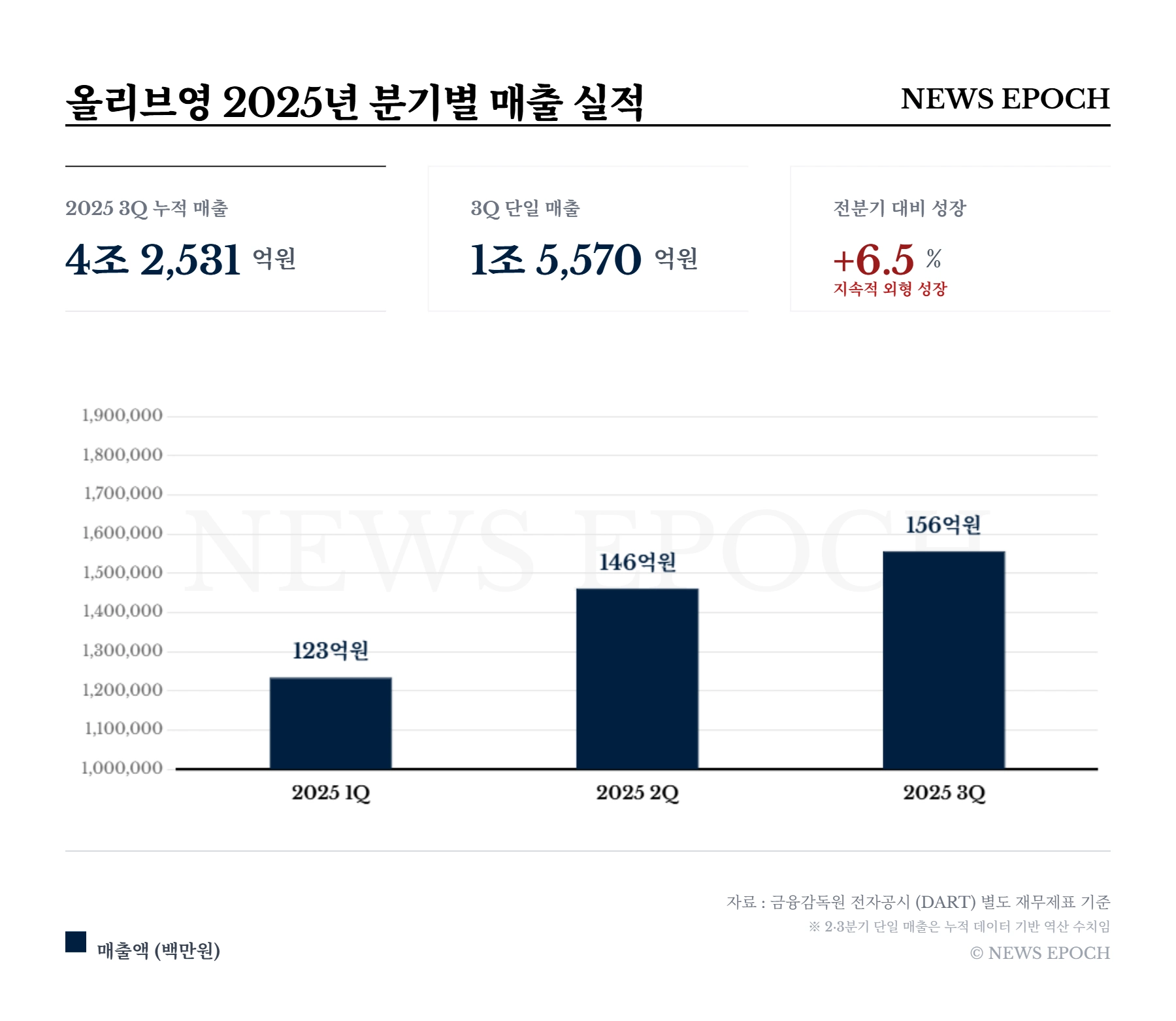
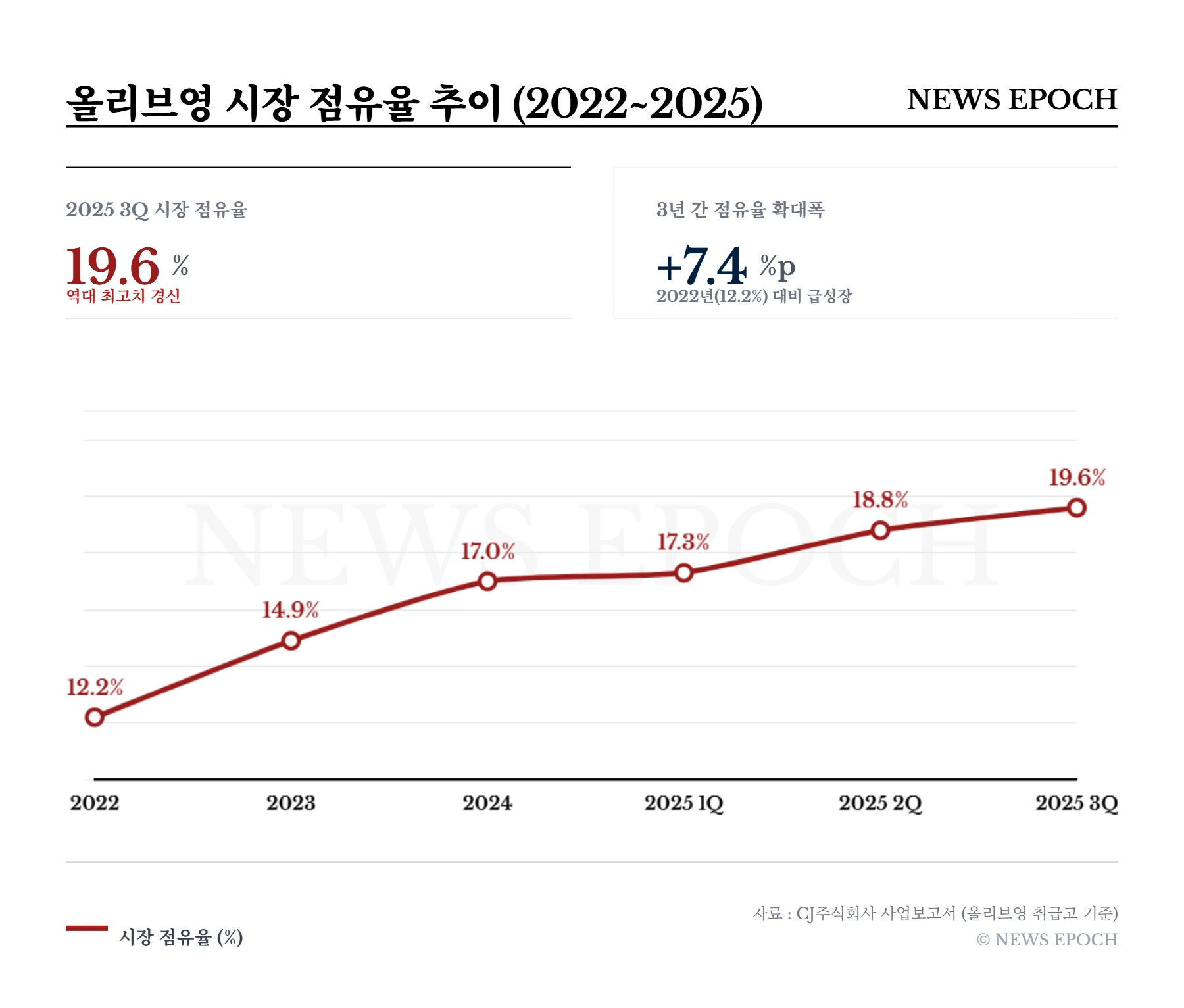
This dominance is becoming even more solidified entering 2025. The beauty market share, which was 12.2% in 2022, soared to 19.6% as of the third quarter of 2025. This means one-fifth of the entire beauty market operates through the single channel of CJ Olive Young. As CJ Olive Young completely takes over the space left by departed former drugstore competitors such as Watsons and LOHBs, the data coldly suggests how this overwhelming dominance encroaches on brand companies' margins and whose pockets the fruits of this labor enter.
An 'overwhelming super gap' of a 12.7% operating profit margin... "E-mart is at 0%, Musinsa is at 10%... A different dimension of profitability"
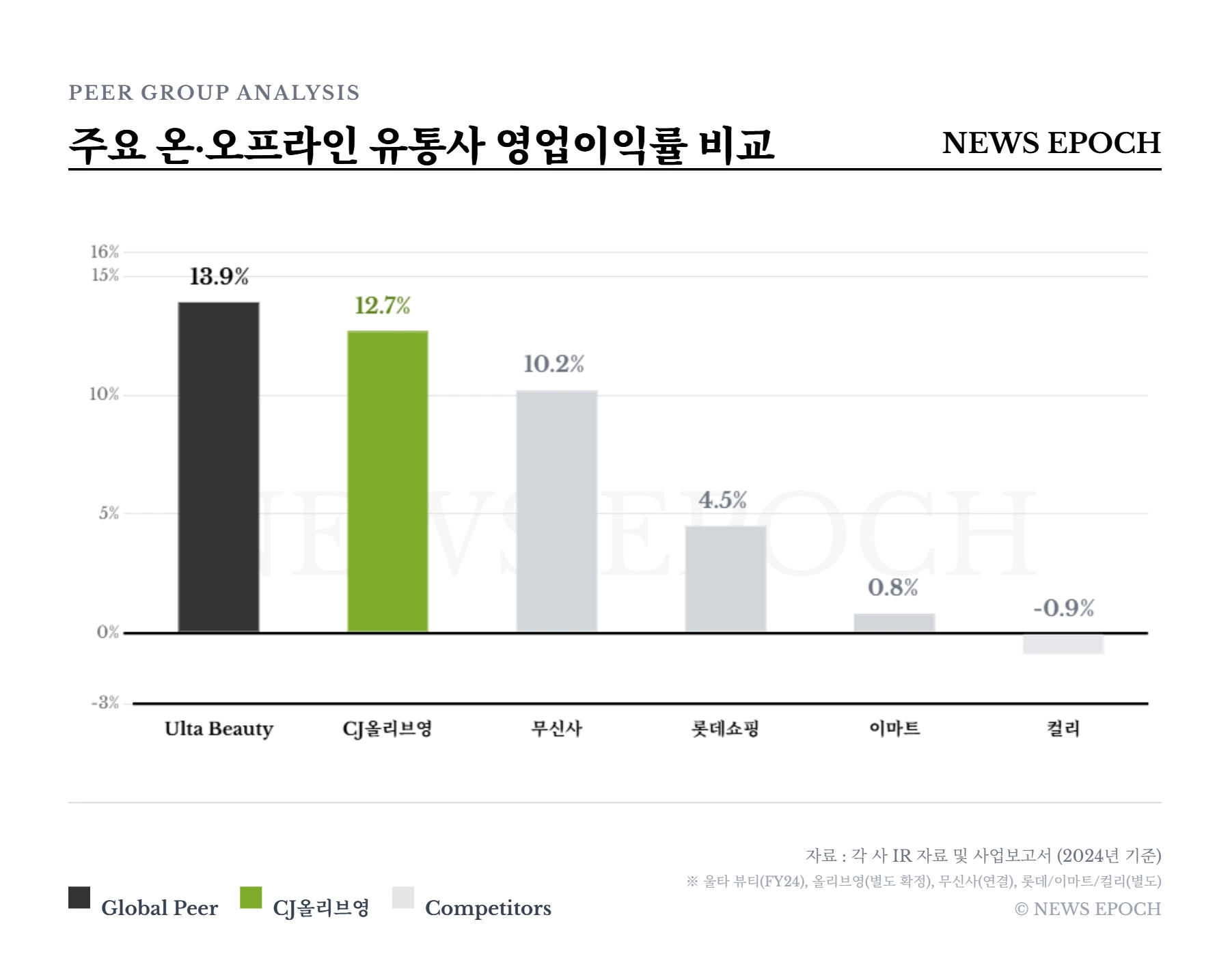
In the domestic retail industry, a double-digit operating profit margin is a highly unusual figure. Comparing the performance of major retail companies in 2024, CJ Olive Young's profit structure shows a distinct difference from other channels. E-mart, a traditional retail powerhouse, recorded 15 trillion won in revenue but suffered stagnant profitability with a 0.8% operating profit margin, while Lotte Shopping only managed to record a 4.5% profit margin after undergoing intensive store efficiency optimization. Kurly, which leads the early morning delivery market, staked its life on improving profitability by launching the high-margin vertical service 'Beauty Kurly', but it remains below the break-even point with a profit margin of -0.9%. Fashion platform Musinsa, which embarked on expanding its territory led by 'Musinsa Beauty', achieved a 10.2% profit margin, proving the efficiency of the platform business. However, in terms of revenue scale, CJ Olive Young (4.8 trillion won) maintained a scale more than four times that of Musinsa (1.1 trillion won), proving a 'super gap' in both appearance and substance.
A comparison with the No. 1 global operator suggests that CJ Olive Young's high profitability stems from a structural level. The cumulative operating profit margin for the third quarter of 2025 of 'Ulta Beauty', a representative beauty distributor in the US, is 12.4%. Ulta Beauty, evaluated as having the most efficient operating system in the world, achieved this profit margin through 'economies of scale' with a revenue of approximately 11.9 trillion won. On the other hand, CJ Olive Young recorded a 12.7% profit margin (as of 2024) in the domestic market, which is one-third the size of Ulta Beauty, surpassing the global benchmark. This shows that unlike Ulta Beauty, which has a US market share in the 9% range, CJ Olive Young's overwhelming market dominance, occupying 19.6% of the Korean market, leads directly to profitability.
Behind this high profitability lies a gross profit margin reaching 48.2%. When a consumer purchases a 10,000 won product, approximately 4,820 won, excluding the product cost, is attributed to the value added in the distribution stage. This is in contrast to other platforms like Musinsa and Kurly, which experience difficulties securing profitability by bearing logistics and marketing costs themselves to acquire customers. Having secured a monopolistic position, CJ Olive Young secures definitive profits by efficiently managing operating costs such as selling, general, and administrative expenses based on high bargaining power. CJ Olive Young's profit structure, which leaves 13 won of operating profit per 100 won of revenue, means it has built a structural barrier to entry that is difficult for competitors to replicate, going beyond simple distribution efficiency.
93% of the money earned has left... For whom is this record-high performance?
CJ Olive Young's capital flow explicitly shows that the company serves as the group's 'cash cow' and 'strengthens the owner family's dominance' rather than promoting 'co-prosperity' with its tenant companies. Out of the 478.8 billion won in net income attributable to 2024, CJ Olive Young leaked 448.4 billion won, reaching 93.6%, to the outside through dividends and share buybacks. In effect, a platform company in the midst of growth has practically retrieved the entire amount of money earned without reinvesting it. In particular, the 396 billion won share buyback executed in May 2025 was a decisive scene that strengthened the owner family's dominance without spending a single penny by supporting the exit (investment recovery) of the private equity fund (Glenwood PE), which was the second-largest shareholder, with company money.
Turning back the clock to 2021 makes the essence of this capital planning clear. At the time, the owner family, including Business Leader Lee Sun-ho, handed over stakes to a private equity fund and secured approximately 140 billion won (Lee Sun-ho 101.8 billion won) in cash to prepare financial resources for succession. And four years later in 2025, CJ Olive Young spent nearly 400 billion won of company money to buy back the private equity fund's stake. Considering the effect of the bonus issue, the private equity fund left with a profit of about twice (estimated return rate of 191%) the principal, and the owner family maintained dominance without diluting their stake. The operating profit created by the blood and sweat of the tenant companies evaporated outside the K-beauty ecosystem, being used for the owner's wallet in 2021 and to guarantee the private equity fund's high returns in 2025.
It is not just shareholder returns. In May 2025, CJ Olive Young purchased land and buildings worth 674.4 billion won for use as an office building, pouring cash equivalent to 30% of its total assets into real estate. The platform, which was stingy with investing in beauty infrastructure or supporting small and medium-sized brands, was bold in becoming a 'landlord.' Ultimately, the high margin rate of 48.2% endured by brand companies saying, "It's expensive but we have no choice in order to sell," was replaced by the owner's succession funds, the private equity fund's profit margin, and massive real estate assets, rather than the K-beauty ecosystem. This is the very reality of the 'castle of capital' created by CJ Olive Young's solo monopoly system.
Disappeared competitors, disappeared bargaining power... How did the brand's margin degenerate into an 'admission fee'?
CJ Olive Young's absolute power originated from the disappearance of competition. Up until the mid-2010s, GS Retail's 'lalavla', Lotte Shopping's 'LOHBs', and Shinsegae's 'Boots' were engaged in a fierce battle, providing brand companies with minimal room for negotiation. However, CJ Olive Young seized the opportunity when competitors were bound by large-scale distribution regulations, carrying out logistics innovation (Oneul Dream) and aggressive store expansion. Eventually, it took over the market through an exclusive strategy of penalizing brands that tried to enter competing platforms. As a result, as of 2024, CJ Olive Young has been left as a de facto monopoly operator with over 90% share of the offline H&B market.
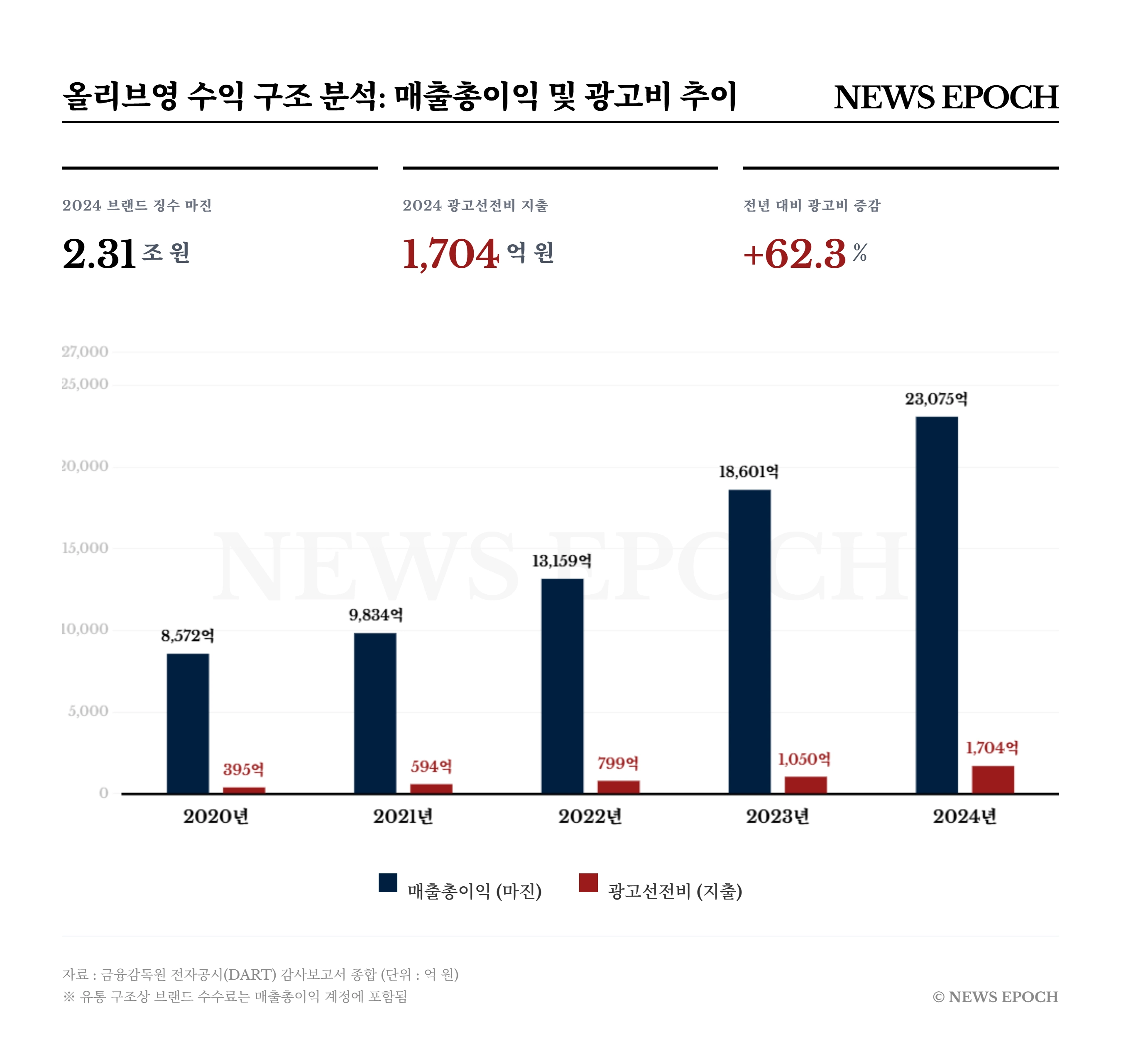
The absence of competing channels eliminated the room for choice for manufacturers. In the past, they could have bargaining power through competitors, but now the structure has become one where being pushed out of a shelf in CJ Olive Young means 'market exit'. This is exactly the background behind the improved profitability even though advertising and promotion expenses recorded 170.4 billion won in 2024, a 62% explosion compared to the previous year. This cost is closer to the result of reinvesting the 'advertising revenue' collected from tenant brands desperate for a single shelf space, rather than 'expenditure' spent by the platform to sell its own goods. To protect their right to survive on the shelves, tenant brands purchase large-scale advertising slots from CJ Olive Young and bear the promotional costs associated with discount events themselves. Ultimately, CJ Olive Young's aggressive marketing was executed using the margins given up by the tenant companies as financial resources. In other words, the true nature of this cost is not marketing expenses spent by CJ Olive Young, but promotional expenses borne by tenant brands biting the bullet to protect their shelf survival rights, and a de facto 'toll' paid to the monopolistic platform.
Nevertheless... The dilemma of 'high cost, high growth' chosen by brand companies
Despite such high cost burdens, the reason brand companies prefer CJ Olive Young is clear. It is because CJ Olive Young, beyond a simple sales channel, holds the 'purchasing conversion power' and 'barometer of corporate valuation' that are directly linked to the brand's survival. First of all, the over 1,300 offline stores are the only alternative for indie brands to secure a nationwide distribution network without injecting massive proprietary capital. From the perspective of a newly established brand lacking financial power, paying high commissions to CJ Olive Young and 'renting' the infrastructure, instead of spending tens of billions of won on store opening costs, becomes a financially reasonable option. In other words, the commission is an opportunity cost for building a distribution network.
A more decisive reason is that it becomes the core performance metric for investment recovery and sales. Entering the upper ranks of CJ Olive Young rankings acts as a 'market verification' tool more powerful than hundreds of millions of won in online advertising. In fact, the majority of K-beauty brands recently sold to global conglomerates were recognized for their corporate value based on the title of 'CJ Olive Young No. 1'. Therefore, even if brand companies record a low operating profit margin of 2.9% like the case of Amuse, they take the strategy of growing their revenue scale through CJ Olive Young, which is practically the only platform. This is because, even if immediate profits decrease, the title of 'CJ Olive Young tenant brand' is the 'most expensive, but most certain guaranteed check' that ensures higher value during future global expansion or corporate sales.
Company financial data, investment reports, and startup analysis — all in one place
Explore PitchdeckCurated news, every week — straight to your inbox
Every Friday · Unsubscribe anytime