![[Price Tag of Content: Music] The Limits of a '1% Margin' Music Market... The Platforms' Answer Was Ultimately 'Outside of Music'](https://d1gl51xbrxoj65.cloudfront.net/uploads/2026/02/04/1770202490375-own0cb.webp)
Accelerated business restructuring following sluggish performance in 2024... Reducing reliance on telecom bundled plans and seeking independent survival
Genie Music restructures financial structure, including goodwill impairment and disposal of investment stocks... 'Books' instead of 'music' defend performance
Dreamus sells hardware business and parts ways with SK... Shedding manufacturing to focus on 'platforms'
Major players in the domestic music platform market, Genie Music (a KT affiliate) and Dreamus Company (Flo), are breaking away from their business models centered on telecom bundled plans and are seeking new growth engines. Underlying these changes are the earnings fluctuations both companies recorded in 2024. At the time, Genie Music's standalone revenue fell 8.5% year-on-year to 229.3 billion won, and it turned to a deficit by recording a net loss of 20.6 billion won. Dreamus Company also saw its consolidated revenue decrease by 16.7% to approximately 225.1 billion won, and recorded a net loss of 17.8 billion won, widening its deficit by about six times compared to the previous year. This is the result of intensifying competition with global Big Tech and a visible slowdown in the profitability of telecom partnership revenues, prompting both companies to launch intense business restructurings.
Consequently, the two companies focused on restructuring their financial structures to fundamentally eliminate potential risk factors rather than preserving short-term performance. Genie Music resolved accounting uncertainties by massively impairing intangible assets such as goodwill recognized during past mergers, while restructuring its profit structure by placing its highly profitable subsidiary (Millie's Library) at the forefront. On the other hand, Dreamus Company chose to simplify its business portfolio to center on platforms by selling off its hardware manufacturing business division, which had hit a profitability limit. This was a strategic decision to secure financial soundness and respond flexibly to the rapidly changing market environment, even at the cost of enduring a temporary expansion in net losses.
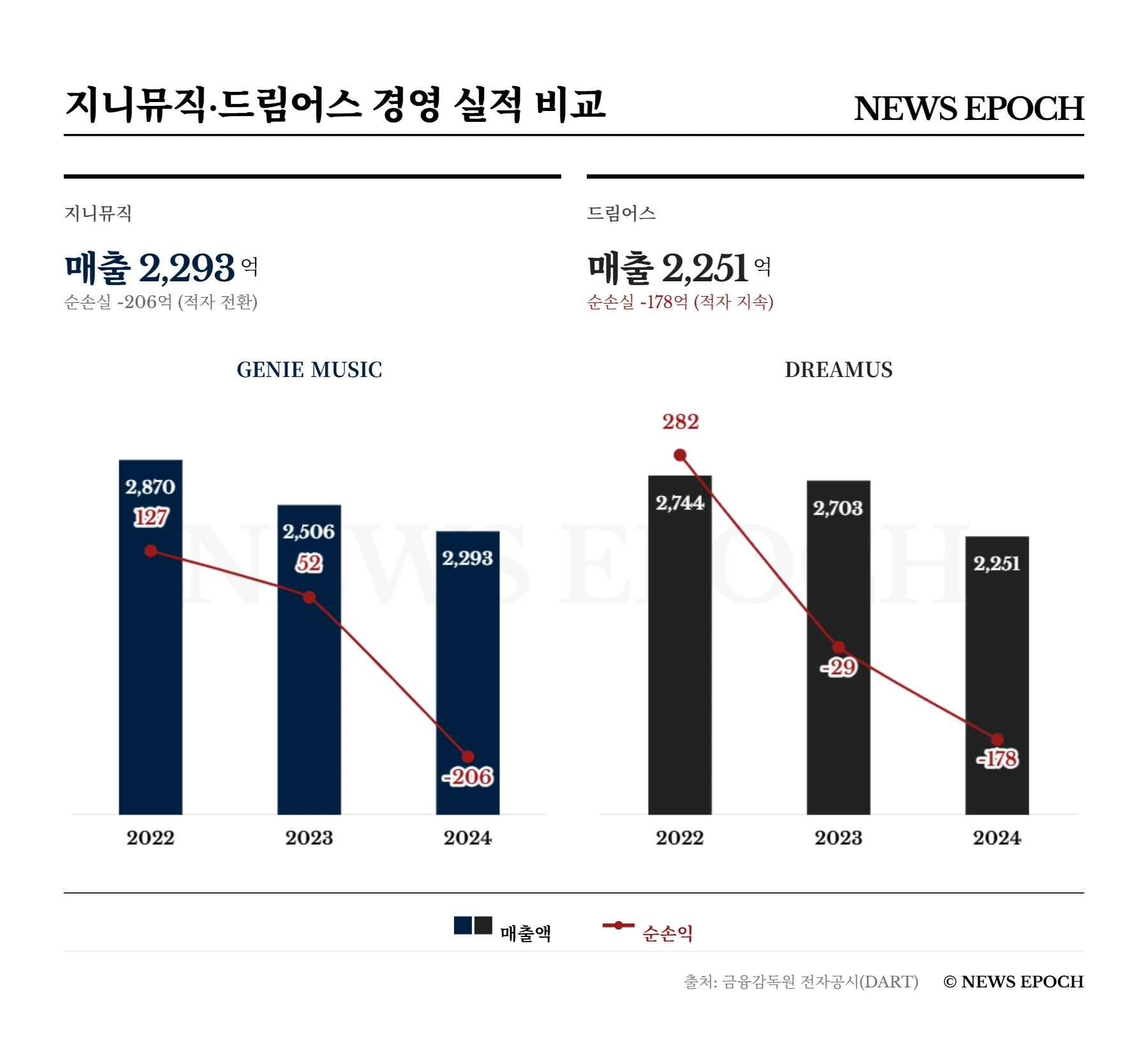
Saved by 'Books' from the Swamp of 1% Margins... A Profit Structure 'Pivot' Completed Through a Big Bath
The financial stability that Genie Music has currently secured is the product of a high-intensity 'Big Bath' executed two years ago (in 2024). At that time, although the company maintained a surplus in its core business by generating an operating profit of 3.1 billion won on a standalone basis, it ultimately finalized a massive net loss of 20.6 billion won. This was the result of recognizing as a one-time expense the goodwill remaining on the books from the 2018 merger with CJ Digital Music (approximately 12 billion won) and the disposal loss of its AI subsidiary 'Juice' (approximately 5.1 billion won). Rather than dwelling on immediate book profits, it was a bold move to decisively write off the aftereffects of past M&A and non-performing assets to fundamentally block potential risks that could drag down future performance.
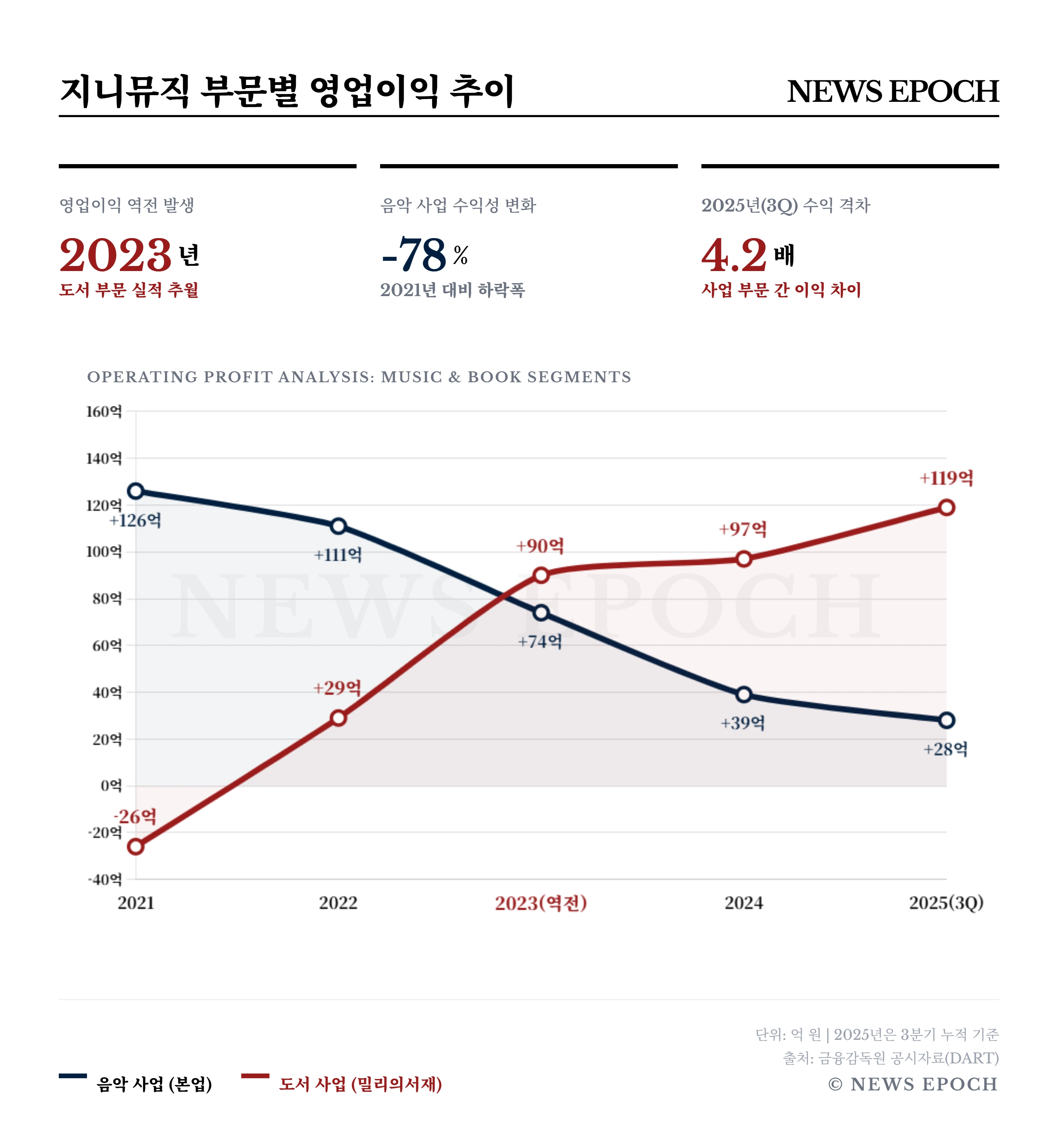
Backing this bold financial overhaul was its subsidiary 'Millie's Library', which it acquired in 2021 by betting a total of 46.4 billion won. When the music distribution business fell into structural stagnation with its operating profit margin hovering around 1.4% (as of 2024), Millie's Library emerged as the group's definitive cash cow, generating over 10 billion won in annual net profit. Considering the recovered profit compared to the invested capital, this is considered the most successful case of capital allocation in Genie Music's history. As a result, it has been proven that the Big Bath two years ago was not merely a loss write-off, but a process of 'successful business portfolio restructuring' that shook off the risks of the low-margin music business and shifted the center of gravity to a high-margin IP platform.
In fact, the performance trends over the past five years clearly demonstrate the results of this structural improvement. The book business (Millie's Library), which recorded a deficit of 2.6 billion won at the time of its acquisition in 2021, achieved an operating profit of 9 billion won in 2023, achieving an 'earnings golden cross' by surpassing the music business (Genie Music's core business), which remained at 7.4 billion won during the same period, for the first time. The gap widened further going into 2025. As of the third quarter of 2025, the cumulative operating profit of the book division was 11.9 billion won, exceeding four times that of the music division (2.8 billion won). Now, Genie Music has completely transformed into a company that makes money from 'books' rather than 'music' in both name and reality.
The 5 Billion Won Sale of 'iriver' and SK's Exit... Standing Alone After Clearing the 'Bubble'
Dreamus Company has completed a high-intensity business restructuring under the principle of 'selection and concentration'. The most symbolic decision was the sale of its hardware business division (iriver) executed at the end of 2024. Looking at the performance of the iriver division for the three years immediately prior to the sale (2022-2024), although cumulative revenue exceeded 110 billion won, it never once achieved a surplus in operating profit and recorded a total cumulative loss of 7.6 billion won. Accordingly, the company made the decision to sell the division, which had an annual revenue of 41.3 billion won as of 2023, for 5 billion won. While the 2024 net loss temporarily expanded to 17.8 billion won due to the loss from discontinued operations (approximately 15 billion won) incurred during this process, this is interpreted as an accounting cost arising during the transition to a profitability-centric business structure.
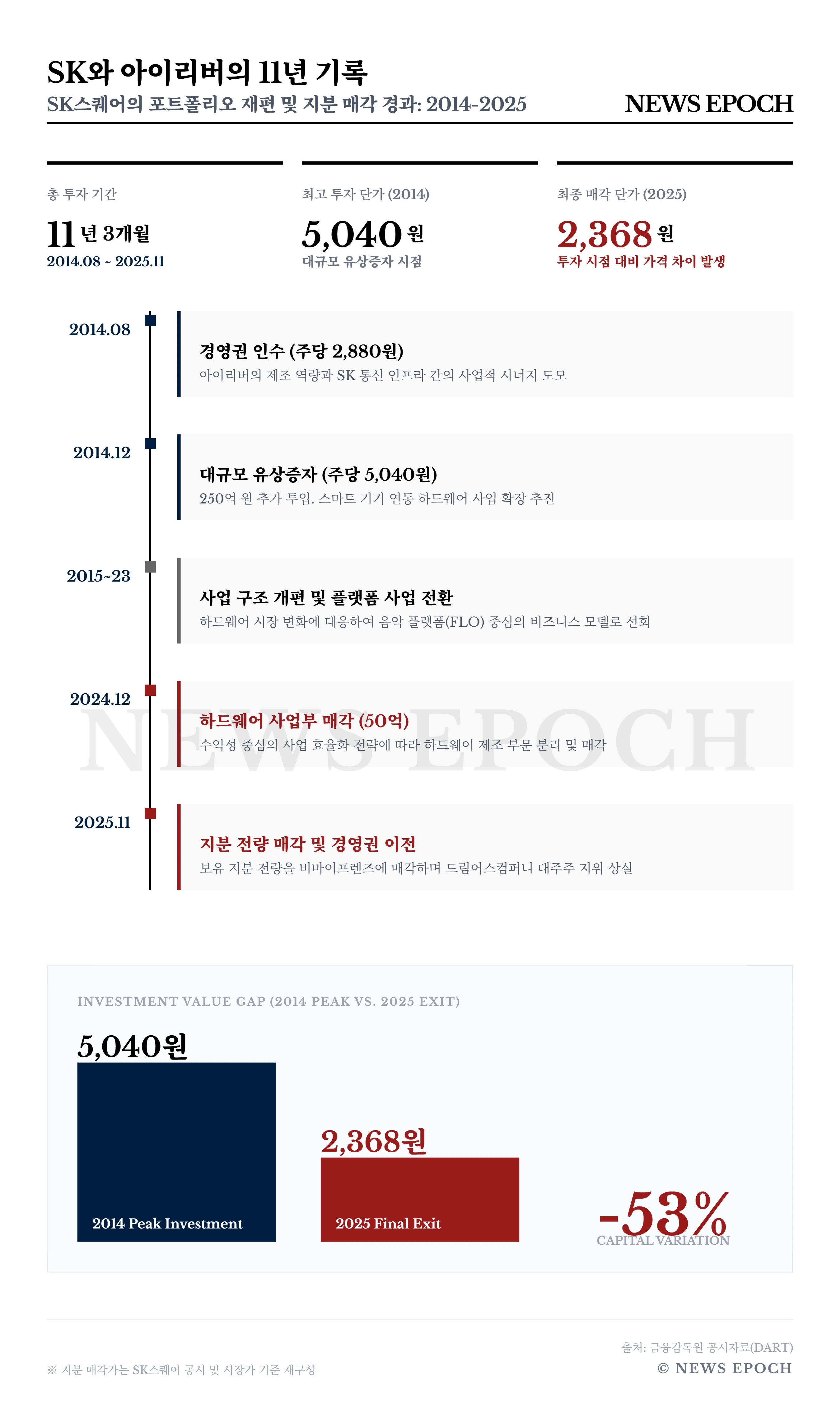
The business efficiency efforts led to the divestment of shares by the largest shareholder, SK Square. Immediately after acquiring iriver in 2014, SK Telecom successively absorbed and merged 'mpman.com' and its subsidiary 'iriver CS', and executed a paid-in capital increase at 5,040 won per share, injecting over 25 billion won into strengthening its manufacturing capabilities. However, as it became difficult to secure the profitability of the hardware business due to changes in the external environment such as the expansion of the smartphone market, it decided to withdraw from the manufacturing sector and sell its management rights after 10 years. The unit price for this sale was 2,368 won per share, which is about half the level compared to the issue price of the paid-in capital increase in 2014 (5,040 won).
In November of last year, SK Square relinquished its management rights by handing over its entire stake to the fandom business company 'bemyfriends'. The sale price was set at a level slightly lower than the tender offer price (2,500 won) that the company had implemented to enhance shareholder value six months prior to the sale. With this, Dreamus Company has stepped out of the conglomerate affiliate system and is now faced with the task of building an independent platform revenue model, such as fandom businesses, with its new major shareholder.
The Limits of the Profit Structure and the 'Post-Music' Strategy
The business restructuring of both companies was an inevitable choice to break away from the structural profit limitations of the domestic music distribution market. Under the current settlement structure where about 65% of revenue is distributed to copyright holders, the approximately 35% of funds taken by platforms is insufficient to cover the costs of competing with global Big Tech. In particular, it was confirmed through past performance that telecom partnership products, which were the core of past growth, are advantageous for securing subscribers but serve as a factor limiting practical profitability improvements due to high discount rates.
Accordingly, the two companies are staking their lives on creating new value-add beyond music streaming. Genie Music is defending its profitability with a subscription model that links 'music and books' by strengthening bundled products with its profitable subsidiary, Millie's Library. Dreamus Company is pursuing business diversification to connect streaming users to high-margin fandom community and merchandise (MD) consumption through synergy with its new major shareholder, bemyfriends. Whether the two companies, having lowered their reliance on telecom operators, can produce tangible results in IP and fandom businesses outside of music is expected to be a key variable determining their future corporate value.
Company financial data, investment reports, and startup analysis — all in one place
Explore PitchdeckCurated news, every week — straight to your inbox
Every Friday · Unsubscribe anytime