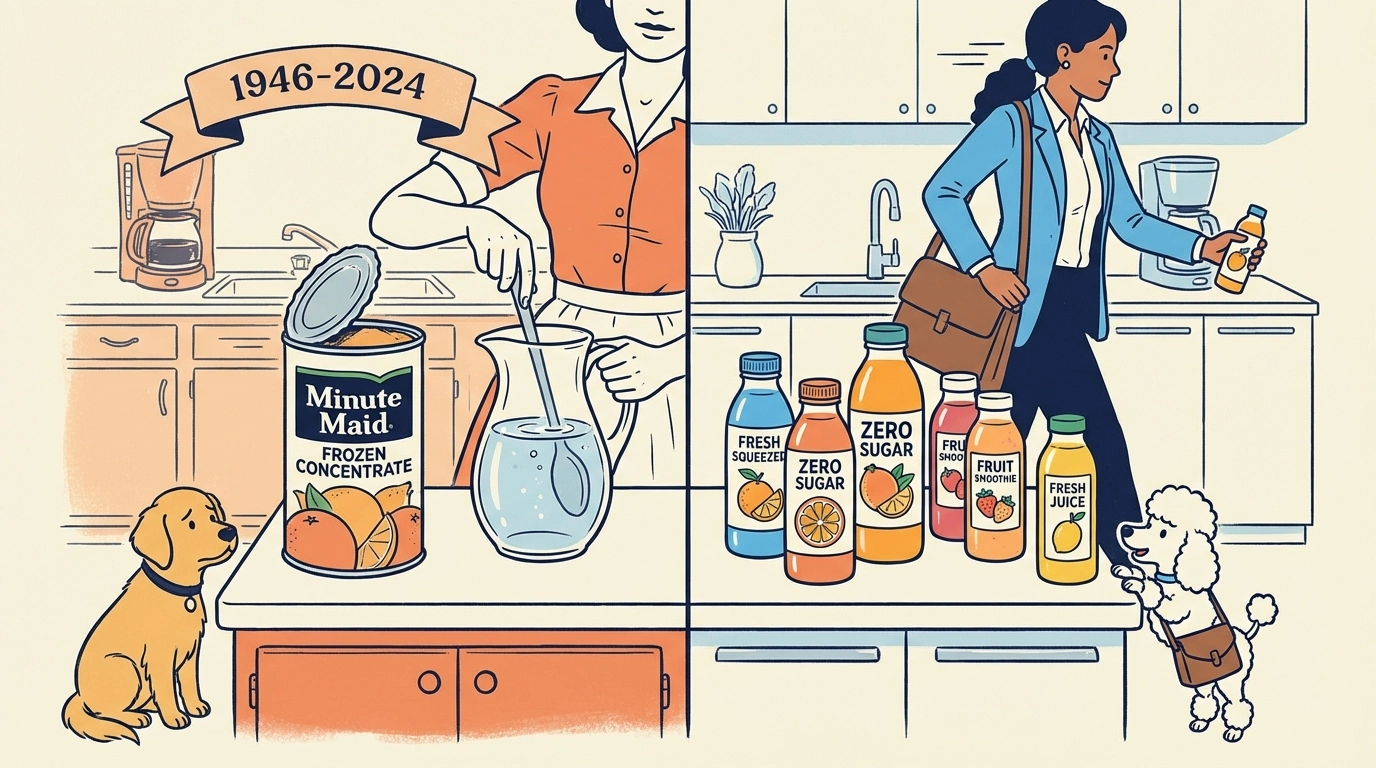
Complete Portfolio Reorganization with 'Fresh·RTD' Instead of 'Concentrate'
Decision to Halt Production Amid Material Shortages, Worsening Profitability, and Shifting Consumption Trends
Florida Orange Production Plummets 90%... Complete Portfolio Reorganization
Global beverage maker Coca-Cola is abruptly halting the production of its 80-year-old 'Minute Maid Frozen Concentrated Juice'. Since its launch in 1946, the frozen canned juice, which has been a staple of the American family breakfast table, will fade into history, unable to overcome the hurdles of raw material supply shortages, worsening profitability, and modern consumption trends that emphasize 'freshness'.
Global beverage maker Coca-Cola is abruptly halting the production of its 80-year-old 'Minute Maid Frozen Concentrated Juice'. The exit of this product, which has symbolized the American family breakfast table since its launch in 1946, goes beyond a simple product line rationalization, starkly illustrating the changes in a health-focused consumption paradigm represented by raw material supply shortages and 'sugar aversion'.
The Coca-Cola Company recently announced in an official statement, "To respond to changing consumer preferences, we are withdrawing from the frozen juice can category in the U.S. and Canada." Minute Maid's frozen lineup, including orange juice and lemonade, will be phased out by April of this year and is scheduled to disappear entirely as market inventory is depleted.
The Era and Evolution of Frozen Concentrated Juice: From Innovation to Retro
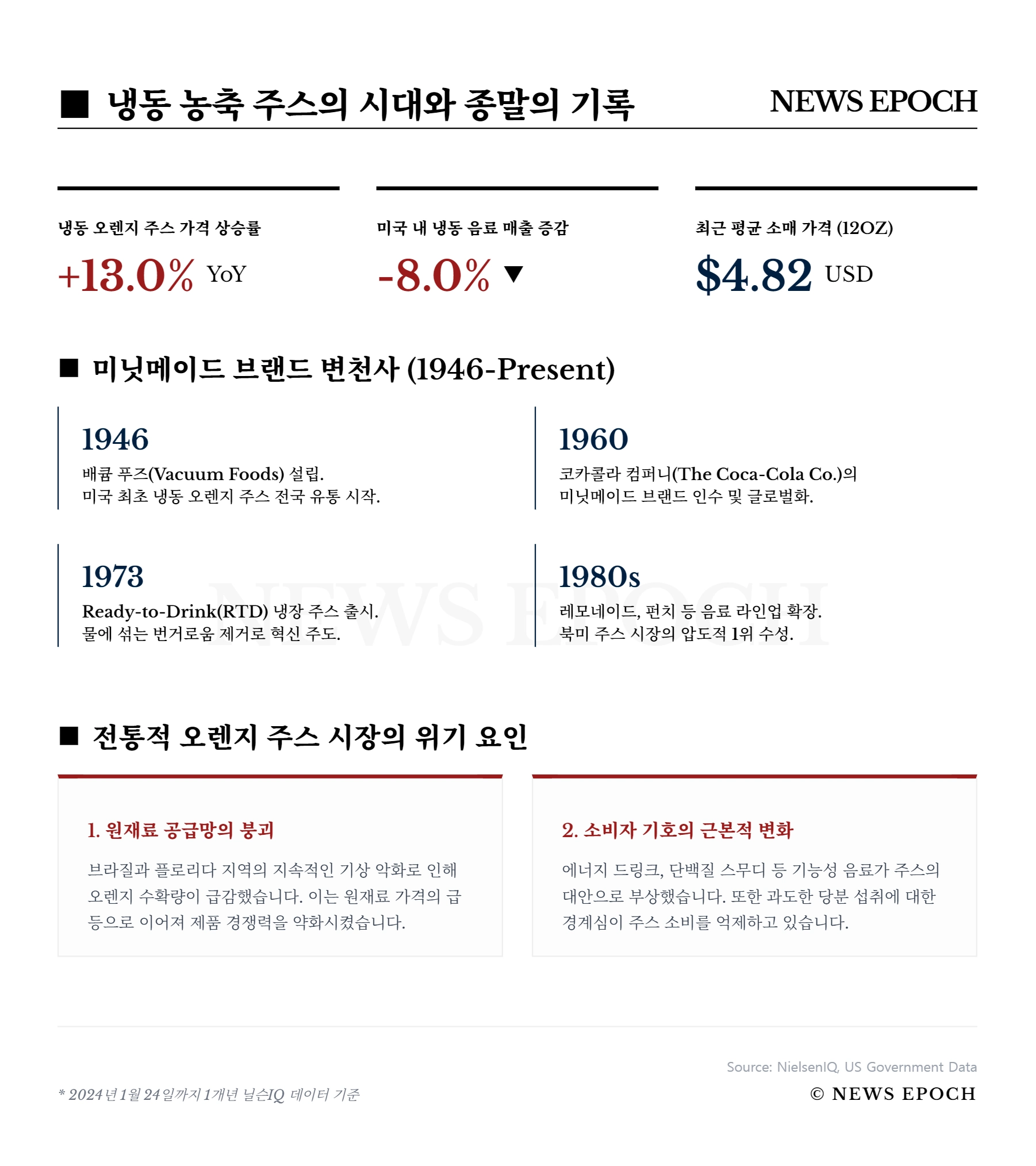
Minute Maid frozen cans were born in 1946 when 'Vacuum Foods' distributed the world's first frozen orange juice. At the time, being able to enjoy juice all year round without the hassle of squeezing oranges directly was embraced as an innovation. After being acquired by Coca-Cola in 1960, Americans considered the practice of 'plopping' the solidly frozen concentrate from the can into a pitcher and mixing it with water as an everyday scene. However, with the advent of ready-to-drink (RTD) refrigerated juice in 1973, its standing began to narrow, and today, 80 years later, it is making its exit, judged as 'inconvenient and old-fashioned'.
Background of Discontinuation ①: Devastation of Major Production Areas and Surging Raw Material Prices
Florida, the largest orange-producing region in the U.S., has seen its production plummet by more than 90% over recent decades due to 'citrus greening'. This disease not only reduces yields but also turns the fruit bitter, making it difficult to maintain the quality of the juice. Due to the instability of raw material supply, the price of frozen orange juice cans in the U.S. as of December last year recorded $4.82, a 13% increase from the previous year. With supply-demand imbalances and cost increases overlapping, the justification to maintain the business has vanished.
Background of Discontinuation ②: Worsening Portfolio Profitability and Trimming the 'Long-tail'
The limitations were also clear from a cost structure perspective. Frozen cans require strict freezing during distribution and display, creating a structure that incurs continuous logistics and equipment maintenance costs. Conversely, sales volume has been on a downward trend every year; according to NielsenIQ, sales of frozen beverages in the U.S. declined by about 8% over the past year. As the juice category itself is growing, Coca-Cola has made the strategic decision to trim less profitable 'long-tail' products and concentrate resources on not-from-concentrate (NFC) juices and zero-sugar product lines that consumers desire.
Background of Discontinuation ③: Sugar Aversion and the Disappearance of Breakfast Culture
Changes in health awareness and lifestyle transformations were the decisive blows. With the recent spread of the 'sugar reduction' trend, the strong negative perception of orange juice shifted from a synonym for a 'healthy breakfast' to a 'lump of high fructose corn syrup'. Instead of high-sugar concentrated juices, consumers are turning their eyes to sparkling water, functional water, and protein smoothies.
Additionally, the disappearance of the 'family-centered breakfast culture', where the whole family sits around and makes juice in a pitcher to drink, played a significant role. With the increase in single-person households and the spread of 'on-the-go' consumption on the way to work, frozen cans—which require a process of thawing and mixing—have become a product out of touch with the lifestyle patterns of modern people.
The discontinuation of Minute Maid frozen cans symbolizes a generational shift in the beverage market. The innovation that led the popularization of orange juice 80 years ago has now become a legacy of the past. Coca-Cola plans to respond to the changed market environment by reorganizing its portfolio going forward, centering on its 'zero sugar' lineup and premium not-from-concentrate juices emphasizing freshness.
Company financial data, investment reports, and startup analysis — all in one place
Explore PitchdeckCurated news, every week — straight to your inbox
Every Friday · Unsubscribe anytime