![[The Price Tag of Content: Music] The '1.8 Trillion Jackpot' and the 'Swamp of 2%'… 10 Years of Korea's No.1 Music Platform 'Melon'](https://d1gl51xbrxoj65.cloudfront.net/uploads/2026/02/06/1770360832676-hjer8.webp)
Sold by SK for 265.9 Billion Won → Acquired by Kakao for 1.87 Trillion Won… Corporate Value Quintupled in 3 Years
Platform Share Dropped from 40% → 35% After 2019 Collection Rule Revision… Profit Margin Fell from 18% → 2% Range
Following Integration into Kakao Entertainment Through Spinoff and Merger… Melon's Performance and Cash Flow Diluted within Consolidated Earnings
The past 10 years of 'Melon' are a microcosm that penetrates the capital logic and policy changes of the Korean content industry. Melon emerged as a hot potato in the capital market, with its corporate value skyrocketing every time its owner changed, but the profitability of its core business has drawn a downward curve due to policy regulations and structural limitations. The capital market highly valued Melon's growth potential, but its actual profit structure has faced structural downward pressure since the revision of the collection regulations in 2019.
From SK Telecom's sale to the private equity fund's exit and Kakao's acquisition, Melon's financial statements over the past 10 years dryly but clearly show the 'profitability dilemma' hidden behind the spectacular valuation increase. Capital raised Melon into a 'goose that lays golden eggs,' but changed policies and the market environment turned that goose back into a 'dry towel.' The discrepancy between the corporate value reaching 1.8 trillion won and an operating profit margin stuck in the single digits proves the profitability challenge of the platform business lying behind the glamorous deals.
Sale Forced by Regulation vs Thorough Exit… The Mixed Fortunes of '1.6 Trillion'
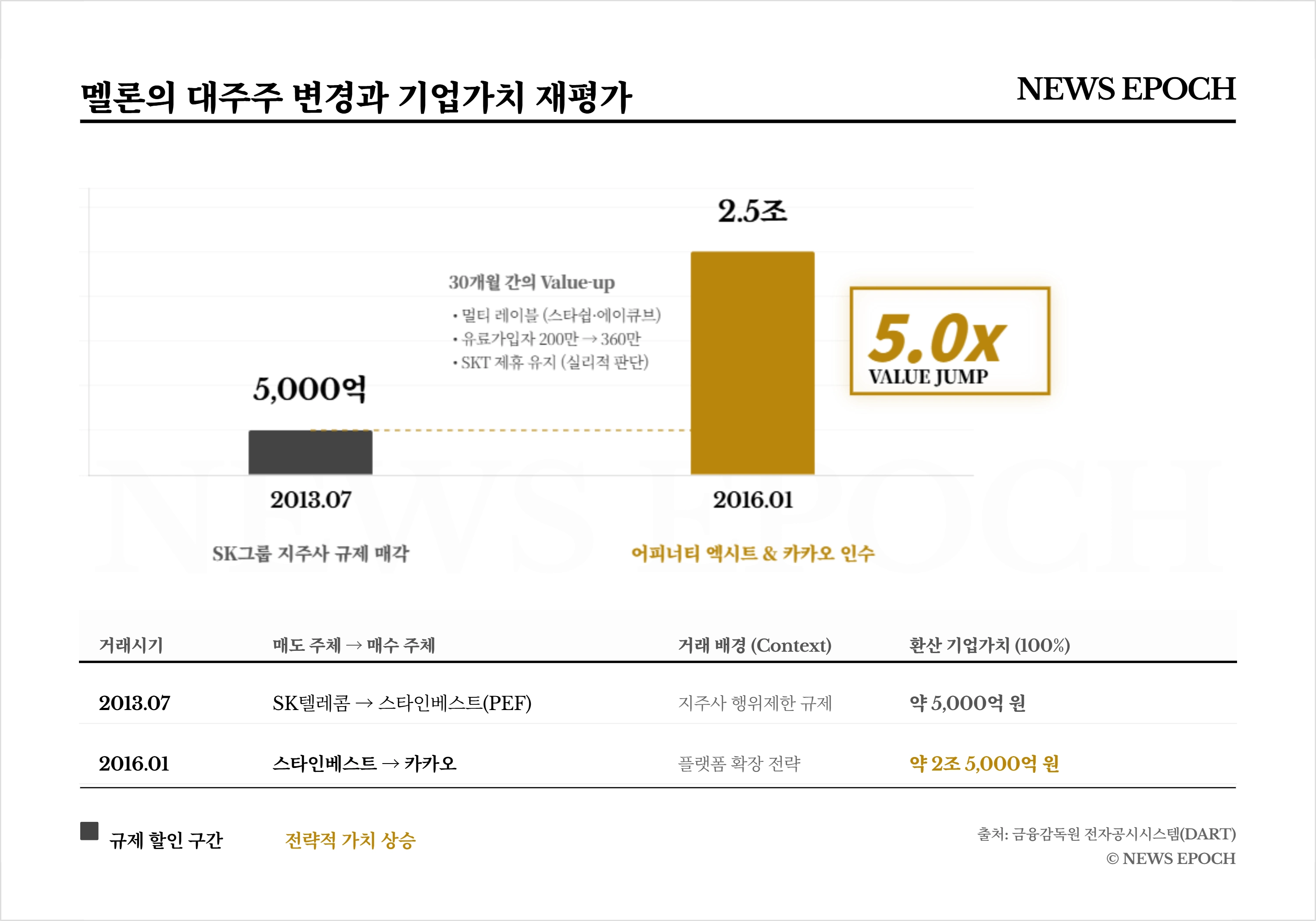
The process of changing Melon's major shareholder is a case that clearly shows how the capital market's valuation method differs depending on the environment a company faces. In July 2013, SK Group sold LOEN Entertainment (Melon) to the Hong Kong-based private equity fund Affinity Equity Partners to comply with regulations restricting the activities of holding companies under the Fair Trade Act. At the time, the sale price for the seller, SK Planet, was 265.9 billion won (52.6% stake). Analysts say that because a sale within the deadline was essential to resolve the regulatory issue, there was a structural limitation making it difficult for the platform business's monopolistic position and future growth potential to be fully reflected in the price.
On the other hand, the private equity fund focused on enhancing corporate value immediately after the purchase. Affinity strengthened Melon's market dominance through profitability improvements and structural reforms, and realized a successful recovery of investment by selling its stake to Kakao in January 2016. Kakao's total acquisition amount reached 1.8743 trillion won (76.4% stake). Through this deal, Melon's corporate value was re-evaluated from about 500 billion won at the time of the SK sale to approximately 2.5 trillion won in just three years. As a result, the fruits of Melon's growth went not to the conglomerate whose sale timing was restricted by regulatory issues or the current owner, the platform company, but to the financial investor who discovered and maximized value during an undervalued phase.
Affinity's strategy was a 'structural expansion' that went beyond simple cost reduction. They executed a 'multi-label' strategy, aggressively adding external entertainment agencies on top of Melon's distribution network. Moving beyond the existing one-person agency system centered around IU, they expanded their size by incorporating 'Starship Entertainment (SISTAR)' in December 2013, just three months after the acquisition, followed by 'A Cube (Apink)' in 2015. At the same time, the practical judgment to enforce the 'continuation of SK Telecom cooperation' clause was also effective. Even after the change in the major shareholder, T Membership benefits were maintained, and paid subscribers surged from 2 million to 3.6 million in two and a half years. This 30-month speed war, which evolved a simple music distributor into a comprehensive content company, is considered the decisive background that made Kakao bet the massive sum of 1.8 trillion won.
The Blade of Policy: The 'Fate of Margins' Divided by the Revision of Collection Regulations
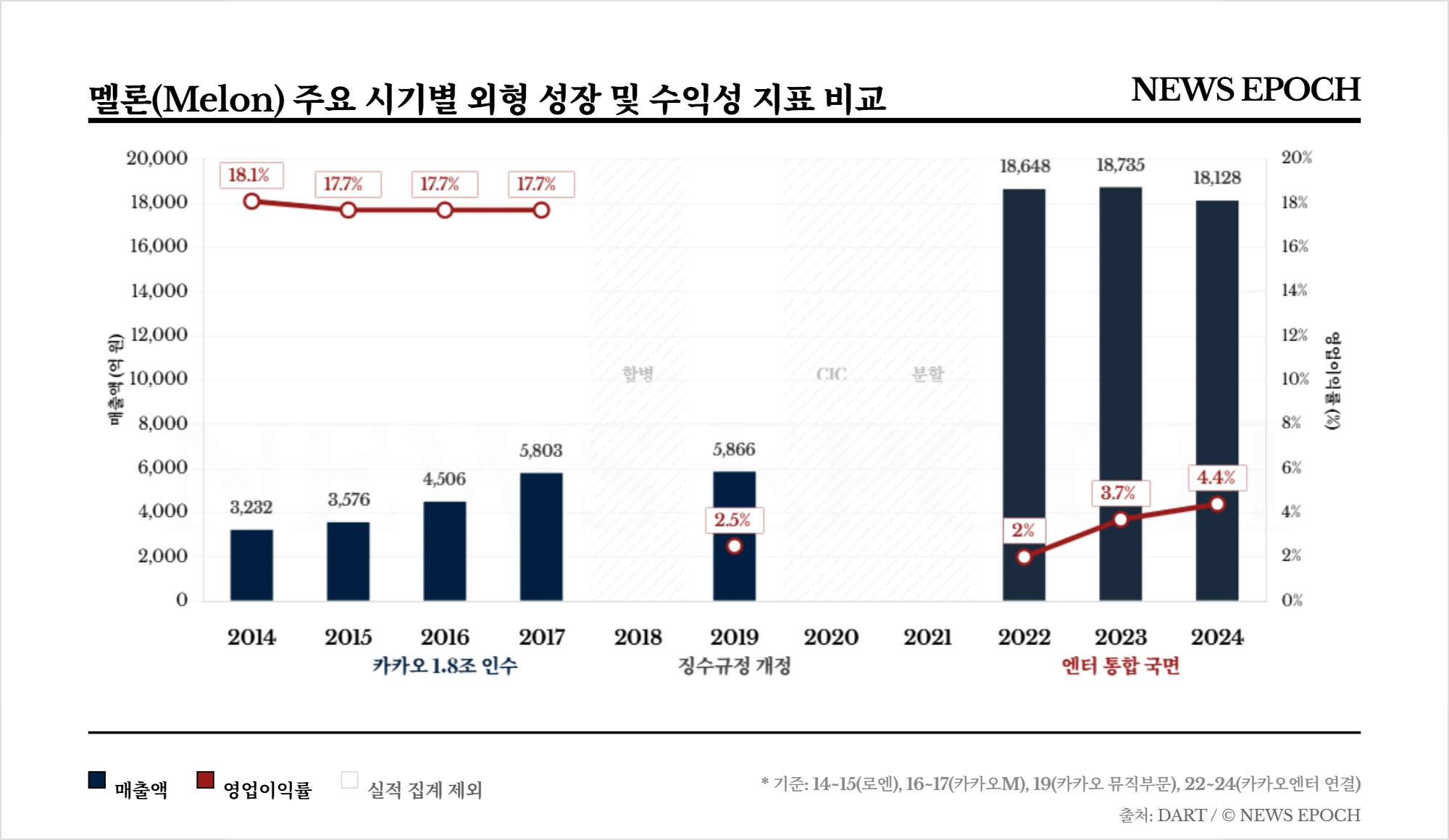
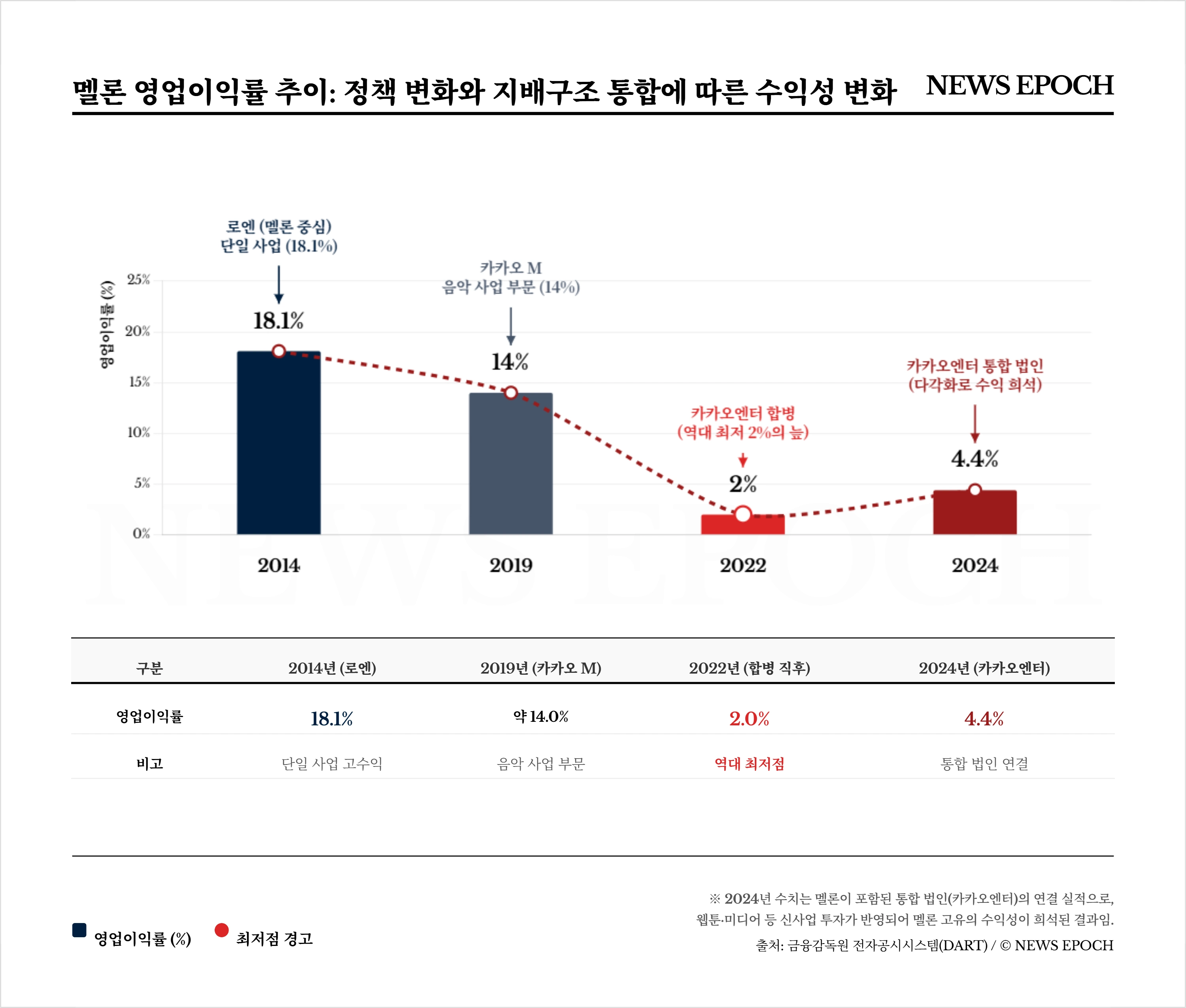
In 2019, three years after Kakao's acquisition, Melon faced a structural deterioration in profitability. The decisive blow was the reduction of the platform distribution ratio from 40% to 35% due to the revision of the 'Music Transmission Royalty Collection Regulations' by the Ministry of Culture, Sports and Tourism. In the past, the 40% margin width was the foundation that supported Melon as a highly profitable company with an operating profit margin in the 18% range, but the profit structure fundamentally changed due to policy. In fact, the operating profit margin, which reached 18.1% in 2014 before the regulation revision, began to face sharp downward pressure afterward.
The deterioration of profitability became entrenched as it intertwined with the realignment of the market competition structure. This is because, in a situation where margins were limited by policy, not only did global platforms like YouTube Music implement aggressive pricing policies, but latecomers backed by telecommunication companies (Flo, Genie Music) also simultaneously launched low-price offensives. Melon had to inject large-scale marketing costs and promotional budgets to defend its market share, which directly led to a decline in profitability. Eventually, after 2019, Melon broke away from its 'independent high-profit' model and faced a structural inflection point where its profits are diluted and financial burdens are shared within the portfolio of a giant platform.
The Labyrinth of Corporate Governance: The 'Cash Flow' Hidden Amidst Mergers
Melon, suffering from deteriorated profitability, became a core pillar of the corporate governance reorganization within the Kakao Group. In 2021, Melon went through a physical spin-off and was ultimately absorbed and merged into Kakao Entertainment. This is interpreted as a strategic decision to combine Melon, which possesses relatively stable cash flow, in order to support the funding requirements of new business sectors such as webtoons and dramas that require massive upfront investments. Following the merger, Melon's independent performance was integrated into Kakao Entertainment's consolidated financial statements, and the solid operating profit generated by Melon acts as a 'financial buffer' that absorbs the large-scale amortization of intangible assets (PPA) incurred during the acquisition of SM Entertainment and offsets the operating losses of new business sectors.
As a result, Melon, which boasted an unrivaled profit margin as an independent entity 10 years ago, has now transformed its nature into a core pipeline responsible for the liquidity of a giant integrated corporation. The 1.8 trillion won valuation remains valid as an asset value within the group, but the profitability of its core business faces a structural decline due to policy risks and changes in its cost structure. Melon's data, revealed behind the glamorous mergers and acquisitions, is an indicator that straightforwardly shows how a 'platform's high profitability' is diluted and transferred into costs during the process of corporate governance reorganization for growth.
Company financial data, investment reports, and startup analysis — all in one place
Explore PitchdeckCurated news, every week — straight to your inbox
Every Friday · Unsubscribe anytime