![[The Price Tag of Content: Entertainment] HYBE ① The Value of 'Post-BTS' Was 1 Trillion Won](https://d1gl51xbrxoj65.cloudfront.net/uploads/2026/02/13/1770947051275-ewfim.webp)
84% of Ithaca Holdings acquisition funds raised externally... Strategy to maximize leverage effect
Suspension of SM Entertainment acquisition, a financial decision to realize 240 billion won in profit instead of management rights
Extensive M&A to resolve single IP risk... The combination of entertainment and financial engineering
The investment prospectus of Big Hit Entertainment (currently HYBE) ahead of its KOSPI listing in 2020 specified a fatal risk factor: 'high revenue dependence on a specific artist (BTS)'. The fact that 97% of the company's revenue at the time was coming from a single IP was the biggest discount factor in its corporate valuation.
To erase this single line of risk, Chairman Bang Si-hyuk chose an aggressive M&A strategy of betting capital equivalent to the company's entire assets instead of the traditional method of internal cultivation. HYBE's past five years have been a process of buying the 'time' to raise artists with money, and a history of 'financial leverage' that expanded its asset size in a short period using various financial techniques such as paid-in capital increases and convertible bonds.
Prerequisite for IPO, portfolio diversification through the acquisition of PLEDIS
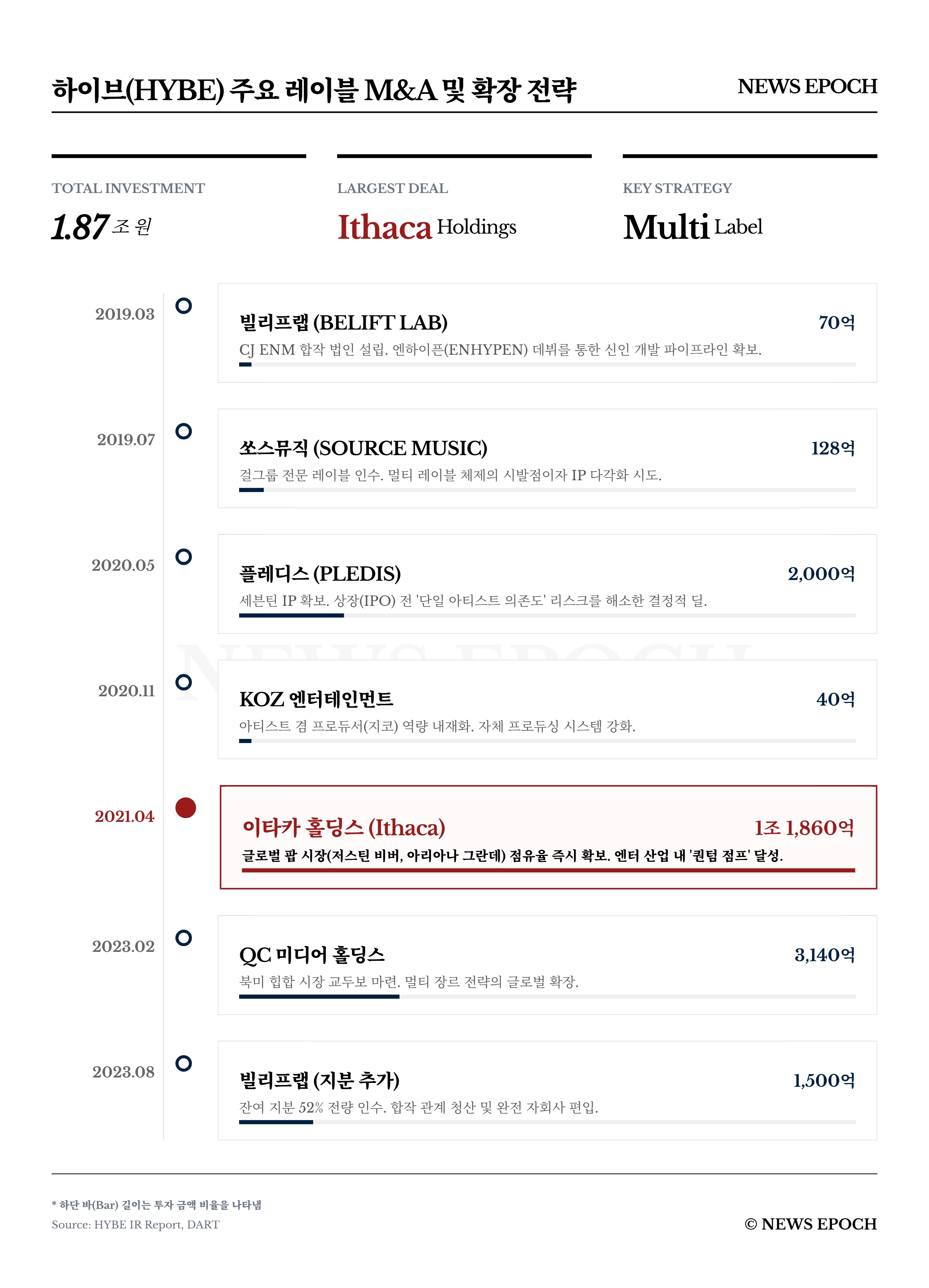
If the establishment of a joint venture (BELIFT LAB) with CJ ENM in March 2019 and the acquisition of SOURCE MUSIC in July were experimental stages to gauge the possibility of a multi-label system, the acquisition of PLEDIS Entertainment in 2020 was an essential prerequisite for going public. In May 2020, right before its listing, HYBE acquired an 85% stake in PLEDIS Entertainment, which manages SEVENTEEN, for 200 billion won.
This was a strategic choice to diversify the revenue pipeline concentrated on BTS and prove a stable profit base as a listed company. Having diluted the single IP risk by securing a solid pipeline called 'SEVENTEEN', HYBE successfully listed on the KOSPI in October 2020 at 135,000 won, the top end of its IPO price band. Afterwards, it systematically resolved the 'concentration on a specific artist' phenomenon that the market feared by successively incorporating KOZ Entertainment (Zico), QC Media, and others as subsidiary labels to expand its artist lineup.
A 1.2 trillion won gamble... A tower built with 'stocks' and 'borrowings'
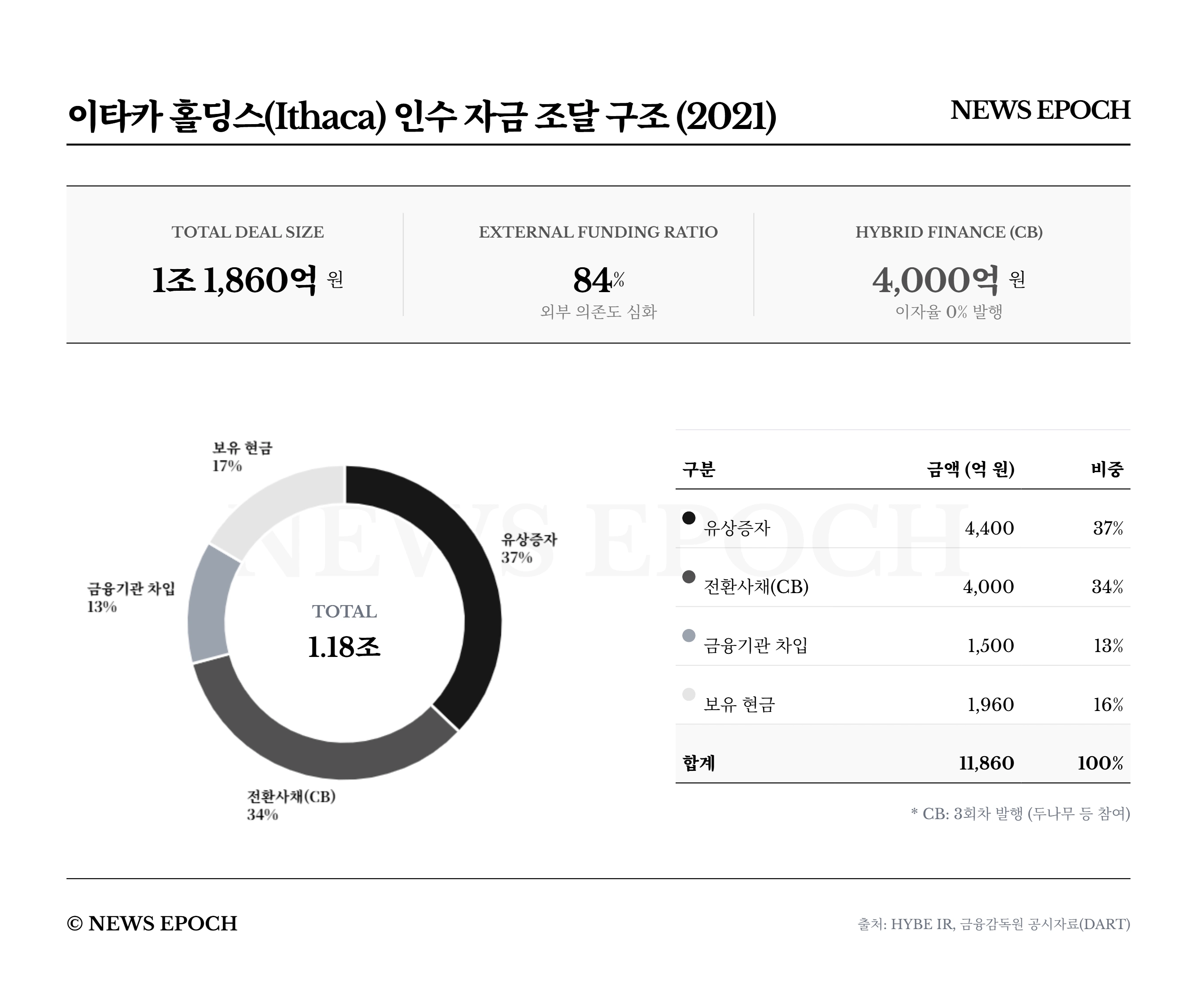
In April 2021, just six months after going public, HYBE signed a massive contract to acquire a 100% stake in the U.S.-based Ithaca Holdings for 1.186 trillion won. It was a decision to instantly increase its market dominance by securing global top-tier IPs such as Justin Bieber and Ariana Grande.
The core of this transaction lies in the financing structure. HYBE covered about 84% of the acquisition funds through external financing. It raised approximately 440 billion won through a shareholder allocation paid-in capital increase and 150 billion won through borrowings from financial institutions, and in particular, the issuance of 400 billion won in convertible bonds accompanied by an equity swap with Dunamu was decisive.
These convertible bonds were issued with a coupon rate of 0% to minimize interest expenses, but resulted in an increase in the debt ratio and the recognition of massive goodwill on the financial statements. This maximized the leverage effect for external expansion, but at the same time, it would act as a potential burden factor on future financial soundness.
Suspension of SM Entertainment acquisition and 240 billion won in financial profit
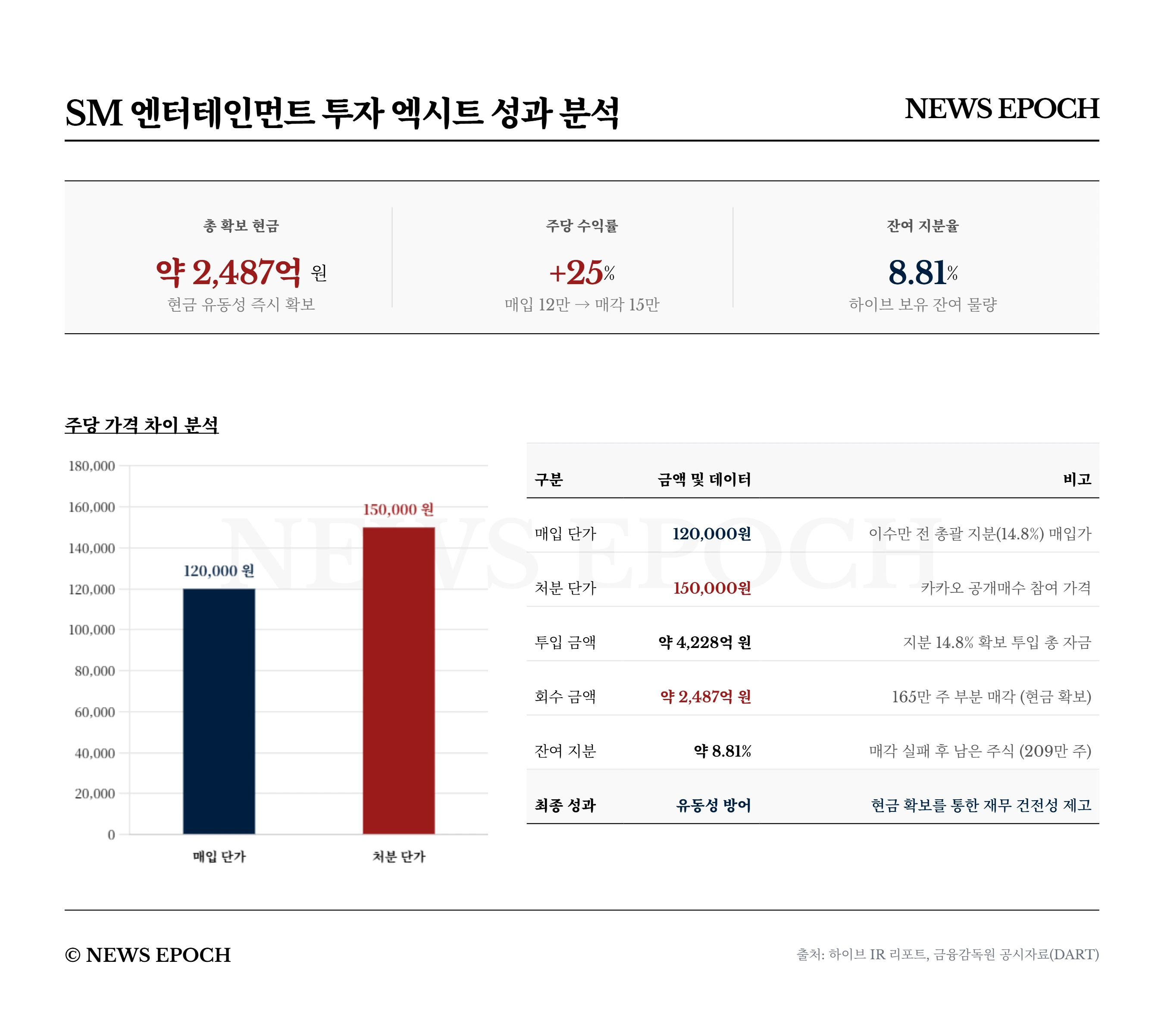
HYBE's expansion strategy reached its peak in the SM Entertainment acquisition battle in early 2023. In February, HYBE became SM's largest shareholder by unexpectedly acquiring a 14.8% stake from former executive producer Lee Soo-man for 422.8 billion won and waging a speed war, such as paying the price early. Afterwards, it attempted a tender offer to secure minority shareholder stakes as well, but the situation rapidly changed when Kakao countered with a higher price (150,000 won). HYBE boldly suspended the acquisition, stating, "The acquisition price has exceeded fair value due to market overheating."
Instead, HYBE made the resolute decision to sell a portion of its SM stakes by participating in Kakao's tender offer at 150,000 won per share. Although the SM acquisition fell through, HYBE recovered approximately 250 billion won in cash and even gained an investment profit from this decision. The liquidity secured through this decision, which chose practical benefits over the justification of management rights, later became a core resource to defend against financial risks that arrived in 2024.
The flip side of rapid external growth
Until 2023, HYBE's strategy was a speed war utilizing capital. It achieved overwhelming external growth in a short period through overseas corporate acquisitions in the 1 trillion won range and equity investments in domestic labels. The supreme task of 'reducing dependence on BTS' seemed to have been resolved.
However, the rapid expansion inevitably exacerbated the load on the internal control system and financial burden. The massive goodwill generated from the Ithaca Holdings acquisition remained a potential risk waiting for valuation every year, and the physically combined heterogeneous labels began to raise their own voices without achieving a chemical union. Behind the scenes of the HYBE empire built with stocks and borrowings, a structural crisis of 'cracks in the multi-label system' and 'deterioration in profitability' was approaching towards 2024.
Company financial data, investment reports, and startup analysis — all in one place
Explore PitchdeckCurated news, every week — straight to your inbox
Every Friday · Unsubscribe anytime