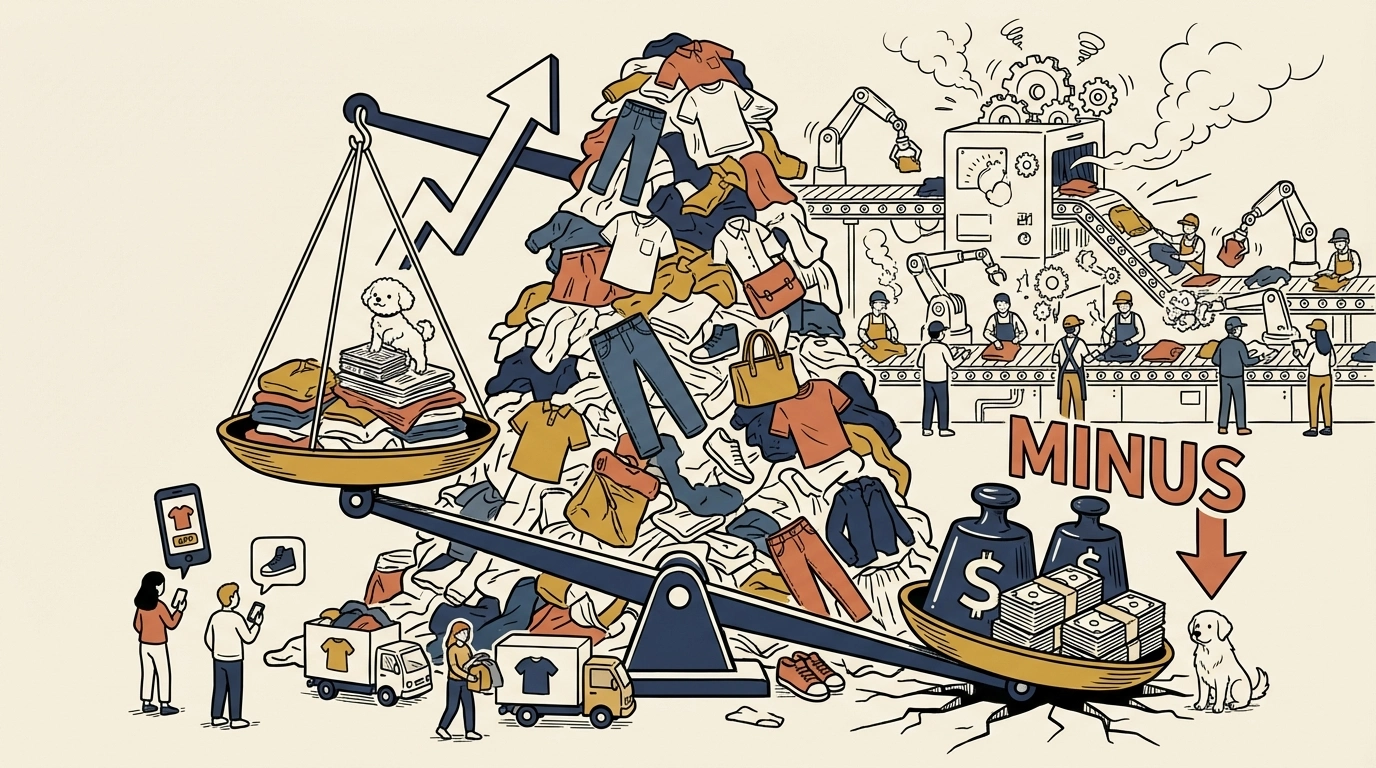
'Recl', which created a sensation in the second-hand clothing market by collecting used clothes from the front of the house with just a few smartphone touches and providing decent pocket money, has ultimately entered court receivership. Although it attracted investments by catching two rabbits at once—environmental protection and a virtuous cycle of second-hand clothing—it leaves a bitter disappointment as it failed to overcome the structural limitation of 'high variable costs' hidden behind its explosive external growth.
Innovation Found in Inconvenience, Establishing Itself as the 'National Used Clothes Collection App'
Recl was established in May 2021, starting from the acute inconvenience CEO Yang Soo-bin experienced firsthand while organizing her closet. Existing door-to-door used clothes purchasing companies unconditionally demanded a weight of 20kg or more, and the compensation was merely around 100 won per 1kg. Furthermore, taking photos one by one and posting them on a second-hand market was too cumbersome. CEO Yang quickly verified market demand through a 'web builder (I'mweb)' and then scaled up the business in earnest.
Recl introduced an unconventional system that collects items non-face-to-face free of charge if the total number of clothes, bags, and shoes is '20 or more pieces', allowing even single-person households to use it without burden. In particular, unlike the existing industry that purchased in bulk by weight, it introduced a 'Plus Purchase' system that compensates up to 20,000 won per piece for marketable clothing, in addition to the 'Basic Purchase' that pays 300 won per 1kg.
Thanks to its convenience and unconventional compensation, Recl grew explosively in a short period of time. Just three years after its service launch, the number of cumulative visitors exceeded 13 million, and as of March 2025, the cumulative collection volume surpassed 8,000 tons. The amount of used clothes collected in a single day reached 30 to 40 tons, boasting the highest collection volume by a single domestic company.
Introduction of AI Technology, Offline Expansion, and Large-Scale Investment Attraction
Efforts to innovate the entire used clothes ecosystem beyond simple collection also stood out. Recl reduced operational risks by signing a business agreement with a logistics company to increase logistics vehicles and secure an efficient collection network. It also actively utilized IT technology to computerize the entire process from collection to settlement using internal algorithms and QR codes, and maximized work efficiency by introducing 'Granter', an AI-based expenditure analysis service, in the financial accounting sector. Recently, it was selected for the Ministry of SMEs and Startups' 'Scale-up TIPS' program, pushing forward the development of a waste clothing condition inspection and resale valuation model using AI.
It also embarked on platform expansion by collaborating with Bunjang to hold a 'Harmless Closet Organizing' event, and aggressively expanded its B2C sales channels by opening a flagship store 'ReNewed' in Seongsu-dong, Seoul, as well as its Namyangju headquarters store, with the goal of 100% resale of collected clothing.
Recognized for such innovativeness and the strong ESG (Environmental, Social, and Governance) value of 'reducing carbon emissions by 70%', love calls from the investment industry poured in. Following The Ventures in 2021, Big Basin Capital and Merry Year Social Company (MYSC) in 2022, it attracted a 3.5 billion won Series A investment led by Smilegate Investment with participation from Sema Investment and others in 2024. According to PitchDeck's data, Recl's enterprise value was evaluated at 18.5 billion won at the time.
As Sales Jumped 15 Times, Deficit Also Exploded... The Trap of 'Variable Costs' that Caught Their Ankles
Behind Recl, which seemed to be on a winning streak, lay a fatal weakness. It was a structure in which profitability deteriorated as the volume of collection increased. According to external information, sales surged more than 15 times from 380 million won in 2022 to 6 billion won in 2024, but operating losses also snowballed from 400 million won in 2022 to 1.3 billion won in 2023, and 3 billion won in 2024.
The cause was excessive 'variable costs'. For Plus Purchases, Recl had to meticulously inspect collected clothes one by one manually through the first and second rounds. In fact, it was a labor-intensive structure to the extent that about half of the approximately 50 employees in total were pickup and inspection personnel. As volume increased, labor and logistics costs increased exponentially, and despite diversifying resale channels, they failed to properly manage the overflowing inventory and debt.
Consequently, Recl had a structure where the deficit grew proportionally to the customers using the service.
Signs of Business Contraction, Followed by 'Simplified Rehabilitation' Proceedings
Originally, Recl had set an ambitious goal to expand its direct collection service to metropolitan cities nationwide by 2025. However, as it encountered severe financial difficulties, it began showing its limits by suspending the nationwide parcel collection service from March 2025 and drastically shrinking the direct collection areas to Seoul, Incheon, and parts of Gyeonggi Province.
Unable to endure the accumulated deficit, Recl eventually applied for simplified rehabilitation at the Seoul Bankruptcy Court. The court issued a comprehensive stay order preventing compulsory execution by creditors on November 7, 2025, and subsequently issued a decision to commence simplified rehabilitation proceedings on December 9, 2025, with CEO Yang Soo-bin as the statutory administrator.
Recl's challenge to prevent environmental pollution caused by clothing waste and change the culture of used clothes collection is currently standing at a critical crossroads. The attention of the industry is focused on whether this 'good company', which created carbon reduction effects equivalent to planting tens of millions of pine trees by collecting used clothes weighing more than the bricks of the Great Wall of China, can truly overcome the shortcomings of its financial structure and rise again through bone-crushing rehabilitation proceedings.
Company financial data, investment reports, and startup analysis — all in one place
Explore PitchdeckCurated news, every week — straight to your inbox
Every Friday · Unsubscribe anytime