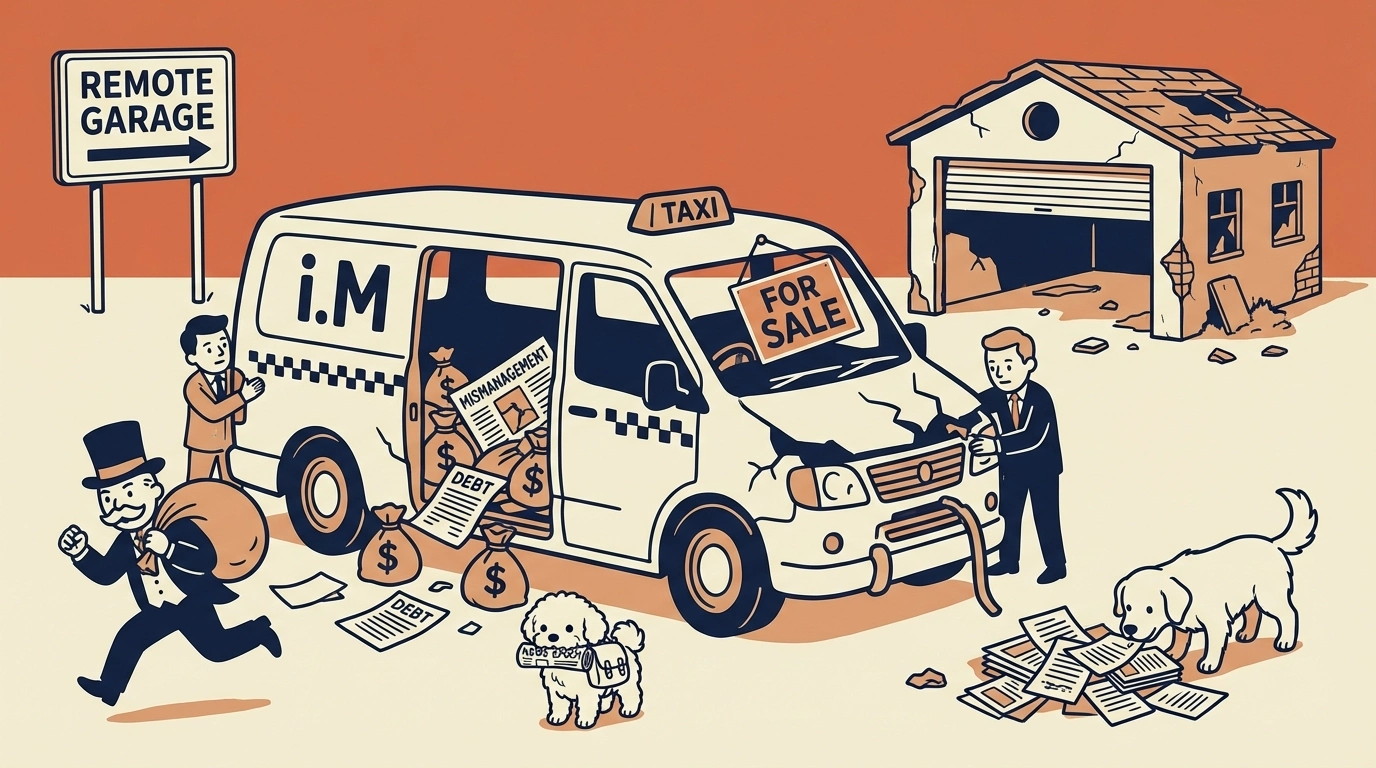
Once drawing attention as an emerging powerhouse in the mobility industry with its premium large van taxi 'i.M', Jin Mobility ultimately received a bankruptcy sentence from the Seoul Bankruptcy Court on February 20, 2026, and disappeared into history. The tragedy of Jin Mobility, which entered directly into liquidation procedures without even undergoing rehabilitation, clearly shows the barren reality and structural limitations facing the South Korean mobility industry, beyond just the reckless management of a single company. We covered the current state of the mobility industry by looking at how Jin Mobility, which started ambitiously by digging into the void left by 'Tada', somehow reached bankruptcy, as well as the situations of competitors such as Papa Mobility.
■ What Kind of Company Was Jin Mobility: The Combination of 'Taxi Licenses + IT' and Attracting Large-scale Investment
Jin Mobility differed from previous startups that relied solely on platform technology and clashed with the existing taxi industry. It was a company that boasted a high understanding of the taxi industry as its strength, with corporate taxi companies directly coming together to integrate IT services. In particular, it thoroughly managed service quality by setting a goal to guarantee drivers an income of around 4 million won per month through 100% salaried direct employment without the daily mandatory deposit (sanapgeum). In addition, it became familiar to citizens by carrying out public projects for families with infants and toddlers, such as the Seoul Metropolitan Government's 'Mom and Dad Taxi'.
According to 'Pitchdeck' data, Jin Mobility was established in 2020 under the co-CEO system of Cho Chang-jin and Lee Sung-wook, who are second-generation managers of a taxi company. Their vision and growth potential were highly evaluated in the capital market as well. In 2022, it attracted a total of 80 billion won in investment from EverBest Partners, Hana Securities, Yuanta Investment, and others, and its estimated corporate value at the time reached a whopping 230 billion won. Based on these massive funds, it aggressively acquired multiple corporate taxi companies, growing to a level that threatened the scale of Kakao Mobility's directly managed operations by once holding over 1,200 taxi licenses.
■ Uncontrollable Deficits and Reckless Management... Why Did It Collapse?
However, behind the spectacular outward expansion, severe financial deterioration and moral hazard were festering. Fixed costs (vehicle installment payments, drivers' salaries, garage maintenance fees, etc.) snowballed before a revenue model could even settle.
Jin Mobility's revenue in 2021 was 5.6 billion won (operating loss of -13.8 billion won), in 2022 it was 13 billion won (operating loss of -13.6 billion won), and in 2023 it recorded 17.8 billion won (operating loss of -4.2 billion won), failing to generate an annual surplus even once.
The most fatal problem was a severe depletion of liquidity. As of the end of 2023, current liabilities amounted to a staggering 77.1 billion won. Looking at the detailed breakdown, there were short-term borrowings (33.6 billion won), accounts payable (5.7 billion won), deposits received (5.3 billion won), and current portions of long-term liabilities (31.2 billion won, of which 26.2 billion won were current corporate bonds), but the cash on hand at the time was only around 560 million won. Even if all short-term loans were recovered, it was a desperate situation where a cash level of 13.5 billion won could never cover over 70 billion won in current liabilities. As severe financial difficulties continued, the number of employees plummeted from 65 in March 2023 to 12 in October 2025.
It failed to pay the four major insurance premiums deducted from the affiliated drivers' salaries for several months, and controversies over various unpaid wages, including severance pay, erupted. Eventually, union members sued CEO Lee Sung-wook on charges of occupational embezzlement, and the police, believing the charges were proven, forwarded the case to the prosecution.
Industry insiders strongly criticized Jin Mobility's reckless management. In an unreasonable attempt to convert Carnival vehicles to LPG, it selected unverified companies, causing frequent breakdowns, and even committed the bizarre act of selling vehicle bodies as used goods to secure cash immediately. Furthermore, poor management was serious, such as causing logistical inefficiencies by allocating garages in outlying areas rather than Gangnam or Dongdaemun, where customers are concentrated.
Ultimately, what cut off Jin Mobility's lifeline was the bankruptcy application by its creditor, Hyundai Capital. When vehicle installments amounting to 5.9 billion won were long overdue, Hyundai Capital judged that management normalization was impossible and directly filed for bankruptcy with the court so that at least the drivers' wage claims could be preferentially reimbursed.
The company was so ruined that it was impossible to even transparently disclose its financial status. Jin Mobility received a disclaimer of audit opinion in December 2024. The external auditor, Yeji Accounting Corporation, formalized the collapse of the financial system by stating the reason for the disclaimer as, "We have not been provided by the company's management with major materials necessary for conducting audit procedures, including the statements of financial position, statements of comprehensive income, statements of changes in equity, statements of cash flows, and notes to the financial statements for the fiscal year ending on the same date."
■ Papa Mobility and the Industry Atmosphere: "Survival is Impossible Without Corporate Backing and Deregulation"
Jin Mobility's failure is largely due to the reckless management of a single company, but at the same time, it represents the harsh reality of the South Korean mobility platform market. This is because, despite being an industry where large-scale initial infrastructure investments (purchasing vehicles, securing licenses, direct employment of drivers) are essential, structural limitations exist that make it difficult to generate profits.
Looking at the case of competitor 'Papa Mobility', one can see how capital-intensive this industry is. Papa Mobility is also mired in a severe swamp of deficits. As of the end of 2022, its total assets were only 3.2 billion won, while its net loss recorded 8.6 billion won, falling into a state of capital impairment early on.
The only reason Papa Mobility has avoided bankruptcy unlike Jin Mobility is thanks to the infusion of funds from its reliable parent company. Starting with the initial investment by Kolon Honorary Chairman Lee Woong-yeul, the holding company Kolon Corporation acquired the management rights and participated in continuous paid-in capital increases, pouring in a cumulative 32.9 billion won in funds to date, which is why it is maintaining its existence. Kolon is also to the extent of facing financial burdens (headaches) due to successive requests for financial support from its subsidiaries.
Even though Papa Mobility continues to receive support from Kolon, it is showing an unusual atmosphere as the number of employees decreased from 166 in January 2025 to 29 in January 2026.
Jin Mobility dreamed of mobility innovation through bold attempts at directly purchasing taxi licenses and 100% direct employment. However, it failed to build a sophisticated revenue model capable of covering the astronomical initial fixed costs, and ultimately went into bankruptcy.
The reality of Papa Mobility, which survives on massive support funds from a large conglomerate like Kolon, and the situation of the industry unable to realize economies of scale due to being tied down by regulations, hold significant implications. The bankruptcy ticket of Jin Mobility painfully proves that the mobility platform industry is a 'thorny path' where independent survival is virtually impossible without groundbreaking deregulation or infinite capital infusion at the level of large conglomerates.
Company financial data, investment reports, and startup analysis — all in one place
Explore PitchdeckCurated news, every week — straight to your inbox
Every Friday · Unsubscribe anytime