![[In-Depth] Hyundai Home Shopping's Voluntary Delisting After 16 Years... Turning 'Stagnant Growth' into an Opportunity for 'Corporate Governance Restructuring'](https://d1gl51xbrxoj65.cloudfront.net/uploads/2026/03/09/1773044855471-enljnqq.webp)
Resolving Multiple Listings and Serializing Corporate Governance Through Spin-Offs
Expanding High-Cost Structure Amidst a 71% Plunge in Operating Profit and Worsening Cash Flow
Utilization of 1.3 Trillion Won in Retained Earnings and Simultaneous Treasury Stock Cancellation by Subsidiaries (Handsome, Hyundai Futurenet)
Hyundai Home Shopping, which entered the KOSPI market in 2010, will leave the stock market after 16 years as it becomes a 100% wholly-owned subsidiary through a stock exchange with the holding company (Hyundai GF Holdings). The superficial justification is the simplification of corporate governance, but a deeper look into the financial data clearly reveals the structural growth slowdown of the home shopping industry and the group-level goal of a massive 'financial restructuring' to overcome it. Judging that there is no practical benefit to maintaining the listing in a situation where the profitability of its main business has declined, the company made a strategic financial decision to block interference from external shareholders and reallocate internally accumulated retained funds around the holding company.
Resolving Overlapping Listings and Serializing Corporate Governance Through Spin-Offs
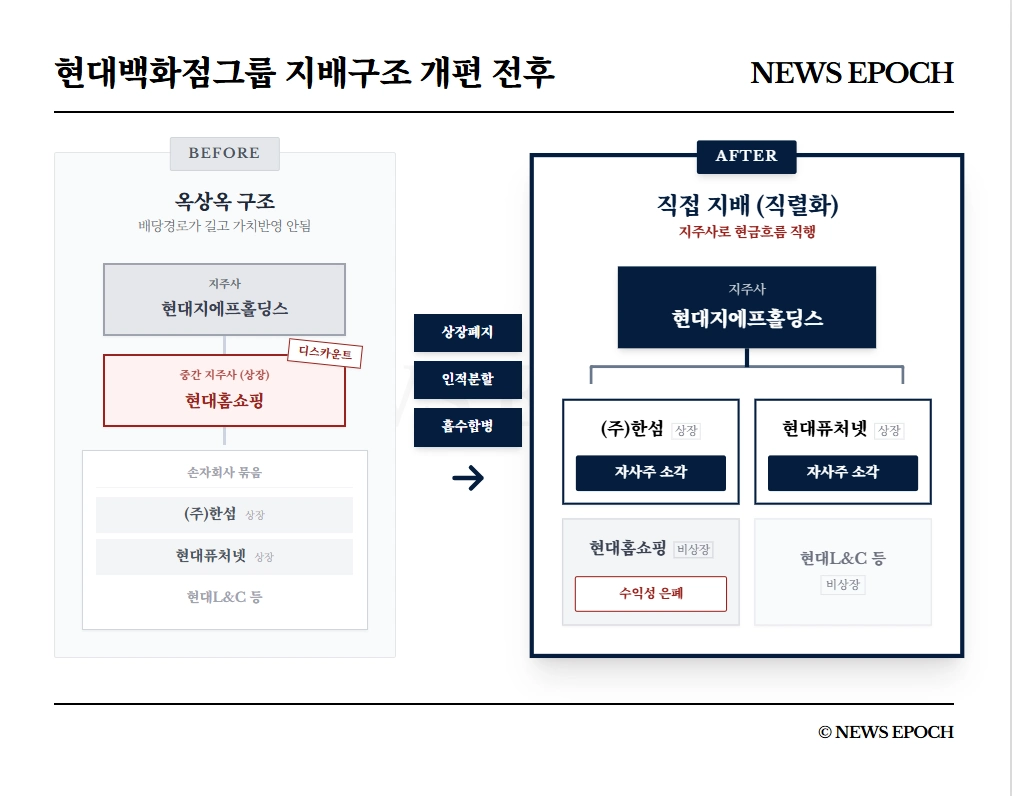
Hyundai Department Store Group decided on the delisting to resolve the double-listing issue caused by the holding company and its affiliates being listed simultaneously, and to improve the undervaluation of corporate value. Until now, Hyundai Home Shopping has played the role of an intermediate holding company with lucrative affiliates such as Handsome and Hyundai Futurenet, but this ultimately resulted in a structural limitation that dispersed the value of the holding company, Hyundai GF Holdings.
Following the delisting, the group plans to take steps to spin off Hyundai Home Shopping into an 'operating company' and an 'investment company'. By merging the spun-off investment company with Hyundai GF Holdings, the existing multi-level governance structure of 'Hyundai GF Holdings → Hyundai Home Shopping → sub-subsidiaries (Handsome, etc.)' can be simplified to 'Hyundai GF Holdings → subsidiaries'.
Through this process, approximately 854.8 billion won (as of 2024) worth of equity-method stocks held by Hyundai Home Shopping will be directly transferred to the holding company. The holding company will directly receive the cash flow and dividends generated by lucrative subsidiaries without an intermediate step, thereby maximizing the efficiency of capital allocation.
A 71% Plunge in Operating Profit and Worsening Cash Flow... Entrenched High-Cost Structure
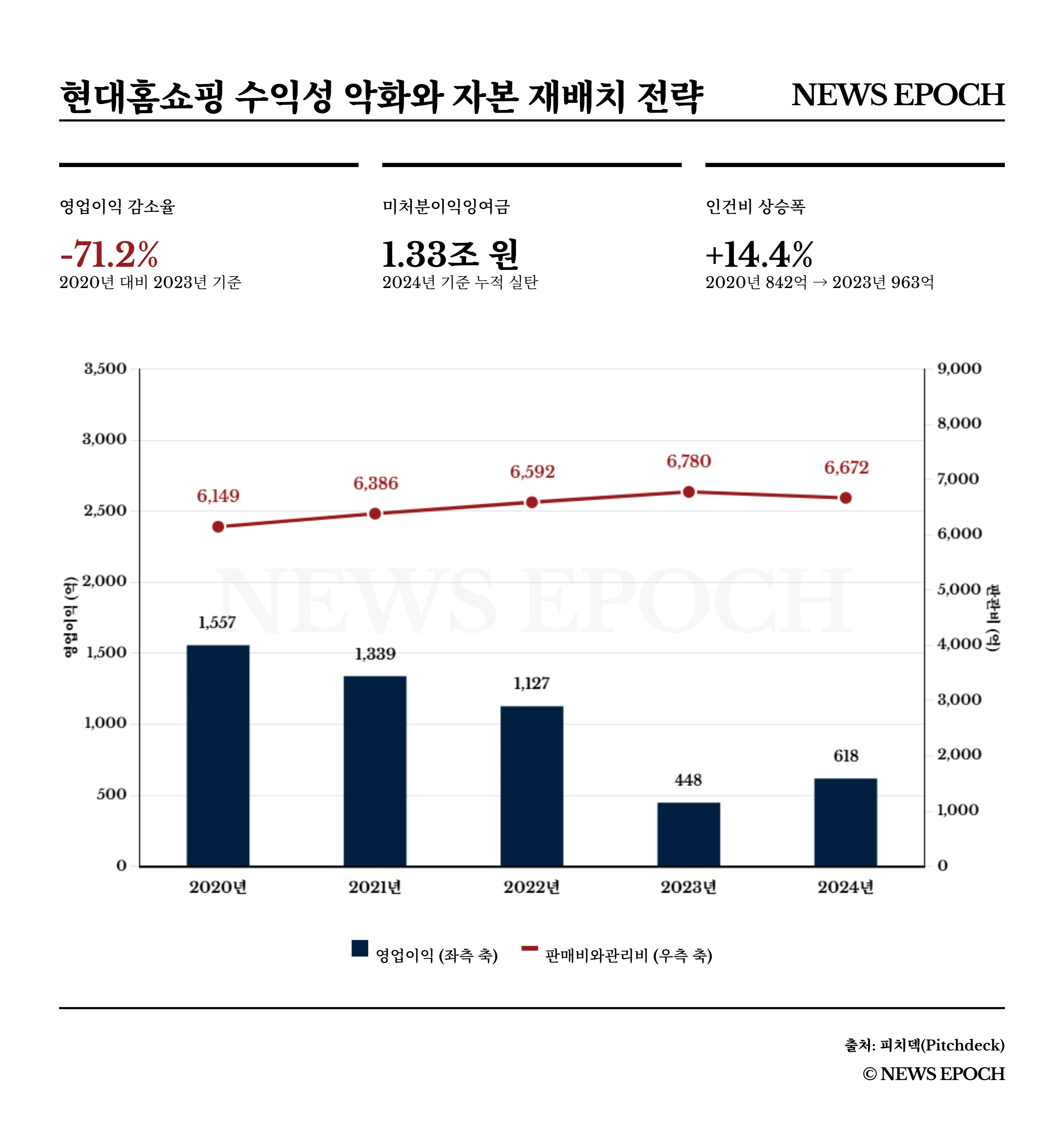
The core reason Hyundai Home Shopping chose voluntary delisting is the continuous deterioration in the profitability of its main home shopping business. The numbers shown on the income statement are grim. Operating profit, which reached approximately 155.7 billion won in 2020, evaporated by about 71% in just three years to approximately 44.9 billion won in 2023. Although it partially rebounded to about 61.8 billion won in 2024, it is insufficient to recover its past profit capacity.
Operating cash flow, which indicates the company's cash-generating ability, also slowed down severely. The cash flow, which recorded an inflow of approximately 159.0 billion won in 2020, turned to a deficit of minus (-) 43.3 billion won in 2023, facing a situation where cash was actually draining out. On the other hand, the company rather increased its expense spending while profitability was being damaged. Selling and administrative expenses, which were approximately 614.9 billion won in 2020, increased to approximately 678.0 billion won in 2023. Total labor costs (including salaries and severance pay), which were approximately 84.2 billion won in 2021, swelled to 96.3 billion won in 2024, and in particular, employee welfare expenses soared by more than 50% from 9.7 billion won to 14.7 billion won during the same period. Ultimately, the transition to being unlisted is a preemptive measure by the group to escape the short-term performance pressure as a listed company and to create an environment to drastically overhaul this entrenched high-cost, low-efficiency structure without external interference.
1.3 Trillion Won of Retained Earnings and Simultaneous Treasury Stock Cancellation by Subsidiaries
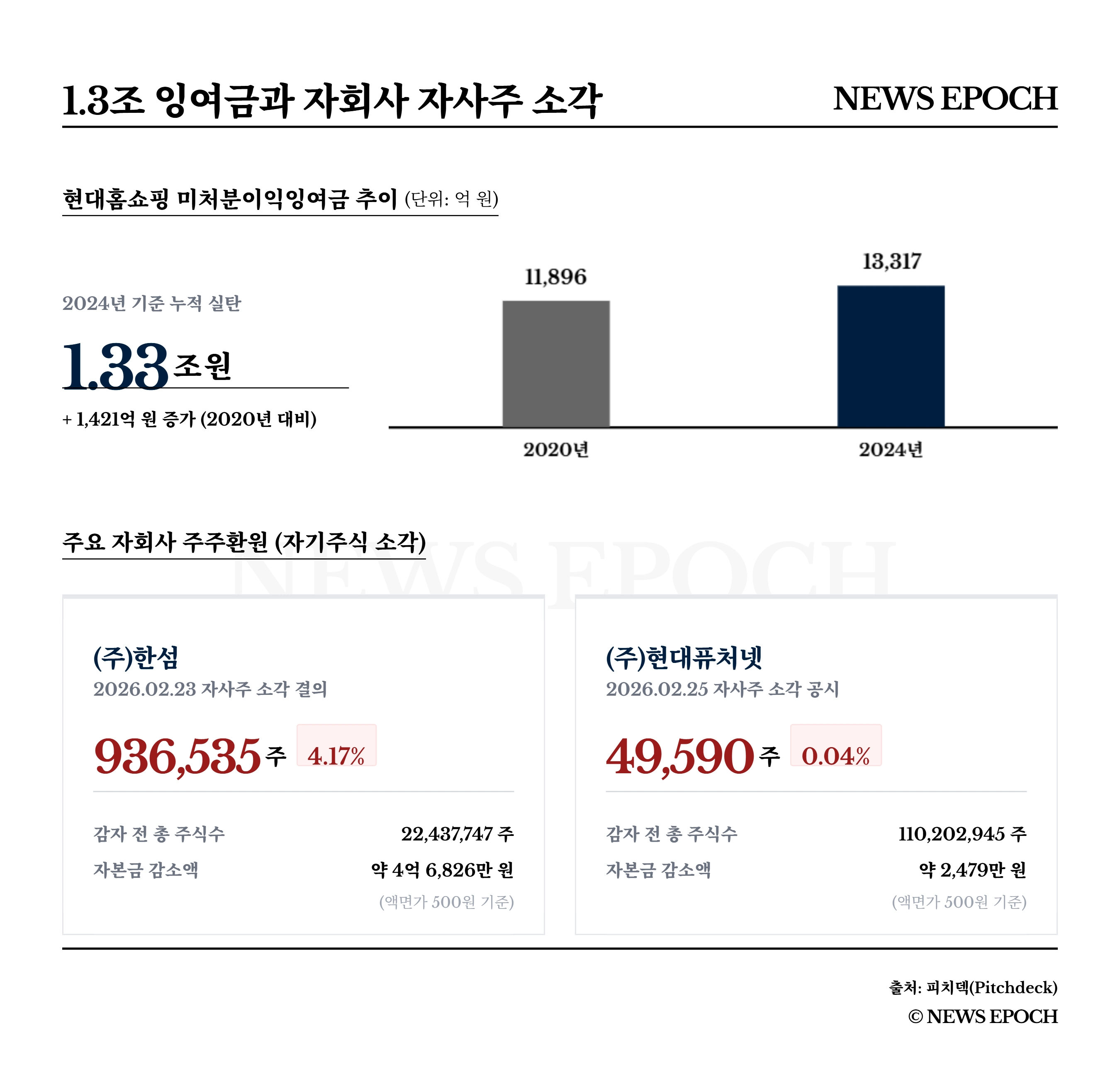
Although the growth of its main business has stopped, Hyundai Home Shopping is firmly stockpiling the massive cash earned during its past boom years internally. According to the statement of financial position and the statement of appropriation of retained earnings, unappropriated retained earnings steadily swelled from approximately 1.1896 trillion won in 2020 to approximately 1.3317 trillion won as of 2024. The group is injecting this large-scale surplus as core ammunition to minimize shareholder backlash and defend against the dilution of the controlling shareholders' stake during the delisting phase.
The group expanded this capital efficiency work not only to the parent company but also to its subsidiaries, scaling it up to a group-wide restructuring. On February 23, 2026, Handsome, a subsidiary of Hyundai Home Shopping, resolved to cancel 936,535 common shares, equivalent to 4.17% of total issued shares (22,437,747 shares), in order to boost shareholder value. This is an intensive measure that directly cuts down capital stock by approximately 468 million won based on face value (500 won).
Subsequently, on February 25, another subsidiary, Hyundai Futurenet, also announced consecutively that it would cancel 49,590 common shares (a capital stock reduction of approximately 24.79 million won), which is 0.04% of total issued shares (110,202,945 shares). In particular, the two companies clearly stated in their public disclosures that they would not stop at this one-time cancellation, but 'plan to proceed with additional cancellations for treasury stocks acquired within the scope of future dividend-distributable profits'. In the face of the delisting phase, the group has firmly imprinted on the market its strong and continuous commitment to capital efficiency at the group level.
From 'Retail' to 'Investment', a Strategy for Efficient Capital Allocation
Hyundai Home Shopping's delisting is a cold-hearted financial reorganization process directly put into action by Hyundai Department Store Group after facing the reality of an industry with declining profitability. In a situation where the practical benefits of capital procurement from maintaining the listing have disappeared, the group has firmly laid the foundation to execute a drastic cost structure improvement by transitioning the home shopping business division into an unlisted company. At the same time, by following the meticulous steps of spin-off and holding company merger, it completely gathered 1.3 trillion won of surplus funds and stakes in lucrative subsidiaries under the direct control of the holding company. Ultimately, this deal is the optimal restructuring scenario completed by the group to preemptively defend against business uncertainties and maximize the capital allocation efficiency of the entire group.
Company financial data, investment reports, and startup analysis — all in one place
Explore PitchdeckCurated news, every week — straight to your inbox
Every Friday · Unsubscribe anytime