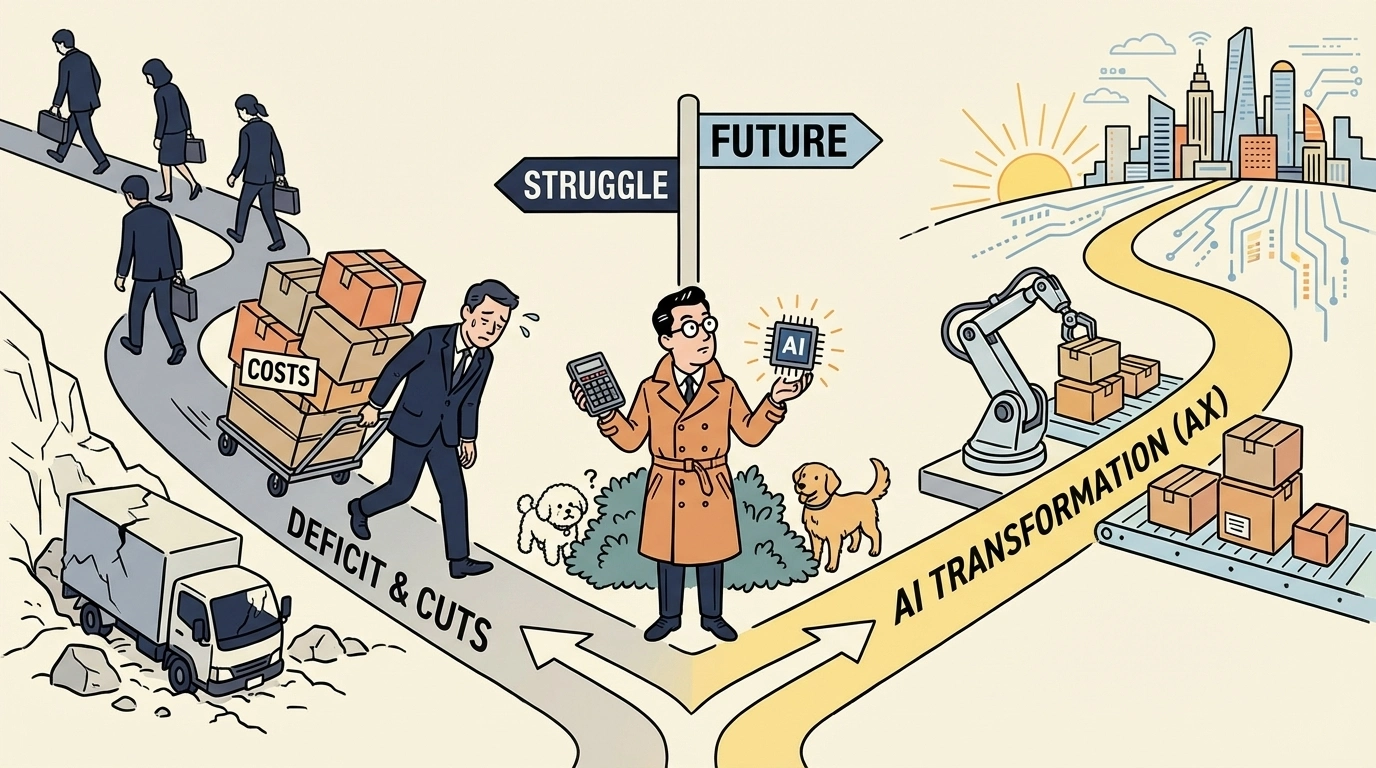
LG Uplus's first in-house venture, the digital logistics startup 'Dver', which had a spectacular start, has reached a critical inflection point in its growth. Although it seemed to be riding high, recording explosive top-line growth every year and being selected as a 'Baby Unicorn' by the Ministry of SMEs and Startups, behind the scenes lies a harsh reality of structural deficits that are rarely improving and the depletion of funds. Dver has currently carried out large-scale workforce reductions for survival while simultaneously casting its final winning move to improve profitability through a complete AI transformation (AX).
■ A Rising Star with Over KRW 8 Billion in Cumulative Investment and an Enterprise Value of KRW 25 Billion
Dver has grown on two main pillars: its smart logistics service, the delivery brokerage platform 'Dver', and its digital mailroom service 'DPOST'. Recognized for its innovation in last-mile logistics, the company has continued to receive love calls from investors.
According to Pitchdeck, Dver has attracted a total of over KRW 8 billion in investment so far. In particular, it drew market attention in 2022 by securing a KRW 2 billion investment from Capstone Partners, SJ Investment Partners, LG Uplus, and others. The following year, in 2023, it not only secured follow-up investment from SJ Investment Partners but also received additional funding from Woori Financial Capital, continuing its capital raising. At that time, as of 2023, Dver's estimated enterprise value was evaluated at around KRW 25 billion, establishing itself as a promising player in the logistics startup industry.
■ Top-line Grew, but High Cost Ratio is a Problem... Deficits Continue Despite KRW 10.4 Billion in Revenue
However, contrary to its spectacular outward growth, internally it was experiencing 'growing pains'.
Dver's revenue grew significantly every year, recording KRW 1.8 billion in 2020, KRW 3.4 billion in 2021, KRW 5 billion in 2022, KRW 7.1 billion in 2023, and KRW 10.4 billion in 2024. The figure of "over 50% growth every year" mentioned by CEO Jang Seung-rae in a media interview was effectively proven by actual performance.
The problem is chronic profitability deterioration, where the deficit either widens or remains the same as revenue increases. Operating losses started at KRW -360 million in 2020, surged to KRW -1 billion in 2021, KRW -2.1 billion in 2022, and KRW -2.6 billion in 2023, and even in 2024 when revenue surpassed KRW 10 billion, it recorded a massive loss of KRW -2 billion.
This is due to an excessively high cost of sales ratio and fixed SG&A (selling, general, and administrative) expenses. Although it generated KRW 5 billion in revenue in 2022, the cost of sales reached KRW 4.3 billion (an 86% cost ratio). In 2023, the cost of sales was KRW 6.4 billion against KRW 7.1 billion in revenue (a 90% cost ratio), and in 2024, the cost of sales soared to a whopping KRW 9.2 billion against KRW 10.4 billion in revenue (an 88% cost ratio). The company has encountered a limitation where the cost burden rises in proportion to the increase in revenue.
In addition, SG&A expenses have steadily remained around KRW 3 billion every year, recording KRW 2.9 billion in 2022, KRW 3.3 billion in 2023, and KRW 3.2 billion in 2024. With fixed-cost-like SG&A expenses of KRW 3 billion occurring while the marginal profit rate is extremely low, the business is stuck in a structure where securing profitability is virtually impossible without fundamental cost improvements.
■ Depletion of Investment Funds and Bone-Crushing Restructuring... 70% of Employees Have Left the Company
As the profit structure rarely improved, the company's coffers quickly dried up. According to the provided status data, it is understood that Dver has currently exhausted most of the over KRW 8 billion in investment funds it had attracted. In a situation where additional large-scale capital injections are difficult, Dver ultimately pulled out the card of large-scale 'workforce reduction' as a last resort for survival.
Dver, which embarked on full-scale restructuring starting in the second half of 2025 to manage costs, saw its number of employees plummet to just 27 as of January 2026, down from 85 in 2024. This means that about 70% of the total employees were cut over a period of a little over a year and a half, clearly showing how severe the financial sense of crisis the company is currently facing is.
■ A Crossroads of Survival, the Last Breakthrough is 'AI Transformation (AX)'
In the midst of a desperate crisis, the only solution Dver has chosen for survival is an 'AI-centric automation transformation (AX)'. The strategy is to fill the workforce void left by restructuring with AI technology and drastically lower the high operating costs that were the cause of the chronic profitability deterioration.
To break away from the existing analog telephone-centric quick service reception method, Dver recently unveiled an automatic order reception system based on an 'AI agent'. CEO Jang Seung-rae has stated, "While an existing agent cost about KRW 1,000 per call, AI can lower this to under KRW 100." The AI agent automatically collects delivery information through natural conversations with customers and automatically processes dispatch requests and real-time monitoring.
This move by Dver is not merely a show of technology, but a cost innovation effort directly linked to survival. This is because the company's future cannot be guaranteed if it fails to cut off the cost ratio, which increased proportionally as revenue rose, through AI technology.
Dver started with a grand dream of digitally innovating the complex structure of the logistics industry, but currently stands in the middle of the 'Valley of Death' in the unforgiving startup ecosystem. The industry's attention is focused on whether Dver, which is undergoing the painful ordeal of large-scale restructuring, will be able to rebuild its collapsed profit structure and soar once again through the 'AI transformation' it advocates.
Company financial data, investment reports, and startup analysis — all in one place
Explore PitchdeckCurated news, every week — straight to your inbox
Every Friday · Unsubscribe anytime