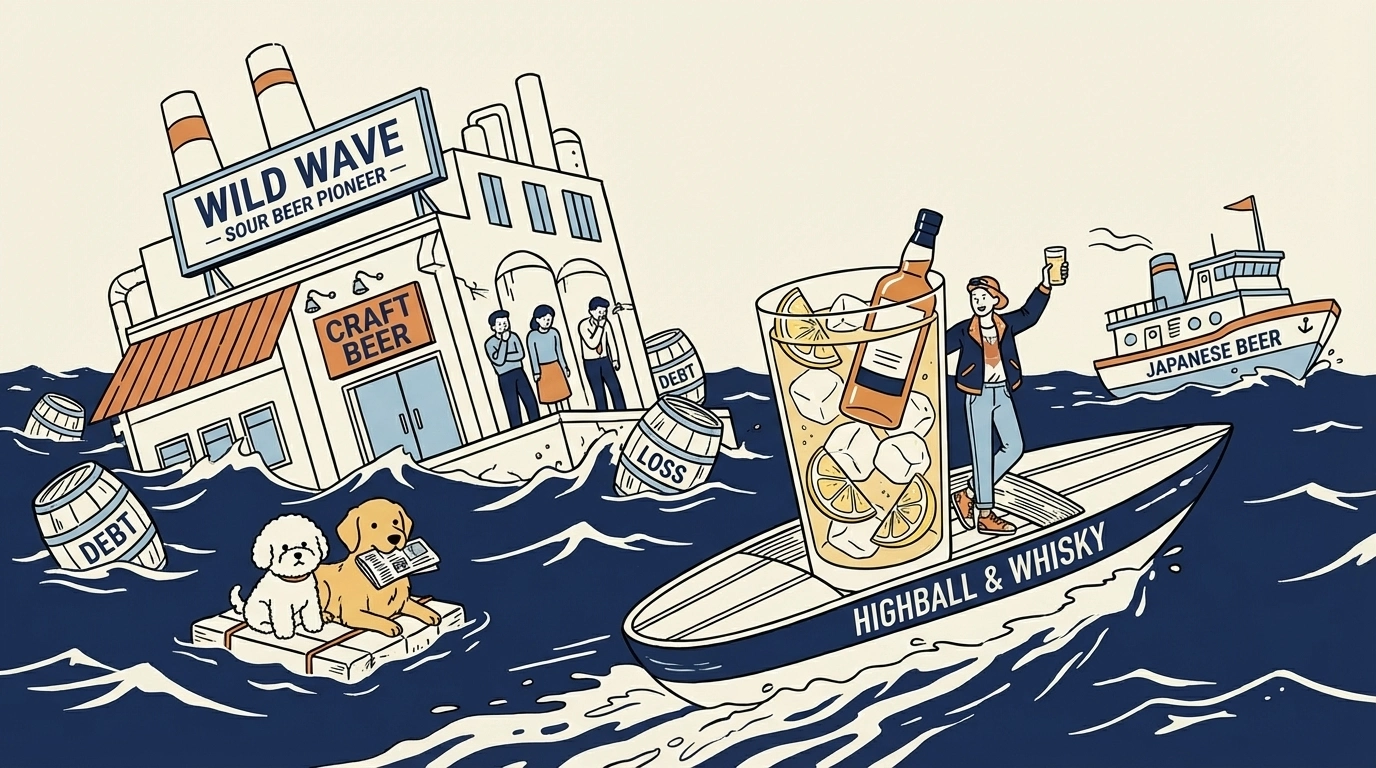
Craft beer market cut in half by the revival of highballs and Japanese beer... A wave of bankruptcies for first-generation leading companies
Just a few years ago, craft beers enjoying their heyday brightly decorated convenience store shelves, but they are now disappearing. The domestic craft beer market, which expanded to a size of 152 billion won in 2021 riding the reflex benefit of the 2019 boycott of Japanese products and the 'drinking at home' trend caused by COVID-19, has walked a steep downhill path since the endemic and recently shrank to the 70 billion won range.
The downfall of the leading companies that led the industry shows the current dismal reality of the craft beer market. First-generation craft beer company Sevenbroi, which spearheaded the market boom by surpassing 60 million cans in cumulative sales with its 'Gompyo Wheat Beer', suffered from deteriorating performance after the expiration of its trademark contract, resulting in its subsidiary being declared bankrupt and being delisted from the KONEX market. Amazing Brewing Company, which made Seongsu-dong a mecca for craft beer with an urban brewery concept, attracted over 10 billion won in investment, and even pushed for an initial public offering (IPO), has also virtually entered bankruptcy proceedings, burdened with an accumulated deficit of 14 billion won. South Korea's first listed craft beer company, Jeju Beer (currently Hanul & Jeju), has also suffered the growing pains of multiple management changes, recording a deficit for four consecutive years without ever generating a single profit.
Experts point to complex changes in the market environment and structural limitations as the causes of the craft beer industry's downfall. The MZ generation's liquor tastes have shifted to whiskey and highballs, which are easy to mix and drink, and as Japanese beer regained immense popularity after the boycott ended, the space for craft beer has narrowed. In addition to a drop in price competitiveness amid high inflation, relying too heavily on a low-margin structure of original equipment manufacturing (OEM) or collaborating with famous brands of large corporations, rather than developing their own brand competitiveness, is also pointed out as a painful blunder. To survive, some companies are jumping into the highball market by utilizing their beer production facilities, but it is difficult to guarantee survival without fundamental structural improvement.
A dream harbored in Germany, the reputation of 'Korean-style sour beer' pioneered by CEO Kim Gwan-yeol
Even amid the frenzy where numerous craft beer companies sprang up, Busan's 'Wild Wave' carved out an unrivaled path and received praise from enthusiasts. At the center of this is CEO Kim Gwan-yeol, who went to study abroad at the VLB brewing research institute in Berlin, Germany in 2013 with the dream of becoming a beer brewer.
After studying abroad, CEO Kim, who gained practical experience as a head brewer at a craft beer company, established Wild Wave with his colleagues under the philosophy of creating 'a craft beer uniquely from our country' that others could not make. He paid attention to the potential of yeast and microorganisms that have grown in Korea for tens of thousands of years. He introduced the nation's first spontaneous fermentation technique utilizing wild yeast and lactic acid bacteria in the air, and incorporated local specialties into the beer, such as strawberries from Gijang, Busan, honey from Jinhae, and wild raspberries from Geumjeongsanseong.
As a result, its flagship sour beer, 'Surleim', boasting the refreshing flavors of tangerine, orange, and lemon, won the grand prize at the Korea Wine & Spirits Awards for four consecutive years, and Wild Wave firmly established itself as a renowned house for 'sour beer' with strong acidity. The brand's prestige seemed to rise day by day, such as opening the contemporary dining bar 'Sour Yeongdo' in Yeongdo, Busan.
The cold reality behind innovation and passion... 'Recession-type surplus' endured through workforce reduction
However, armed with innovative technological prowess and a distinct philosophy, Wild Wave also could not avoid the bitter cold wave that hit the entire craft beer industry.
According to Pitchdeck, Wild Wave previously attracted over 800 million won in external investment, and its estimated corporate value at the time of the investment in 2021 was 7 billion won. However, their financial report card plummeted, exactly coinciding with the stagnation period of the craft beer market.
Sales, which were 1.2 billion won in 2019, decreased to 1 billion won in 2020, and were rather halved to 510 million won in 2021 when the craft beer market reportedly peaked. The scale of operating losses also swelled from 140 million won in 2019 to 390 million won in 2021 and 2022 respectively, and up to 420 million won (sales of 630 million won) in 2023.
Entering 2024, it struggled to turn a profit, recording sales of 780 million won and an operating profit of 50 million won, but few interpret this as a positive sign of a rebound. This is because this surplus did not come from actual sales growth or structural competitiveness recovery, but is a typical 'recession-type surplus' squeezed out by drastically reducing selling and administrative expenses. The number of employees, which amounted to about 10 during 2024, has recently plummeted to 3. The dominant analysis is that it merely created a surplus on the books through such severe restructuring, and realistically, it seems unreasonable to rebound the declining sales again with only 3 employees.
Numerous breweries that sprang up like bamboo shoots after the rain, intoxicated by the craft beer craze, are now standing at the crossroads of life and death amidst bone-numbing pain. Even CEO Kim Gwan-yeol's Wild Wave, which rose to the top of the industry with a firm brand identity and craftsmanship, is in a situation where it is barely catching its breath through the extreme measure of workforce reduction.
Domestic craft beer companies, which once soared brilliantly, are expected to continue being constantly tested for survival at the crossroads of their existence amidst the double and triple hardships of completely changed consumer tastes, fierce competition, and cost burdens.
Company financial data, investment reports, and startup analysis — all in one place
Explore PitchdeckCurated news, every week — straight to your inbox
Every Friday · Unsubscribe anytime