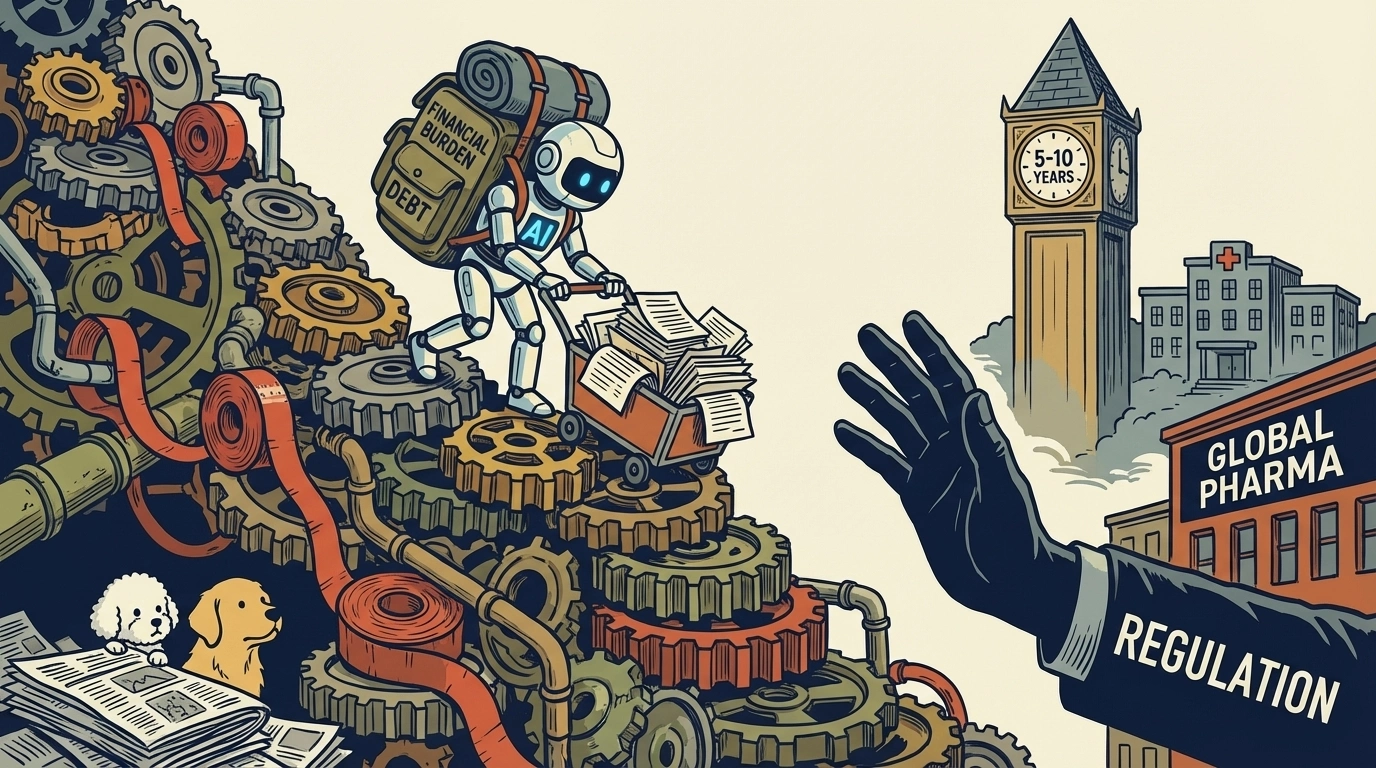
Promising domestic medical AI venture 'RayMed' is struggling in the radiopharmaceutical (RPT) AI solution sector. RayMed has proven its technological prowess by developing 'RayVision (RayDose),' a software that creates personalized precision treatment plans for patients by reducing Monte Carlo calculations, which previously took tens of days, to less than one minute. Recently, the company has been actively expanding its business by signing a strategic investment and joint research agreement with Ahn-Gook Pharmaceutical, and concluding a business agreement with HLB Pep for the development of 'peptide + AI' radiopharmaceuticals.
However, despite these remarkable moves and technological achievements, RayMed has hardly generated any earnings and is being pushed to the edge of a cliff. Behind this lies a complex industrial structural barrier and a severe financial crisis that go beyond a simple lack of capability as a venture company.
■ Industrial Structural Barriers Blocking Innovative Technology
Experts point out the following industrial limitations as the reasons why radioligand therapy (RLT) software companies like RayMed are struggling.
1. Conservative Clinical Fields and the Dilemma of 'Accountability'
Currently, representative radiopharmaceuticals, such as Novartis's Pluvicto, which have been approved by the US Food and Drug Administration (FDA), were strictly authorized with a 'fixed dose' from the clinical stage. Although there are large variations in drug distribution among patients, if a doctor arbitrarily increases the administered dose according to the recommendation of an AI software and side effects occur, it is unclear who is responsible among the doctor, hospital, or software. For this reason, clinicians are reluctant to adopt new solutions while bearing the risk of violating guidelines.
2. The Arduous 5 to 10-Year Sales Cycle and Infrastructure Costs
It takes too much time to translate directly into sales. The process of integrating software with a hospital's security system and existing imaging equipment (such as PACS) is complex and incurs high infrastructure costs. Even if introduction discussions begin, the company must endure a long sales cycle of 5 to 10 years—from Proof of Concept (PoC) to clinical papers, licensing, guideline reflection, and full-scale proliferation—before it leads to actual paid license revenue. Furthermore, due to the short half-life characteristic of radiopharmaceuticals, it is also difficult to secure large amounts of high-quality training data needed for AI advancement.
3. Ecosystem Domination by Global Giant Companies
The global market situation is not easy either. GE HealthCare is pre-empting the global market with its 'vendor neutrality' strategy, which is compatible with various imaging equipment, spearheaded by 'MIM Software.' In addition, pharmaceutical companies like Novartis and Telix are integrating their own customized platforms from the new drug development stage, meaning the ground for purely independent software startups is gradually narrowing.
■ A Painful Financial Report Card... Growing Deficits and Departure of Core Personnel
These structural barriers are reflected exactly in RayMed's financial indicators, dealing a fatal blow.
While the company's sales have stagnated at 600 million won in 2022, 700 million won in 2023, and 800 million won in 2024, its operating loss surged from 500 million won in 2022 and 600 million won in 2023 to a staggering 1.8 billion won in 2024. Although the sales volume itself is not large and thus might not be significant, the fact that accounts payable turnover days have rapidly increased from 14 days in 2022 to 90 days in 2024 is a concerning signal.
Recently, it received a 200 million won investment from Ahn-Gook Pharmaceutical at an estimated corporate value of 17.5 billion won, and it is estimated to have secured approximately 4 billion won in cumulative investments and around 700 million won in government subsidies. However, as the accumulated deficit reached 3.2 billion won at the end of 2024, and it is practically difficult to turn a profit in 2025 due to its structure, considering the depletion speed of the cumulative investments and government subsidies, it is a time when attracting large-scale follow-up investments immediately is absolutely necessary for the company's survival.
The most painful part is the manpower exodus. According to coverage, most of the nearly 20 employees as of January 2026 have resigned, and it is estimated that currently, only the registered executives remain to keep the company going. In effect, the company's core growth engine has been severely damaged.
■ At the Crossroads of Survival, Is There a Breakthrough?
In conclusion, the task RayMed is solving, 'personalized precision administration,' is clearly a clinically necessary field. However, the problem is that "the issue is genuinely significant, but the market structure to pay and solve that problem immediately is not yet fully mature."
To overcome the desperate situation of the current financial crisis and the departure of personnel, the prospect is that the company can only seek stabilization by rapidly attracting follow-up investments to provide breathing room and somehow pioneering a commercialization market to lead to meaningful actual license revenue.
Company financial data, investment reports, and startup analysis — all in one place
Explore PitchdeckCurated news, every week — straight to your inbox
Every Friday · Unsubscribe anytime