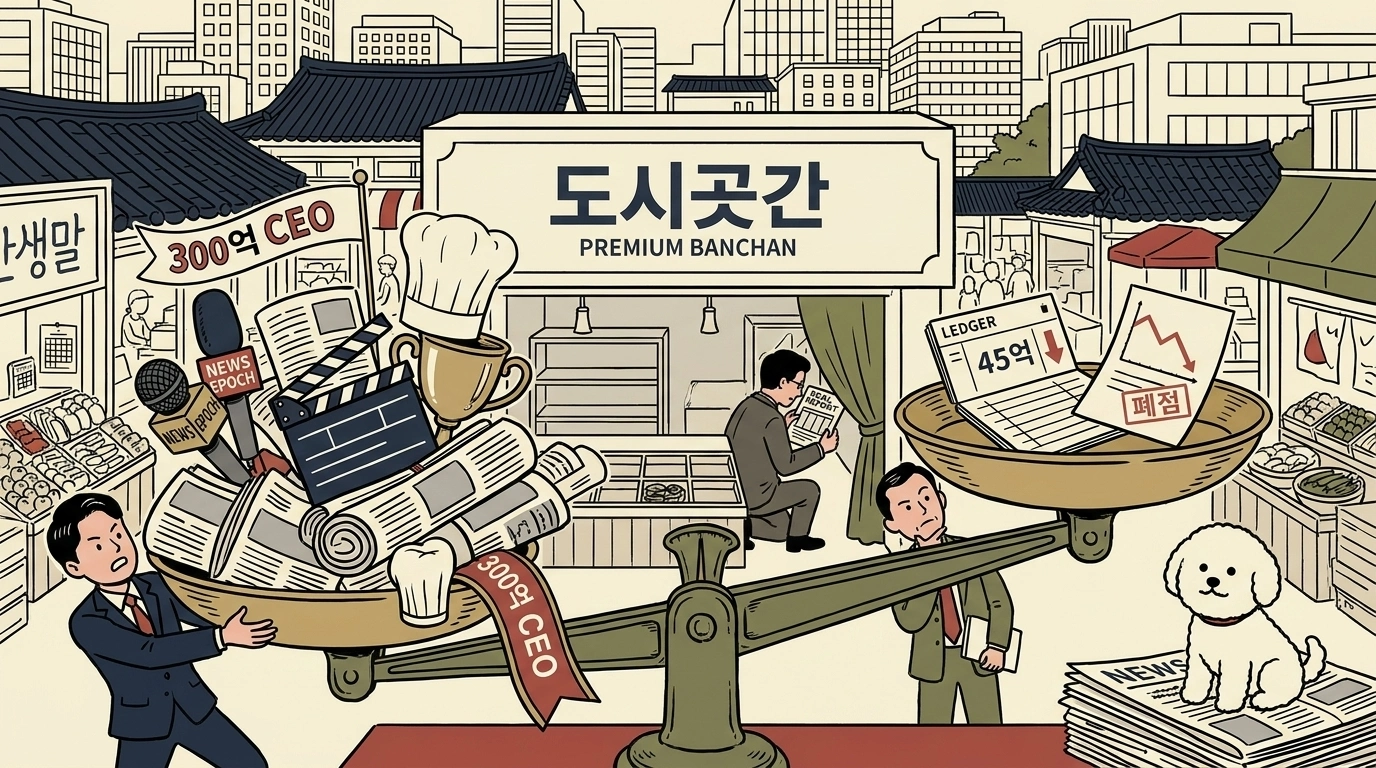
A young entrepreneur in his 20s who graduated from the CIA (The Culinary Institute of America) in New York, one of the world's top three culinary schools known as the 'Harvard of the culinary world.' This is the glamorous modifier for CEO Min Yo-han of the premium banchan (side dish) select shop 'Dosigotgan,' which has recently been receiving massive spotlights from the restaurant industry and media.
Especially after his appearance on the popular Netflix variety show 'Culinary Class Wars' under the title '30 Billion Won Banchan CEO,' the media have been scrambling to report the success story of Dosigotgan. It is said to be creating a sensation in the 5 trillion won domestic banchan market through mutual growth with farmers, trendy interiors, and differentiated menu planning capabilities.
However, there is a hard-to-overlook discrepancy between the 'rosy numbers' pouring out through multiple media outlets and the actual financial and franchise business data. It is time to examine whether the franchise headquarters, which should provide transparent information to franchisees and prospective entrepreneurs, is masking the true reality of the company through exaggerated media play.
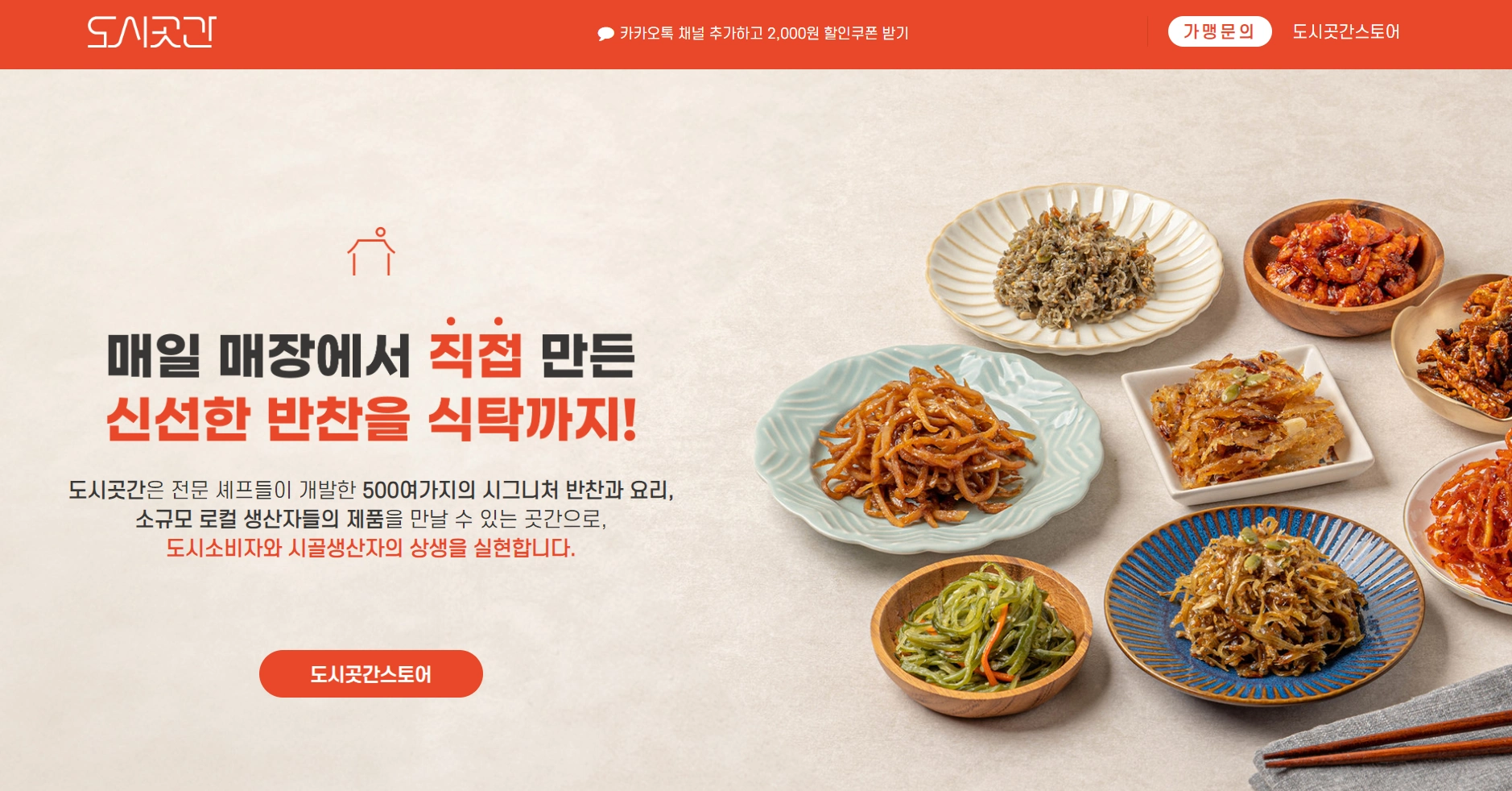
[Source: Dosigotgan Homepage]
Revenue of 25 Billion Won? 40 Billion Won?… The 'Truth of the Numbers' Revealed by the Separate Financial Statements
According to media reports, Dosigotgan is known to have started as a 16-pyeong store in 2019 and grown rapidly. The media reported that revenue, which was at the 900 million won level in 2020, jumped to 15 to 16 billion won in 2022, and achieved 25 billion won in 2023. Furthermore, CEO Min expressed confidence in a media interview, stating, "We expect the 30 billion won range this year, and more than 40 billion won next year."
But the reality is completely different. Synthesizing the Fair Trade Commission's information disclosure document and corporate data, the franchise headquarters Dosigotgan appears to have no subsidiaries, in which case the performance on the separate financial statements is the company's real report card. The revenues of 16 billion won in 2022 and 25 billion won in 2023, which were heavily promoted to the media, are also confirmed to have only reached 3.8 billion won in 2022 and 4.5 billion won in 2023 on the actual separate financial statements. In effect, the company has been exposed to the media by inflating its size by a whopping four to five times its actual size. Considering that the essence of a franchise business lies in trust with franchisees, such exaggerated promotion poses a great risk of clouding the judgment of prospective entrepreneurs, regardless of its purpose.
In relation to this, Dosigotgan CEO Min Yo-han explained to News Epoch, "25 billion won is the combined revenue of the franchise stores, and the headquarters' revenue is 4.5 billion won," and added, "Due to the restaurant industry's convention of promoting externally by combining direct and franchise sales into brand sales, it is a difference that occurred in that process."
The Illusion of 67 Stores… A 'Crisis Inflection Point' Where Closures Exceed New Openings
Dosigotgan has emphasized through the media that the average monthly revenue per store nationwide reaches 50 million won, boasting a high average spend per customer in the 21,000 won to 23,000 won range and an astonishingly low minimum disposal rate in the 0.8% range. In a media interview in 2024 after the broadcast of 'Culinary Class Wars', they touted that the number of stores had expanded to 67 (11 direct stores, 56 franchise stores).
However, the actual franchise indicators are sounding the complete opposite 'warning signs of negative growth.' According to actual data, the number of stores as of 2023 was 37 (3 direct, 34 franchise), and it was confirmed to be 46 in 2024 (11 direct, 35 franchise). The increase in store count in 2024 was the result of increasing direct stores with invested funds, not through the franchise business. The part to note is the sharp decline in new store openings and the increasing trend of closures. The number of new store openings, which reached 26 in 2022 when promotional effects peaked, plummeted to 9 in 2023. On the other hand, in 2023 alone, franchise departures occurred in rapid succession, including 9 contract cancellations, 1 contract expiration, and 3 changes of ownership. In 2024 as well, new openings stopped at 7, while contract cancellations reached 6 stores. In the media, they are calling for expansion dreaming of becoming the 'Olive Young of the banchan world,' but the reality has reached an inflection point right before the speed of franchise contract cancellations outpaces new store openings.
Innovation on the Outside, Continuous Deficits on the Inside… What Sustains the Company is 'Venture Investment Funds'
The profitability indicators behind the outward expansion are also precarious. Contrary to glamorous media reports, Dosigotgan has not been able to escape the swamp of chronic deficits, recording an operating loss of -200 million won in 2022, -700 million won in 2023, and -580 million won in 2024 (based on revenue of 6.5 billion won).
The only driving force that allowed Dosigotgan to hold out in this deficit situation is thanks to the infusion of funds from external venture capital (VC). Starting with an initial investment from Sopoong Ventures in 2022, it received a 3.1 billion won Series A investment at an estimated corporate value of 26 billion won from CJ Investment, Lotte Ventures, and others in 2023. Subsequently, in September 2024, it secured an accumulated investment of 6.2 billion won by additionally attracting a 2 billion won Series A bridge investment at an estimated corporate value of 37 billion won from CJ Investment, Bilance Investment, and others. As a result, thanks to an external infusion of about 6 billion won, the accumulated deficit of about 1.1 billion won as of the end of 2024 is at a defensible level, but it remains in a situation where it cannot generate self-sustaining profits from its main business of franchise operations and banchan sales.
Time to Step Down from the Media Spotlight and Face Inner Stability
The merit of Dosigotgan in collaborating with small-scale local farms to open new sales channels for young farmers and elevating the underdeveloped banchan shop market into a trendy lifestyle shop deserves recognition.
However, if behind the image of the young entrepreneur who emphasized fierceness by saying "the driving force of my life is deficiency," there lies a 'show window management' full of exaggerated numbers disconnected from facts, the trust of the public and investors will inevitably collapse like a sandcastle. What Dosigotgan needs now is not grandiose blueprints such as 'achieving tens of billions in revenue' or 'globalization of K-food' aimed at the media. This is a time when 'truly solidifying inner stability' based on transparent information disclosure and practical improvement of a profit model that can achieve mutual growth with franchisees is more important than ever.
Company financial data, investment reports, and startup analysis — all in one place
Explore PitchdeckCurated news, every week — straight to your inbox
Every Friday · Unsubscribe anytime