Established in 1976 and operating directly-managed ranches in Icheon and Hoengseong spanning a total area of 777,000㎡, 설성푸드 (Sulsung Food) is a company that has built deep consumer trust through sustainable, reliable, and high-quality food products. Its flagship premium Hanwoo (Korean beef) brand, 'Sulsung Ranch', excludes inhumane livestock practices and raises Hanwoo under strict ecological rules such as animal welfare, free-range grazing, antibiotic-free practices, and well-being feed. The healthy Hanwoo raised this way is processed into various forms ranging from fresh meat to HMR (Home Meal Replacement) and meal kits through a state-of-the-art 'smart factory' with an annual production capacity of 11,100 tons, leading the premium food market.
Based on this brand power, the company achieved a surplus in 2025 and stood at a new starting line, but behind the scenes, a daunting financial wave is approaching, drawing market attention.
Completion of Massive Loss Processing in 2024... Operating Scorecard Flashes 'Warning Lights'
In 2024, 설성푸드 (Sulsung Food) recorded a massive net loss of 9.26 billion won, reflecting equity method losses and other factors. However, during the absorption merger of its subsidiary 설성식품 (Sulsung Food Co., Ltd.) at the end of 2024, the company executed a so-called 'Big Bath' measure, clearing potential insolvencies from its income statement in advance. Thanks to pre-reflecting these large past losses, a base effect occurred where the equity method loss item disappeared from the 2025 performance, and as a result, it succeeded in turning a book profit by generating a net income of approximately 280 million won.
However, the actual operating performance is somewhat disappointing. Sales in 2025 were 60.5 billion won, a decrease of approximately 18.7% compared to the previous year (74.5 billion won). On the other hand, due to the aftermath of increased borrowings and interest rate hikes, interest expenses surged from 1.57 billion won in the previous year to 2.55 billion won in 2025. With the operating profit earned during the year (2.05 billion won) failing to cover even the incurred interest expenses, the company has fallen into a state of 'interest coverage ratio of less than 1', making profitability improvement an urgent priority.
Imminent Repayment Pressure of 18.1 Billion Won... Tightly Blocked Collateral Capacity
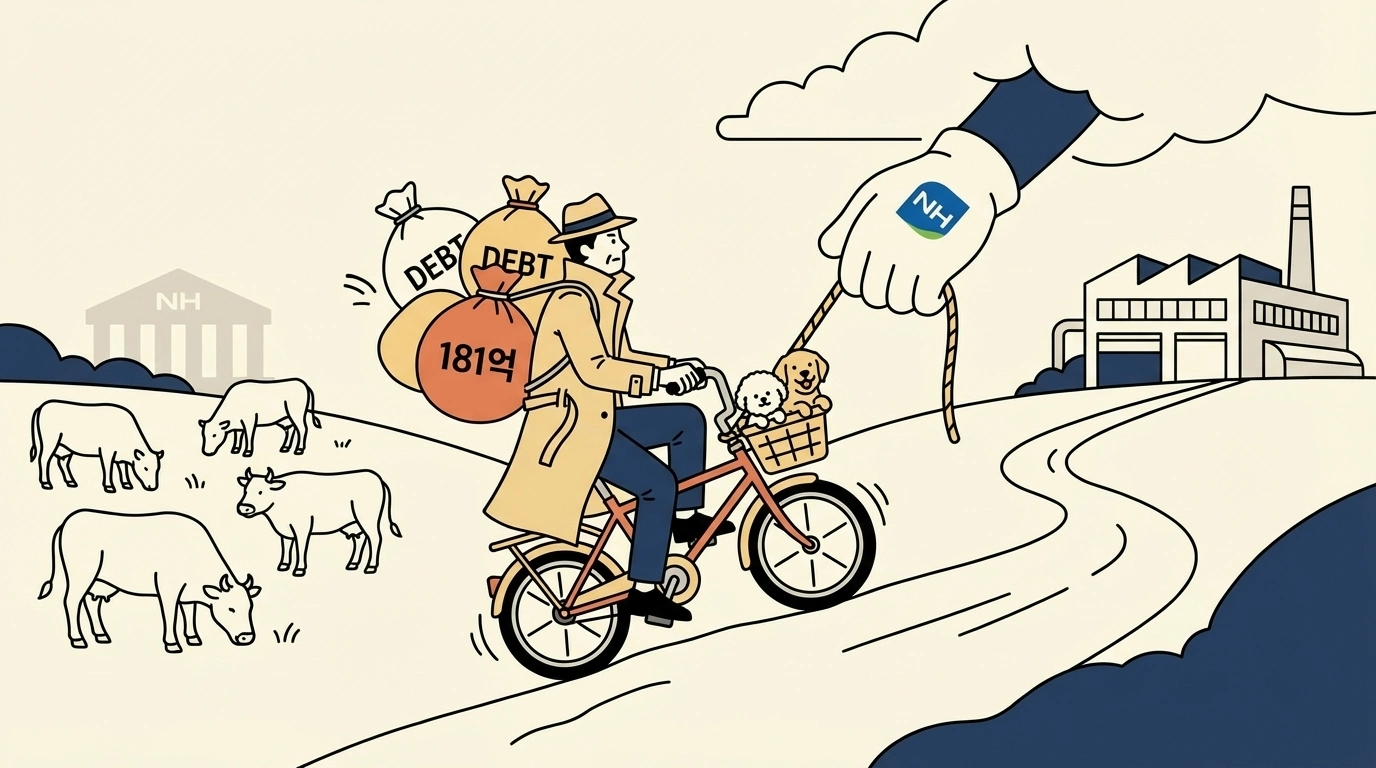
The most urgent obstacle currently facing 설성푸드 (Sulsung Food) is 'liquidity risk'. As the maturity of NH Nonghyup Bank facility funds, which were previously classified as non-current liabilities, approaches in 2026, the 'current portion of long-term debt' to be repaid within one year has surged to approximately 18.1 billion won. The company inherited massive facility investments, but its cash generation capacity has not supported it, causing repayment dates to hit all at once. As of the end of 2025, the company's cash and cash equivalents amount to merely 180 million won, making self-funded repayment practically impossible.
A bigger problem is that the collateral capacity for loan extensions (roll-over) or additional borrowing is severely lacking. Currently, a maximum claim amount totaling 24.11 billion won is set on the company's major assets, such as land and buildings, including 22.8 billion won from NH Nonghyup Bank and 1.31 billion won from the Korea SMEs and Startups Agency (KOSME). If liquidity risks are highlighted while collateral value is fully maxed out, the company may face demands for higher interest rates from financial institutions, further exacerbating its financial burden.
Inventories Jump 2.3 Times Amid Declining Sales... Inventory Management on 'Emergency'
The rapid increase in inventory assets can also become a future detonator. Even though the sales volume decreased compared to the previous year, inventory assets in 2025 swelled to approximately 9.59 billion won, surging more than 2.3 times compared to the previous year (about 4.13 billion won). This suggests a failure in production control or sluggishness in securing sales channels, and requires meticulous management as piled-up inventory could lead to massive inventory valuation losses if it results in a decline in asset value.
Recognized with a Corporate Value of 95 Billion Won in 2023... Will 'Pan-Nonghyup Synergy' Be the Relief Pitcher?
Amidst these overlapping unfavorable factors, the breakthrough that the market is paying attention to is 'synergy with Nonghyup'. In July 2023, 설성푸드 (Sulsung Food) raised funds by issuing convertible bonds (CB) worth 10 billion won targeted at the 'Pan-Nonghyup AgTech Mutual Growth Innovation Fund' co-managed by NH Nonghyup Bank and the PE division of NH Investment & Securities. At that time, 설성푸드 (Sulsung Food) was recognized with a corporate value of approximately 95 billion won and garnered expectations as a promising innovative company in the agricultural and livestock sector.
If the high-quality eco-friendly livestock technology and premium HMR product planning capabilities held by 설성푸드 (Sulsung Food) generate full-fledged synergy with Nonghyup affiliates, which possess a nationwide distribution network (such as Hanaro Mart) and robust financial infrastructure, it could become the decisive key to breaking through current financial pressures as well as expanding tightly blocked sales channels. In fact, key executives, including NH Nonghyup Bank CEO Lee Seok-yong, visited the site and promised to foster a private investment ecosystem, volunteering to act as strong allies.
설성푸드 (Sulsung Food) has achieved a book profit after wrapping up the painful loss processing of 2024. Although heavy tasks such as the imminent refinancing risk of 18.1 billion won, swollen inventory, and high interest expenses lie ahead, attention is focused on whether it can safely navigate this crisis by leveraging the premium brand competitiveness of 'Sulsung Ranch' and synergy with its reliable investment partner, 'Nonghyup'.
Company financial data, investment reports, and startup analysis — all in one place
Explore PitchdeckCurated news, every week — straight to your inbox
Every Friday · Unsubscribe anytime