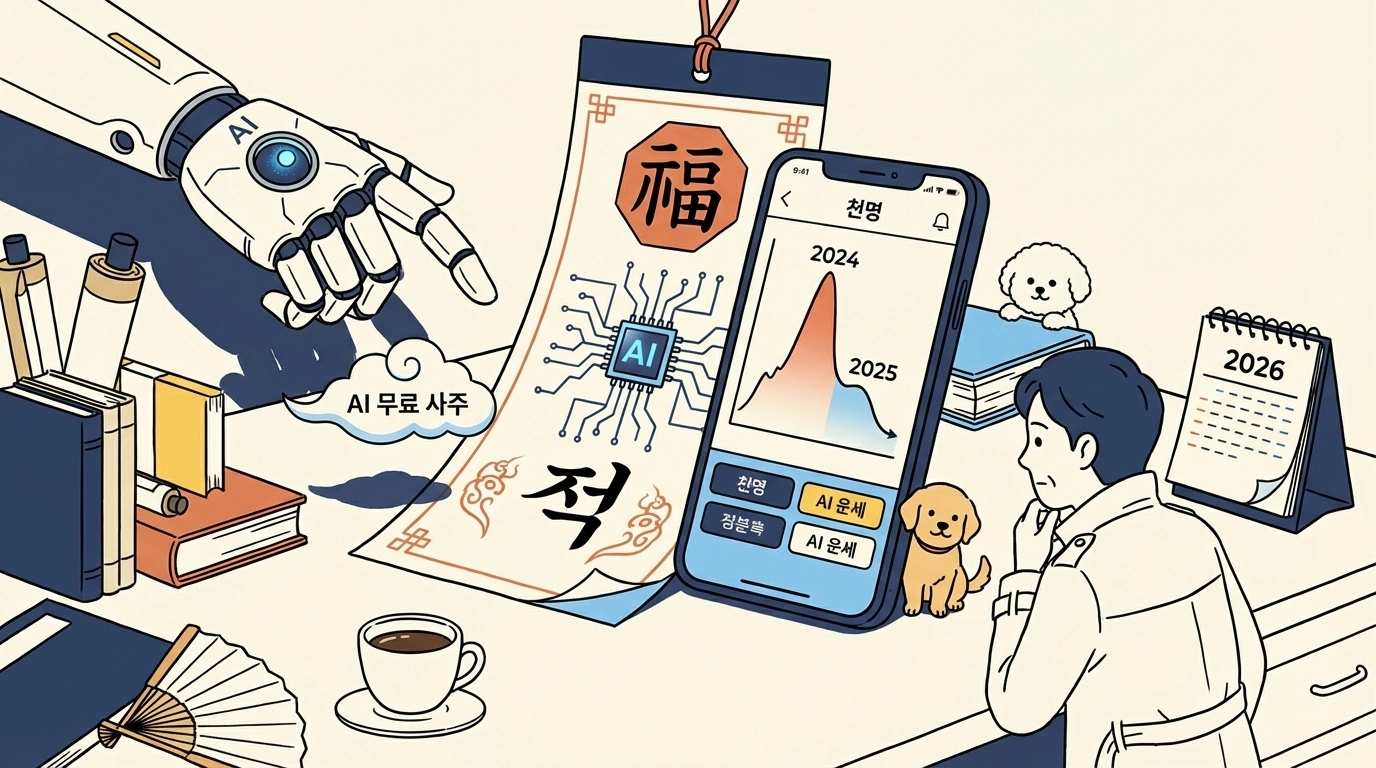
Breaking the Opacity of the Fortune-Telling Market Reliant on Word-of-Mouth
The domestic fortune-telling (shamanic readings, saju, tarot) industry is a fragmented market where official statistics are unclear due to the large number of single-person micro-businesses. According to the Association of Korean Fortune Tellers, it boasted a massive scale with 300,000 fortune tellers and 150,000 shamans around the time of the COVID-19 pandemic. However, consumers had to rely entirely on word-of-mouth passed through acquaintances, making it a typical 'information asymmetry' industry with opaque service quality and pricing.
Co-CEOs Yoo Hyun-jae and Jeon Jae-hyun of Chunmyung & Company faced the chronic problems of this market following a painful past experience where CEO Yoo's mother was scammed out of 30 million won by a shaman for an exorcism (gut). The two CEOs founded 'Chunmyung' with the goal of institutionalizing the fortune-telling market into an O2O (online-to-offline) platform so that outstanding fortune tellers can be treated appropriately and consumers can receive transparent consultations without being scammed.
Customized Service Combining Strict Verification and Cutting-Edge AI Technology
Unlike existing services that recklessly increased the number of counselors, Chunmyung staked its survival on 'service quality management.' A verification team consisting of 100 excellent customers who had received consultations over 20 times without a single friction directly experiences the consultation, and entry into the platform is only possible if all of them 'highly recommend' the counselor. The acceptance rate is so strict that it is only 10 to 15%, and the company also operates a full refund policy in case of dissatisfaction.
In particular, they achieved differentiation by actively incorporating cutting-edge IT technology. When a client inputs their concerns in text, the internal machine learning algorithm and natural language processing model analyze a vast amount of existing consultation review data to recommend the most suitable fortune teller. The fortune teller's consultation style is also categorized into options like 'goosebump-inducing' or 'warm,' thereby increasing the accuracy of customized matching. Furthermore, in the case of phone consultations, speech-to-text (STT) technology is utilized to automatically convert the entire consultation content into text in the form of a messenger conversation, maximizing convenience so that customers can review the consultation content at any time.
Venture Capital (VC) Opens Wallets for Fortune-Telling Services Around 2022
In particular, around 2021 and 2022, there was a golden age when massive investments from venture capital (VC) poured into the fortune-telling industry, coinciding with social uncertainty caused by the COVID-19 pandemic. The investment industry re-evaluated fortune-telling not simply as superstition but as 'big data created by ancestors,' determining that there was sufficient marketability if it was digitized and brought into the formal economy using IT technology.
During this period, large sums of money poured into fortune-telling startups. Chunmyung & Company secured a 5 billion won Series A investment in April 2022 from Altos Ventures—which had invested in Coupang, Baedal Minjok, and others—and Spring Camp, among others, attracting significant attention. Competitors in the same industry also received investments one after another. People Ventures, the operator of the online fortune-telling consultation platform 'Hong Cafe,' received a 2 billion won investment from DSC Investment in May 2022, and Unchilgisam, operating the fortune-telling content app 'ForceTeller,' attracted 8.5 billion won from Kakao Ventures, Kakao Games, Capstone Partners, and others. Thingsflow (later acquired by Krafton), behind the saju and fortune-telling chatbot 'Hellobot,' also received investments from BonAngels, Spring Camp, and others, demonstrating how VC capital drove the explosive growth of fortune-telling platforms.
The Feat of Turning a Profit Achieved in 2024… However, Stagnant Growth Arrives in 2025
Recognized for such innovation, Chunmyung attracted a cumulative investment of approximately 5.3 billion won from Altos Ventures, Spring Camp, and others, and its estimated enterprise value reached 22.2 billion won at the time of the investment.
Based on the investments, its performance also continued to grow rapidly. Revenue, which was 290 million won in 2020, expanded its scale to 1.8 billion won (operating loss of -3.2 billion won) in 2022, and in 2023, it recorded a revenue of 4.8 billion won and an operating loss of -300 million won, dramatically reducing the deficit. And finally, in 2024, it achieved a revenue of 5.4 billion won and an operating profit of 150 million won, successfully turning a profit.
However, the rosy trend was dampened entering the following year, 2025. In 2025, revenue was 4 billion won and operating profit was 40 million won, showing negative growth and entering a full-fledged revenue stagnation phase. In conjunction with this, the number of employees, which exceeded 30 in 2023, has been drastically reduced to less than half as of 2026.
The 'Free AI Saju' Craze Sweeping the Entire Industry
Behind this performance slowdown lies the trend of 'AI fortune-telling and saju reading,' which rapidly spread mainly among the digitally-friendly people in their 20s and 30s. The younger generation, experiencing high anxiety due to an uncertain future, is inputting their birth dates into large language models (LLMs) they normally use, such as Google's Gemini or OpenAI's ChatGPT, to seek customized saju and advice to resolve concerns about employment or dating. Furthermore, ultra-low-cost AI fortune-telling services priced at around 990 won or AI robot saju cafes have emerged, gaining immense popularity.
As a result, analysis suggests that as AI services with excellent accessibility and cost-effectiveness became popularized, a massive exodus of fortune-telling app customers—who had relatively low loyalty to existing platforms and desired light advice or entertainment—led to the decline in Chunmyung's performance.
Is It Just Chunmyung's Problem, or Is the Entire Industry Struggling? Whether this decline in revenue and profit is an isolated issue for Chunmyung & Company or if the entire industry is struggling under the fierce impact of AI saju services is expected to become clear once the 2025 performance results of other competitors are released and compared. If the 2025 performance metrics of major saju service competitors such as Unchilgisam, which operates 'ForceTeller,' and Thingsflow, which operates 'Hellobot,' are released and compared, it will be possible to determine whether the current crisis is a growing pain for a single platform or a structural seismic shift in the entire fortune-telling O2O industry.
Company financial data, investment reports, and startup analysis — all in one place
Explore PitchdeckCurated news, every week — straight to your inbox
Every Friday · Unsubscribe anytime