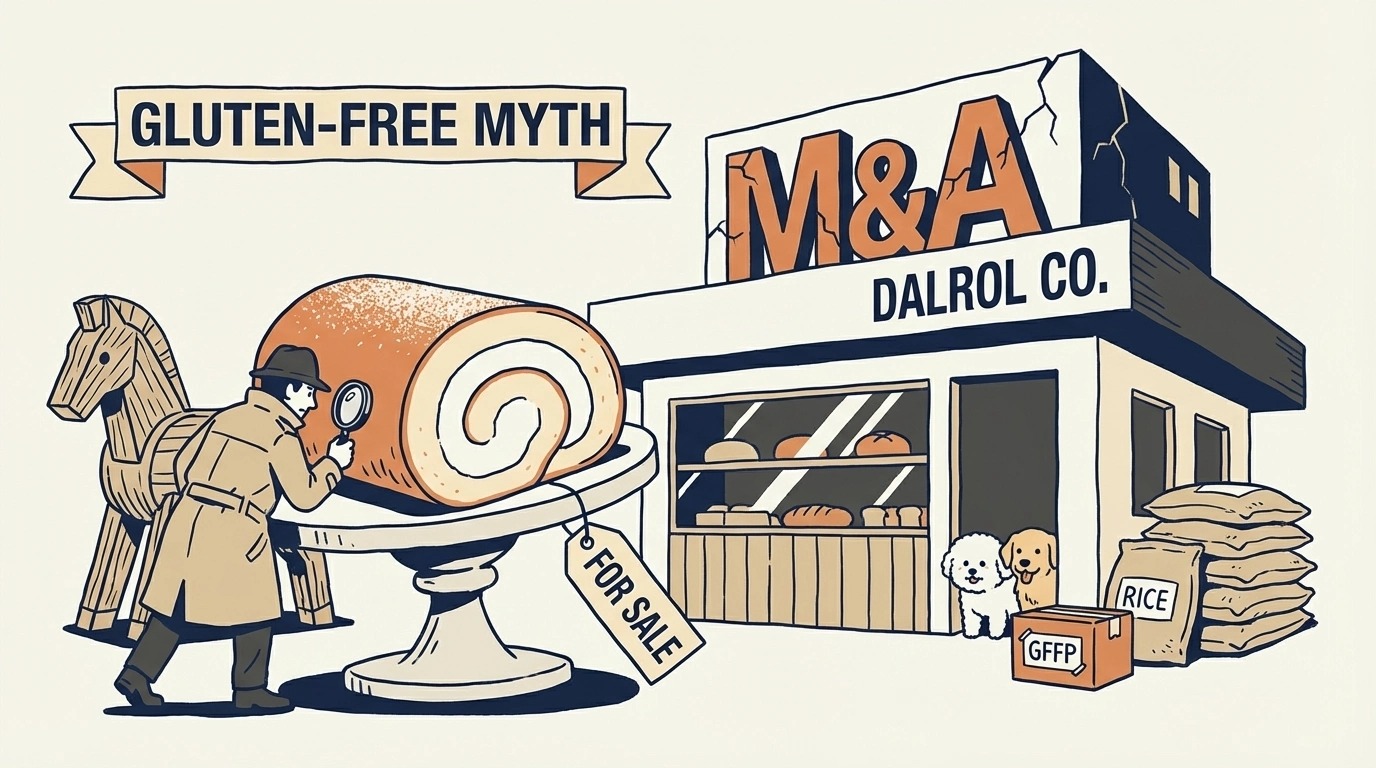
Leading a 'Healthy Alternative Food Culture'… A Gluten-Free Confectionery Specializing in Rice-Baked Goods
Established in 2013, Dalroll Company Co., Ltd. is a 'Gluten-Free' confectionery and bakery enterprise that manufactures baked goods using domestic rice instead of wheat flour. Advocating a 'healthy alternative food culture', it has operated various brands including the gluten-free bakery brand 'Dalroll', the tea brand 'Positive', and the pet dessert brand 'Dalmipet'. The company has garnered a great response from consumers by supplying a diverse product line, such as cheesecakes, roll cakes, rice bread, and scones, to online and offline distribution channels as well as B2B (business-to-business) stores.
Exceeding 5 Billion Won in Cumulative Investment and Expanding Globally… Technological Prowess Coveted Even by Large Corporations
Dalroll Company achieved spectacular success, establishing itself as a leader in the domestic gluten-free market. Following a 1 billion won investment from Kingo Investment Partners in 2021, it successfully attracted 1.5 billion won from Hyundai Technology Investment and Dongmun Partners in 2022, and 1.5 billion won from ROI Investment Partners and Daesung Private Equity in 2023, successfully drawing over 5 billion won in cumulative investments. Large corporations such as Binggrae and GS Retail also participated. At the time of its investment attraction in '23, its estimated corporate value had risen to 25 billion won.
In terms of infrastructure and technological prowess, the company built a large-scale production plant in Gimpo, Gyeonggi-do in 2022, acquiring the 'GFFP (Gluten Free Food Program)' facility certification, a global certification approved by the US Celiac Association, as the first single facility in Korea. The 'Zero Wheat Roll' launched in collaboration with GS25 surpassed 100,000 units sold in just two months, and the company leaped forward as a K-gluten-free enterprise by signing an export MOU with the US premium commerce platform 'Wooltari USA'. In 2024, it also achieved the splendid feat of winning the Minister of Agriculture, Food and Rural Affairs Award at the Korea Food Research Institute's Food Technology Awards.
Promising Venture Pushed to the Edge of a Cliff… 'Stalking Horse' M&A in Full Swing
Dalroll Company, which had been on a roll, ultimately could not overcome its financial difficulties and filed for corporate rehabilitation procedures at the Seoul Bankruptcy Court in July 2025. To normalize management, it received Letters of Intent (LOI) through its lead sale manager, Samil PwC, until 3:00 PM on March 16, 2026, and the process of finding a new owner is currently underway.
In particular, this sale will be conducted using the 'Stalking Horse' method. A stalking horse refers to a method in which a company finds a preliminary acquirer in advance and signs a conditional acquisition contract, and then seeks another acquirer who offers better conditions through a public competitive bidding process. If no party appears in the public bidding offering a higher price or better conditions, the preliminary acquirer will make the final acquisition. Because it can minimize the risk of the sale falling through, finding a stable new owner is possible, and management rights will be transferred through the acquisition of new shares in a third-party allotment paid-in capital increase.
Snowballing Deficits and Accumulated Deficits of 11 Billion Won… The 'Poison' Brought On by Unreasonable External Expansion
The core reason the promising venture company ended up undergoing rehabilitation procedures lies in an unreasonable external expansion that overwhelmed profitability and worsened liquidity. With the construction of a new plant in Gimpo in 2022, the burden of borrowings from the financial sector increased significantly, and painful deficits occurred due to the expansion of its nationwide distribution network.
Externally, the company achieved sales growth from 3.4 billion won in 2023 to 4.7 billion won in 2024, but gross profit turned into a deficit as costs for product production and logistics surged. The cost of goods sold more than doubled from 1.6 billion won to 3.4 billion won, and selling and administrative expenses for distribution and marketing also increased sharply. As a result, the operating loss expanded significantly from the level of 3.21 million won in the previous year to 1.99 billion won in 2024, and it also recorded a net loss of 2.3 billion won. Ultimately, the main background is that it hit the limits of its financing capabilities, with an accumulated deficit reaching approximately 11 billion won (11.04583 billion won) according to the investigation report reported to the court (as of August 8, 2025).
Company financial data, investment reports, and startup analysis — all in one place
Explore PitchdeckCurated news, every week — straight to your inbox
Every Friday · Unsubscribe anytime