Fully Capital-Impaired (-12.5 Billion Won) NDT Fails to Pay 31.2 Billion Won Balance... Deal Ultimately Collapses
Funding Fails Following Direct Hit from Injunction Lawsuit... Bugs Reduced to Overhang Status
Exit Bearing 120 Billion Won Real Loss Scrapped... NHN Maintains 45.26% Stake
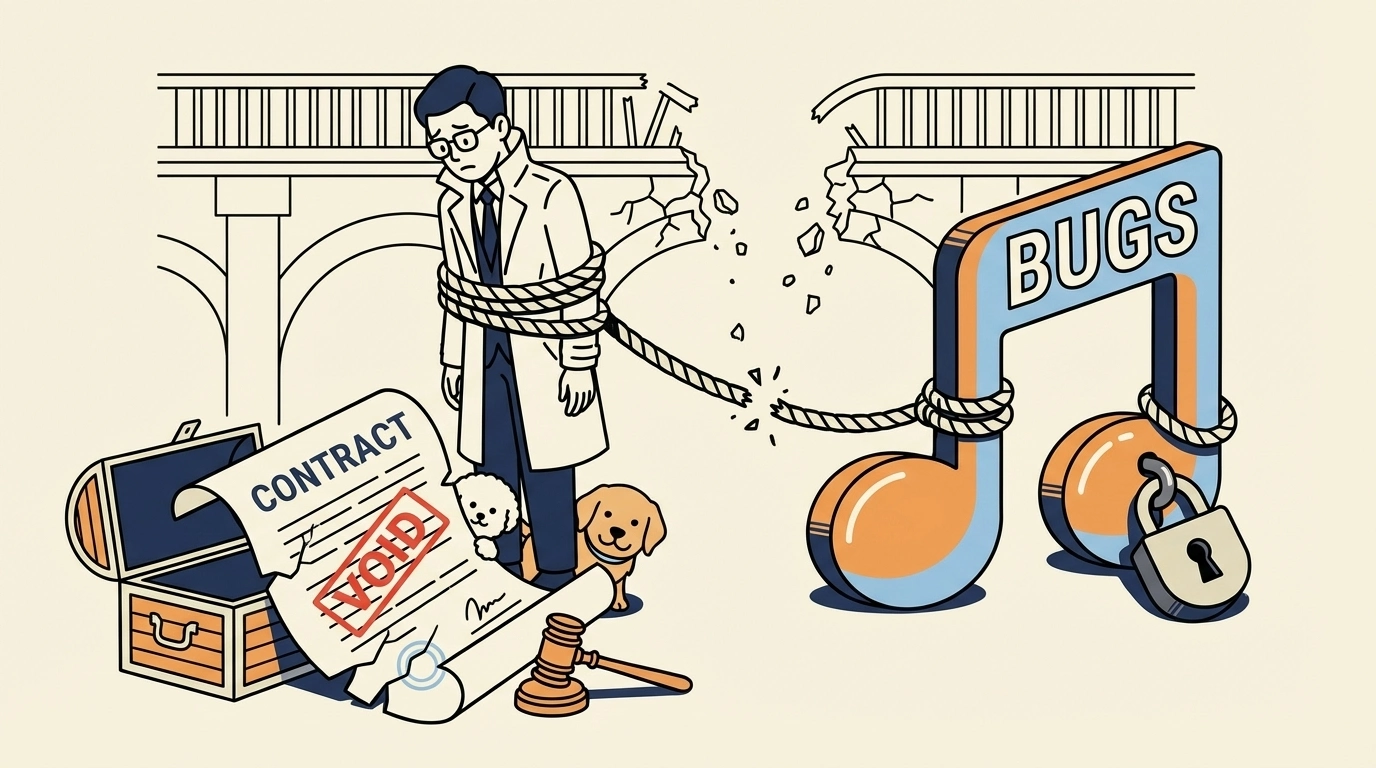
Ultimately, the risks warned by the numbers have become reality. NHN's attempt to transfer the management rights of NHN Bugs (hereinafter Bugs) to an insolvent company in a state of complete capital impairment has ultimately fallen through due to the acquirer's failure to pay the purchase price. A legal lawsuit from shareholders that erupted right before the balance payment served as the decisive deal breaker, causing NHN's plan to dispose of the asset and shake off Bugs after 11 years to go down the drain.
Contract Cancellation Due to Non-Payment of 31.2 Billion Won Balance
NHN's sale of management rights for Bugs was ultimately canceled as of March 27, 2026. The assignee, NDT Engineering Co., Ltd. and three others, failed to pay 31.23 billion won by the balance payment date of March 26, 2026. Accordingly, NHN immediately dispatched an official notice of contract termination (cancellation).
As a result, no transfer of shares occurred. NHN will retain its existing 45.26% stake (6,711,020 shares) in Bugs and extend its status as the largest shareholder.
A Foreseen 'Money Drought', The Bare Face of Funding Failure
The data proves that this deal was close to impossible to conclude from the beginning. The acquiring entity, NDT Engineering, was in a state of complete capital impairment with total equity of -12.5 billion won, based on 2024 consolidated assets of 99.6 billion won and liabilities of 112.1 billion won. In a state with absolutely no internal capital capacity, it had to raise the massive 31.2 billion won balance from the outside, but it is known that the cash raised from selling core assets amounted to only about 15.8 billion won.
Furthermore, the shareholders' 'injunction to suspend the effect of the stock transfer agreement' lawsuit, which erupted 7 days before the balance payment date (March 19), dealt a fatal blow. Financial investors (FIs) who would execute funds for a company where legal risks have exploded do not exist in the capital market.
Exit Failure Brought About by Inadequate Verification
The structural cause of this incident lies in NHN's unreasonable push for a sale, driven by urgent needs to secure liquidity following the TiMef crisis, and its failure to verify the acquirer's eligibility.
NHN attempted to execute the sale for 34.7 billion won even at the expense of a real loss of approximately 120 billion won, which combines the principal invested in the past acquisition of Bugs and the opportunity cost. However, by selecting a capital-impaired company and an investment association consortium—which were suspected of a 'backdoor listing and financial money game'—as its partners, it ultimately resulted in depriving itself of the opportunity to secure cash.
Tied-Up Asset, Increasing Downward Pressure on Valuation
Due to the contract cancellation, NHN's financial strategy has been completely scrapped. The confiscation of the already received down payment of 3.47 billion won (10% of the total amount) is highly likely to lead to a legal dispute over the attribution of fault between the two parties in the future.
The biggest risk is that it must re-bid Bugs, which has lost market trust. To find a new buyer to take over an overhang (potential selling volume) asset with remaining sparks of management dispute litigation and a once-broken deal, a more painful valuation discount than the previous sale price (5,170 won per share) will be inevitable. NHN's concerns are deepening as it bears the burden of Bugs, which has become a bottomless pit.
Company financial data, investment reports, and startup analysis — all in one place
Explore PitchdeckCurated news, every week — straight to your inbox
Every Friday · Unsubscribe anytime