
The Growth and Limitations of Papa Mobility, Which Started as a Platform for the Transportation-Vulnerable
Papa Mobility started in 2018 as a customized mobility platform for the transportation-vulnerable, such as the disabled and the elderly. The company, which drew attention from its early days when former Kolon Group Honorary Chairman Lee Woong-yeol participated in its equity in a personal capacity, gained a favorable response from the market by introducing specially equipped vehicles capable of wheelchair boarding for the first time in the industry and launching specialized services like 'Papa Escort' and 'Papa Junior'. Afterward, it moved beyond simple B2C ride-hailing and went through its own growth process by focusing on premium reservation-type demand, such as corporate VIP clients and transportation for international events.
However, the reality of the domestic mobility market was not easy. As a latecomer in a fiercely competitive ride-hailing market dominated by giant IT companies like Kakao Mobility and UT, it was difficult to achieve economies of scale. In addition, due to the strict fleet expansion regulations of the Ministry of Land, Infrastructure and Transport, the company experienced severe difficulties in expanding its infrastructure, operating only about 100 vehicles despite growing demand. The fixed cost burden was immense due to the structure of directly hiring Papa Crew (drivers), and profitability continued to deteriorate amid a lack of clear differentiation.
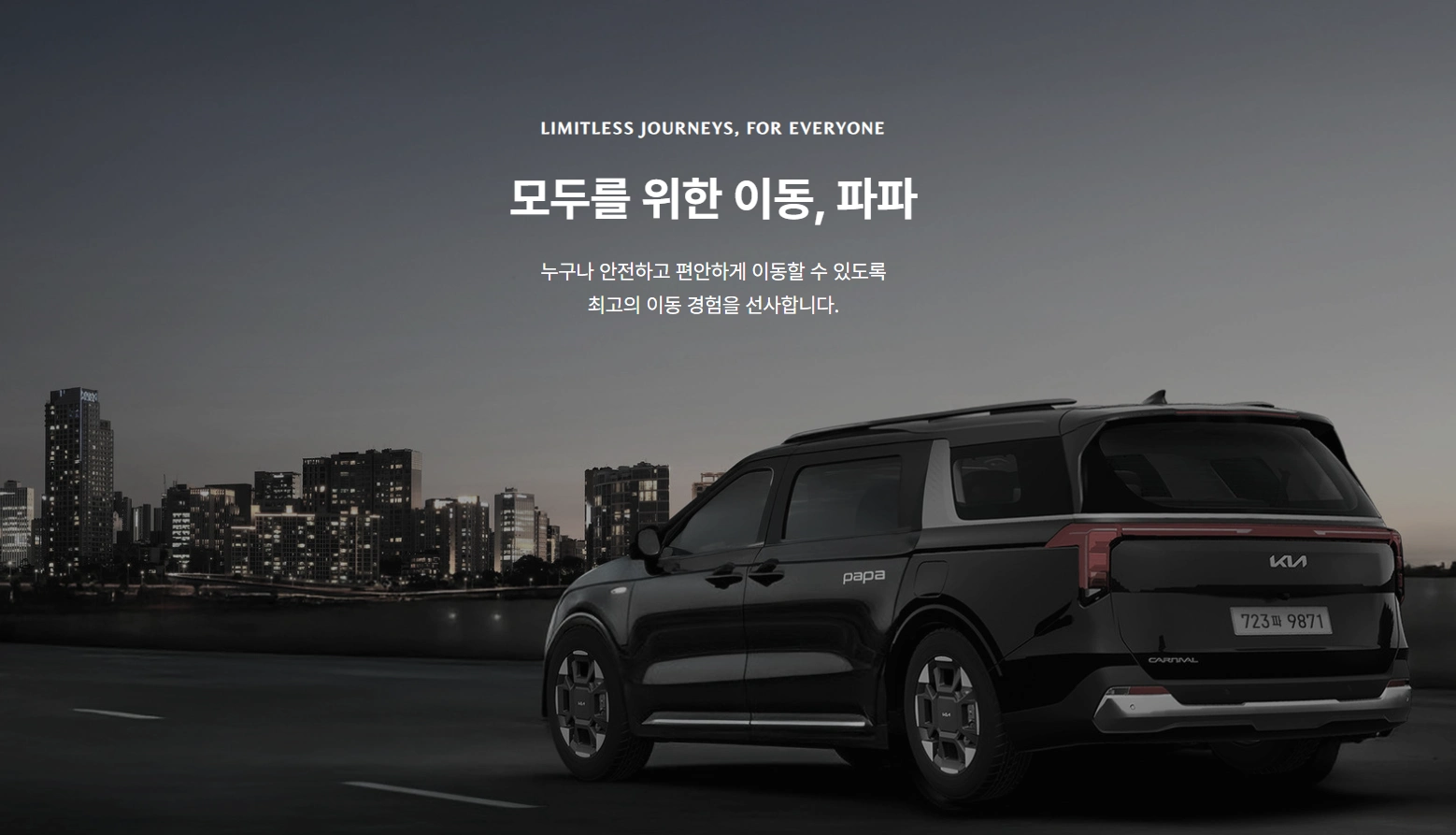
[Source: Papa Mobility Website]
Papa Mobility Becomes a 'Money Pit', Kolon's Painful Failure
Kolon abruptly acquired Papa Mobility in April 2022 by participating in a third-party allotment capital increase, securing a 72.19% stake. It was initially a decision made in anticipation of creating synergy with automotive distribution affiliates such as Kolon Mobility Group. After being incorporated into the Kolon enterprise group, Kolon carried out five capital increases, injecting massive funds of approximately 38.5 billion won into Papa Mobility.
However, despite Kolon's full-scale investment, Papa Mobility could not escape the swamp. Instead, it recorded consecutive net losses of 10.1 billion won in 2023, 10.8 billion won in 2024, and 11.9 billion won in 2025, degenerating into Kolon's representative 'sore thumb' and a money pit. Eventually, as the accumulated deficit ballooned, it fell into a state of complete capital impairment (-1.3 billion won) by the end of 2025, and unable to withstand the financial difficulties, Kolon had to reduce its capital stock (from 29.3 billion won to 100 million won) by executing a massive 99.66% capital reduction without refund in May 2025. Along with this, a painful workforce restructuring of over 130 employees was carried out, which was effectively a preliminary step by Kolon to lighten the financials and organization in preparation for the sale of Papa Mobility's stake.
Sale After 4 Years, the Blueprint of the New Owner UHC
Ultimately, Kolon, failing to find a clear solution in the ride-hailing business, raised the white flag four years after the acquisition. Kolon sold its entire 98.33% stake (568,581 shares) in Papa Mobility to UHC Co., Ltd. Following the signing of the stock transfer agreement on February 25, 2026, the final payment of the purchase price was completed on March 20, and a public disclosure was announced that Papa Mobility's largest shareholder had fully transferred from Kolon to UHC as of March 30.
Although detailed information about the acquiring company UHC is not yet widely known through the media or public disclosures, according to information registered in the Pitchdeck database, UHC is presumed to be a hospitality specialized company operating premium boutique hotel brands such as 'UH Suite' and 'UH Flat'. It possesses a business model that dramatically increases asset value through direct operation after utilizing a 'real estate conversion' technique, which involves purchasing or leasing aging downtown buildings and remodeling them into high-profit accommodation content.
Looking at UHC's income statement, one can confirm steady external growth. The revenue, which was 3.3 billion won in 2019, surpassed 10 billion won in annual revenue by reaching 13.7 billion won in 2022, and recorded about 22.9 billion won in 2023 and about 36.1 billion won in 2024, proving a consistent upward trend. As of 2024, it achieved an operating profit of approximately 2.4 billion won and an EBITDA (Earnings Before Interest, Taxes, Depreciation, and Amortization) of about 3.9 billion won, solidifying a robust position in the hospitality industry. The number of employees is 208 as of early 2026, half of whom joined within the past year, indicating that the company is hiring rapidly alongside its growth. In early 2025, it attracted the market's attention by raising 5 billion won in investments from LB Investment and others, achieving an enterprise value evaluation of approximately 65 billion won.
The industry expects this acquisition to create a synergy of 'the combination of tourism and mobility'. As the proportion of foreign tourists among UHC's hotel guests is high, it can offer Papa Mobility's premium vehicle services, which support airport pickups or transportation to tourist destinations, as a bundled package to hotel reservation customers. Furthermore, moves to leap forward as a comprehensive travel platform by fully integrating mobility functions into 'STATION', a travel platform app launched independently by UHC, are also expected to go into full swing.
Company financial data, investment reports, and startup analysis — all in one place
Explore PitchdeckCurated news, every week — straight to your inbox
Every Friday · Unsubscribe anytime