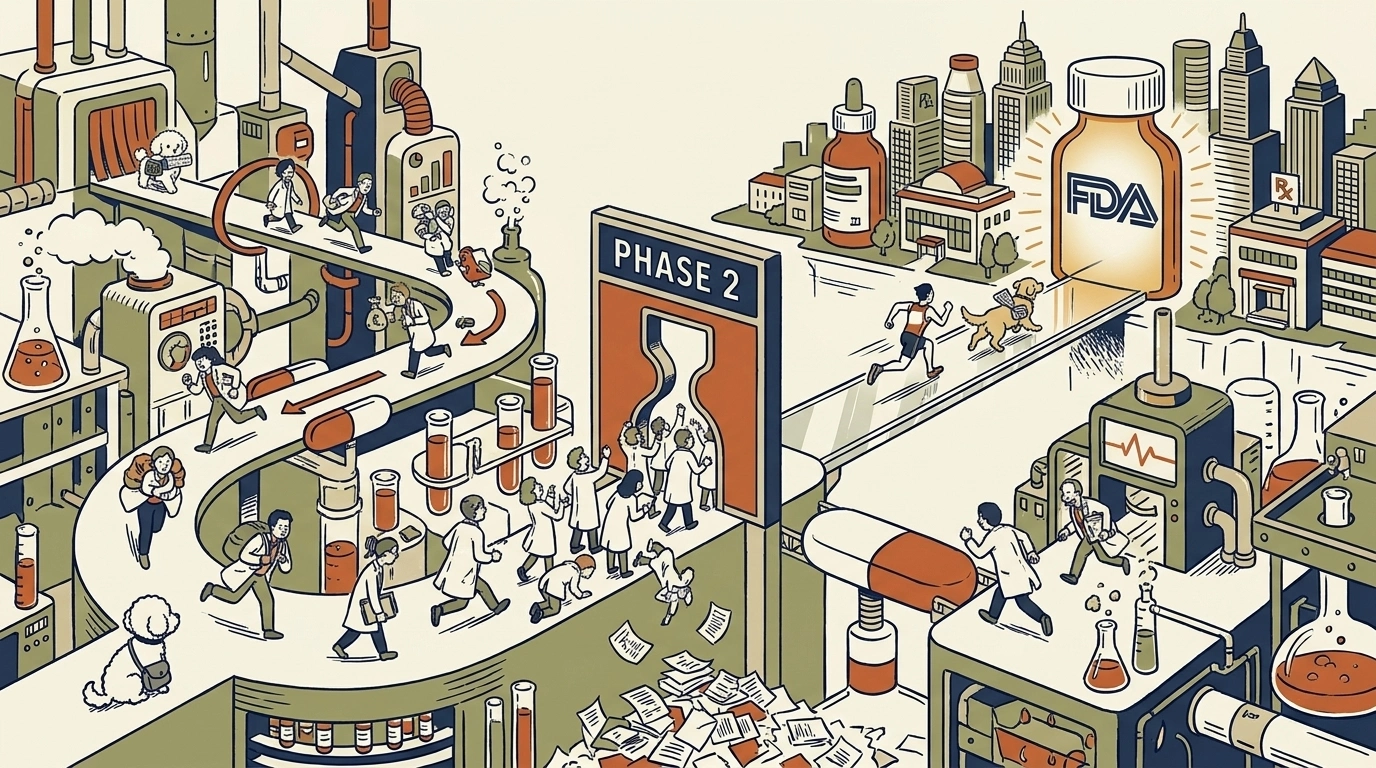
Despite domestic companies surpassing 10,000 clinical trials, actual FDA approvals are concentrated on specific companies like Celltrion, revealing a distinct 'commercialization gap'
Phase 2 clinical trial completion rate is 41.5%, the lowest among the three phases... Many of the incomplete trials are 'in progress' rather than 'suspended'
The proportion of trials reaching Phase 3 among the top 6 companies varies widely from 16% to 84%, highlighting an urgent need for fundamental improvement focused on qualitative results rather than quantitative expansion
Although clinical trials led by domestic companies and institutions have achieved quantitative expansion by surpassing 10,000 cases, it has been revealed that only a very small fraction has reached the final gateway of global commercialization: approval by the U.S. Food and Drug Administration (FDA). In particular, Phase 2 clinical trials had the lowest completion rate among the three phases, as this includes not only suspended trials but also those still in progress.
Phase 2 Clinical Trials Have the Lowest Completion Rate at 41.5%
As a result of analyzing 10,282 cases of data from the U.S. clinical trial registration system, Phase 2 had the lowest completion rate when comparing the phases. In contrast to Phase 1, which confirms initial safety, recording a completion rate of 75.3%, and Phase 3, a large-scale verification stage, also seeing 59.0% completed, Phase 2 stopped at only 41.5%.
Out of a total of 1,329 Phase 2 attempts, only 551 cases were completed, while the remaining 778 cases are either halted midway or ongoing indefinitely. Since this low completion rate reflects not only suspended trials but also those that have not yet finished, it is too early to immediately conclude that Phase 2 is a 'wall of failure.'
Distinct Gap in Pipeline Substance by Company... Phase 3 Reaching Ratio at 16~84%
Looking at the distribution of clinical trial phases among the six major listed bio companies, the differences in business models between the companies are clearly revealed. Celltrion recorded 31 Phase 3 trials compared to 37 Phase 1 trials, showing a high Phase 3 reaching ratio of 84%. This is interpreted as the result of maximizing success rates and efficiency through a biosimilar-focused strategy that proves equivalence with original drugs whose efficacy has already been proven.
Boryung and Daewoong Pharmaceutical recorded Phase 3 ratios of 57% and 47%, respectively, showing that they are stably managing late-stage pipelines that have entered the visibility of approval. On the other hand, although Hanmi Pharmaceutical registered 108 Phase 1 trials, the most among the six companies, the ratio of reaching Phase 3 remained at 33%. Initial clinical trial attempts are active, but the concentration leading to subsequent stages was relatively low.
Yuhan, which focuses on the post-management of already approved drugs, had a notably high proportion of Phase 4 trials (23 cases) compared to its Phase 1 trials (48 cases), while LG Chem had only 5 Phase 3 trials compared to 32 Phase 1 trials, recording the lowest Phase 3 ratio among the surveyed subjects at 16%.
Celltrion's Dominance in FDA Approvals, Gap with the Remaining 5 Companies
In terms of FDA approval performance, which can be considered a practical report card for the global market, Celltrion's dominance continues. Starting with Vegzelma in 2022, followed by Zymfentra and Yuflyma, Celltrion additionally acquired three more approvals in the single year of 2025: Stoboclo, Eyedenzelt, and Abtozma.
In contrast, the combined 746 ongoing clinical trials conducted by the remaining five companies—Daewoong Pharmaceutical, Hanmi Pharmaceutical, Boryung, LG Chem, and Yuhan—are mostly still in progress or aiming for approval from the Ministry of Food and Drug Safety in Korea. Although the domestic clinical trial infrastructure, centered around the top five major hospitals, has reached a world-class level, the capability to connect this to global commercialization achievements, such as FDA approvals, is still concentrated in specific companies.
It is not only these six companies that have reached the FDA. Samsung Bioepis has received FDA approval for several biosimilars, such as Hadlima and Epysqli, and SK Biopharmaceuticals received FDA approval in 2019 for its self-developed epilepsy drug, cenobamate, which is currently being sold in the U.S. In particular, SK Biopharmaceuticals is a case where a self-developed new drug, rather than a biosimilar, directly reached the FDA.
For the 10,282 Cases to Become the Power of the Industry
The number of annual clinical trial registrations in Korea peaked at 644 in 2016 and then gradually declined, moving sideways at 415 to 416 cases in 2024–2025. Prematurely terminated or withdrawn clinical trials account for only 5.0% (509 cases) of the total. The problem is not that clinical trials are failing, but that the final stretch, where successful clinical trials lead to entry into the global market, is empty.
Korea has achieved a world-class scale in the quantity of clinical trials. The top five hospitals lead 65.3% of the total, accumulating fundamental data, and the six companies operate 822 pipelines. For the 10,282 clinical trial assets to become practical competitiveness for the industry, successful cases that go beyond late-stage clinical trials to reach the FDA must spread beyond a few companies like Celltrion and Samsung Bioepis.
This article was written by News Epoch by securing and analyzing clinical data from the U.S. clinical trial registration system and openFDA drug approval data through The Proxy collection pipeline.
The clinical data is the result of collecting clinical trials registered and led by Korean institutions and companies, and global multi-center clinical trials where they are only listed as participating institutions are not included.
104 cases of FDA medical devices were excluded from this analysis due to insufficient classification by company. Data standard: Collected on April 3, 2026.
Company financial data, investment reports, and startup analysis — all in one place
Explore PitchdeckCurated news, every week — straight to your inbox
Every Friday · Unsubscribe anytime