$500 Billion Worth of Drug Patents at Risk of Expiration by 2033
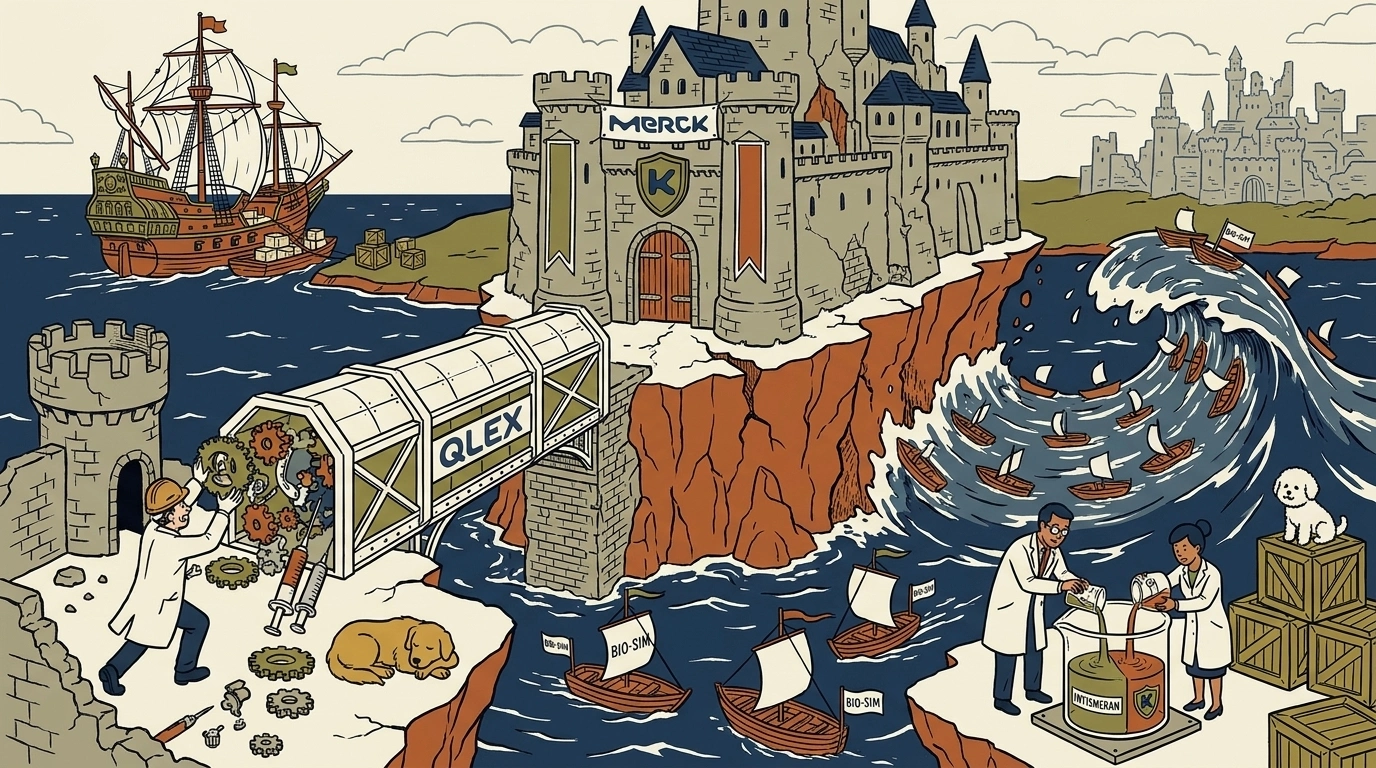
Merck earned $31.7 billion last year from its cancer treatment Keytruda. This is close to half of the company's total revenue of $65 billion. As a single drug, it was the world's best-selling medicine in 2025. The problem is that this massive source of income is not forever. Keytruda's core patents in the U.S. will expire starting in 2028. If cheaper biosimilars with similar efficacy emerge afterward, revenue could rapidly decline.
This phenomenon, where revenue plummets as generic drugs are released after a patent expires, is called a 'patent cliff' in the pharmaceutical industry. While general manufacturers can continue to sell the same product as long as consumers seek it, pharmaceutical companies must open the market to competitors after a certain period of time passes.
Patents start ticking from the early stages of development, not from the day the new drug is launched. If clinical trials and approvals take more than 10 years, the actual period of exclusive sales is not as long as one might think.
The Wall Street Journal (WSJ) recently cited an analysis by market research firm Norstella, reporting that the global revenue of drugs at risk of patent expiration by 2033 amounts to $500 billion. This does not mean that this entire amount will disappear. However, it means that many well-known drugs currently selling at high prices will have to compete with cheaper generics.
Merck Searching for the Next Drug While Protecting Keytruda
Merck's response largely takes two paths. While protecting Keytruda's revenue for as long as possible, it is looking for new drugs to make up for the declining sales. The first defensive measure is to change the administration method of Keytruda. The existing Keytruda requires patients to receive an intravenous injection at a hospital for about 30 minutes. The newly launched 'Keytruda QLEX' is injected under the skin and the administration time is only 1 to 2 minutes. As it is convenient for both patients and hospitals, Merck's strategy is to shift existing Keytruda users to QLEX to maintain its market share even after biosimilars are released. Merck expects that 30 to 40% of Keytruda patients will use QLEX within two years. In 2025, during its initial launch, QLEX revenue was only $40 million. However, in the second quarter of this year, it generated $463 million in revenue in just one quarter. Although it is still small compared to overall Keytruda sales, the strategy to shift patients to the new product is beginning to show results little by little.
The second response is to create new treatments to be used in combination with Keytruda. Merck and Moderna are co-developing 'Intismeran', a cancer treatment tailored to the characteristics of a patient's tumor. The two companies announced on August 19 that in a Phase 3 clinical trial involving melanoma patients who had undergone surgery, administering Intismeran and Keytruda together delayed cancer recurrence and metastasis more than using Keytruda alone. Intismeran is not a drug that replaces Keytruda. It is a method of adding a new treatment on top of Keytruda. If approved in the future, it could become a separate source of income to offset the revenue decline caused by Keytruda's patent expiration. This result also holds significance as the first case where a personalized tumor-tailored treatment and an mRNA-based cancer treatment succeeded in a Phase 3 clinical trial. However, specific clinical figures have not yet been disclosed, and regulatory approval remains. Time is needed before this translates into actual revenue.
Merck is also active in mergers and acquisitions. Since in-house development alone lacks sufficient time, it is buying companies that already have drugs with significantly advanced clinical trials or drugs currently on sale. The market expects Keytruda's revenue to peak at around $35 billion in 2028, when its patents begin to expire. Merck estimates that the drugs it is currently developing or has acquired could create business opportunities of more than $70 billion annually by the mid-2030s. Although this is a company forecast that does not yet reflect the probability of success, it shows Merck's goal of preparing for the post-Keytruda era.
Ozempic and Eliquis Also Burdened by Patent Expirations
Novo Nordisk, which grew the obesity and diabetes treatment market, is also not free from the patent cliff. An analysis of Norstella data by the WSJ found that 77% of Novo Nordisk's 2025 revenue came from drugs whose patent protection will weaken by 2033.
The product accounting for the largest share is the diabetes treatment Ozempic. Its revenue last year was about $20 billion. While core patents remain in the U.S. and Europe until the early 2030s, the protection period has already ended in some countries like Canada and India. Health authorities in Canada approved the first generic drug using the same active ingredient as Ozempic in April. Afterward, other companies also began releasing generics. Canada is essentially previewing the price competition that Ozempic will face in the U.S. and Europe in the future. Eliquis, a blood clot prevention drug co-marketed by Bristol Myers Squibb (BMS) and Pfizer, is also facing patent expiration. According to the WSJ, Eliquis's revenue last year was around $14 billion. Because this drug is a joint business venture between BMS and Pfizer, both companies will be impacted when a generic version is released. Since each company records revenue differently, the numbers disclosed by each company cannot simply be added together, but it remains the same that both companies rely on Eliquis as a major source of income.
Stacking Patents to Delay Generic Drug Launches
Pharmaceutical companies seek to find new treatments while simultaneously trying to extend the exclusivity periods of their existing drugs. They do this by adding patents not only on active ingredients but also on manufacturing methods, administration methods, and dosages. AbbVie's autoimmune disease treatment Humira is a prime example. While biosimilars have been sold in Europe since 2018, competing products only emerged in the U.S. in 2023. AbbVie secured over 100 related patents and reached agreements with competitors on launch timing, thereby delaying competition in the U.S. by about five years. BMS's multiple myeloma treatment Revlimid was similar. Generic drug companies in the U.S. could sell their products starting in 2022, but their sales volumes were limited. They will be able to sell without restrictions starting January 31, 2026.
Therefore, it is difficult to judge the timing of a revenue decline solely by the expiration date of a single specific patent. Depending on multiple patents, lawsuits, and agreements between pharmaceutical companies, the time when generic drugs actually hit the market can vary by several years.
Valuations of Biotech Companies with New Drugs Rise
As the patent cliff approaches, large pharmaceutical companies are actively acquiring biotech companies that possess new drug candidates. This is because it is faster to acquire a company that has somewhat completed clinical trials rather than developing a new drug from scratch. According to the WSJ, citing data from financial information provider LSEG, the volume of global pharmaceutical and biotech M&A in the second quarter of this year was $114 billion, the largest since 2019. Merck, AbbVie, and GSK each announced acquisition deals exceeding $5 billion so far this year.
Money is also flowing back into biotech startups. The WSJ reported that funding for biotech startups in the second quarter of this year reached about $15 billion, the largest since 2021. As the likelihood of selling technology to large pharmaceutical companies or selling the company itself increased, investors also began to move. Revolution Medicines' pancreatic cancer treatment Lasonk, which recently received approval from the US Food and Drug Administration (FDA), demonstrates this trend.
Lasonk is intended for patients with metastatic pancreatic cancer who have received at least one prior treatment but their disease has progressed, or those who find it difficult to receive combination therapy with multiple drugs. It is not a primary treatment used from the beginning. In a clinical trial of 500 patients, the median survival time of patients administered Lasonk was 13.2 months. For patients who received existing chemotherapy, it was 6.7 months. The FDA approved this drug on August 26, six and a half months ahead of the originally scheduled date.
Eli Lilly Still Has Time
Not all pharmaceutical companies are in the same situation. Core patents for Eli Lilly's diabetes treatment Mounjaro and obesity treatment Zepbound are expected to last until 2036. Compared to Merck or BMS, which must worry about large-scale patent expirations immediately, they have about 10 years left. McKinsey's Greg Graves explained to the WSJ that massive patent expirations are a key factor driving pharmaceutical companies to find new growth engines.
The patent cliff is a crisis for pharmaceutical companies, but it is also an opportunity for drug prices to fall for patients. This is because when generic drugs and biosimilars are released, they can receive similar treatments at lower prices.
In the coming years, there is a high possibility of a succession of new drug clinical trials and large M&As in the global pharmaceutical industry. How long they can protect well-selling drugs like Keytruda, and whether they can find the next product before those revenues decline, is expected to determine the performance of large pharmaceutical companies.
Company financial data, investment reports, and startup analysis — all in one place
Explore PitchdeckCurated news, every week — straight to your inbox
Every Friday · Unsubscribe anytime