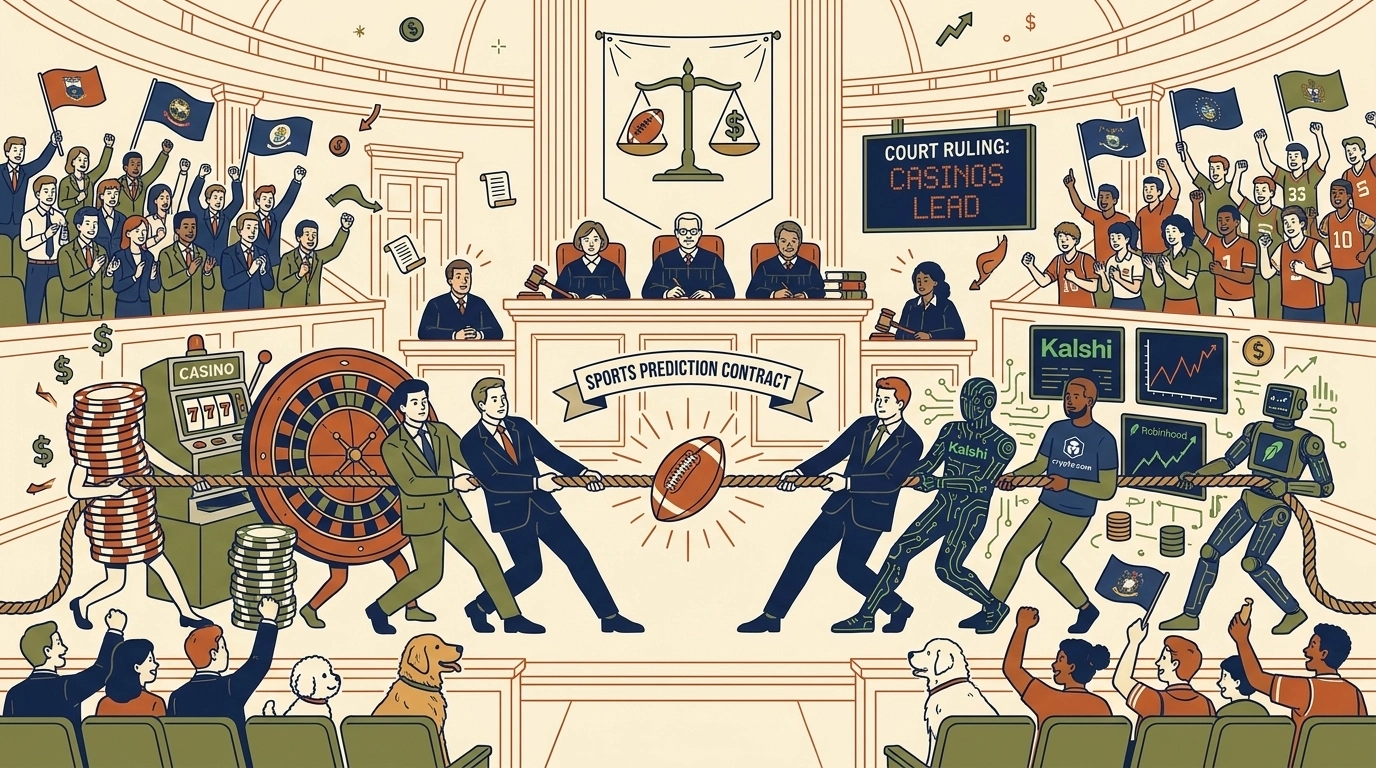
Kalshi, Crypto.com, and Robinhood All Lose in Appeals Court... New Jersey to Decide on Supreme Court Appeal by September 3
Suppose you bet on whether a US professional football team will win by 7.5 points or more. If you place the money at a casino sportsbook, it is sports betting. Then, if you buy a "yes/no" contract for the exact same thing on Kalshi, is it a financial transaction? The US Court of Appeals for the Ninth Circuit ruled that there is no significant difference between the two. Even if the trading method is changed and it is labeled a "contract," the structure of receiving money if you guess the game outcome correctly and losing money if you guess wrong is identical to sports betting.
On August 28, the court determined that it is difficult to view Kalshi's sports prediction products as financial instruments. Consequently, Kalshi will no longer be able to bypass Nevada's gambling regulations simply because it is registered with the US Commodity Futures Trading Commission (CFTC). However, this ruling was made during the process of determining whether to permit operations before the formal trial concludes, so it is not a final decision.
Kalshi was not the only one to lose this time. The court concurrently heard cases filed by Kalshi, a Crypto.com-affiliated exchange, and Robinhood. All 3 companies requested exemption from Nevada's regulations, but their requests were denied.
Kalshi Claims "Financial Transaction," Casino Industry Says "Gambling by Another Name"
Kalshi describes its service as a prediction market, not sports gambling. Users do not bet directly against the company, but rather buy and sell contracts with other users within the exchange. Kalshi facilitates the trades and collects a fee.
Traditional sportsbooks are different. Users bet against the sportsbook, and the sportsbook pays out the dividends. Based on this difference, Kalshi has argued that its products are financial transactions, not gambling.
The court considered what is being bet on to be more important than who the trading counterparty is. It noted that the products are no different from regular sports betting in that participants receive money if they correctly predict game outcomes, point differentials, or whether a player scores.
The CFTC, which oversees Kalshi, supported Kalshi in this lawsuit. However, the CFTC's current regulations state that game-related contracts cannot be listed on exchanges. The court ruled that even if the CFTC leadership recently provided a different interpretation, the currently written rules must be followed until the regulations are changed. Whether CFTC registration alone allows for the sale of sports contracts nationwide was also a point of contention. If Kalshi's arguments are accepted, the company could operate even in states where sports betting is prohibited. It would also create the possibility of bypassing state-by-state regulations regarding business licenses, taxes, age limits, and gambling addiction prevention.
The court found no clear evidence that Congress transferred the authority to manage state sports gambling to the CFTC. Simply put, it ruled that being registered with financial authorities once does not allow a company to bypass all state gambling regulations. The panel reached a unanimous 3-0 decision. However, it left some leeway, stating that this does not mean all sports contracts are unconditionally gambling. If a sports contract is used in special cases to mitigate risks arising in actual business or financial processes, there is a possibility it could be recognized as a financial product.
The Casino Industry's Counterattack Spreads to Courts and Congress
This ruling is a welcome outcome for the casino industry, which has been wary of the growth of prediction markets. Over 90% of the transactions processed by Kalshi in 2025 were related to sports, and 95% of its total revenue came from sports contracts. If sports contracts become subject to state gambling regulations, a major blow to Kalshi's business is inevitable. The casino industry also actively participated in the lawsuit. The Nevada Resort Association supported the state of Nevada, and the American Gaming Association (AGA) submitted a brief to the court. The Indian Gaming Association and 24 tribes also argued that state regulations should be maintained.
It was not only states with developed casino industries that stepped forward. 39 states, including New Jersey and Ohio, along with Washington D.C., supported Nevada. Given that both Republican and Democratic-leaning state governments participated together, it is difficult to view this conflict as a partisan battle in politics. A lobbying competition also unfolded in Washington. According to reports compiling local lobbying disclosure data, Kalshi spent approximately $990,000 on direct lobbying in the first half of this year. Including costs for external lobbying firms, the total amounts to about $1.8 million. The AGA also invested approximately $1.39 million in direct lobbying during the same period. Including external firm costs, this is estimated at about $1.8 million, similar to Kalshi. While it cannot be concluded that lobbying directly influenced this ruling, it is confirmed that both sides acted fiercely targeting the courts and Congress.
Bills attempting to block sports prediction contracts have also emerged in Congress. In March, 3 senators introduced a bill to ban prediction contracts targeting sports events and casino games. In July, House representatives from Nevada introduced a bill with the same content, which the AGA publicly supported.
However, not everyone in the existing betting industry is on the same side. As DraftKings and FanDuel entered the prediction market and their business strategies no longer aligned with the AGA's policies, they withdrew from the association in November 2025. Following this, Fanatics and bet365 also left the association. As the prediction market grows, a complex dynamic has been created where traditional online betting companies are competing against the casino industry on one side and Kalshi on the other.
Kalshi Might Not Be the First to Head to the Supreme Court
If this case goes to the US Supreme Court, the party most likely to file the appeal first is New Jersey, not Kalshi. In April, the US Court of Appeals for the Third Circuit reached a conclusion opposite to this ruling. It sided with Kalshi, stating that it would be difficult for New Jersey to regulate Kalshi's sports contracts. New Jersey applied for an extension of the deadline with the Supreme Court, stating it would decide whether to appeal after confirming the conclusions of appeals courts in other regions. The Supreme Court's deadline for New Jersey's appeal is September 3. Given that contradictory rulings have emerged in the Nevada and New Jersey cases, the likelihood that New Jersey will request a final decision from the Supreme Court has increased.
Kalshi also announced that it would take further action regarding this ruling. However, it has not yet decided whether to ask the appeals court for a reconsideration or head straight to the Supreme Court. Ultimately, the issue is simple. It is about whether to view Kalshi's sports predictions as a new financial transaction or as gambling, akin to traditional sports betting. If it is a financial transaction, it can operate nationwide under the federal government's management, but if it is gambling, it must obtain permission from each state.
If the Supreme Court accepts the case, the outcome will not be limited to Kalshi alone. The business methods of companies that have jumped into the sports prediction market, such as Crypto.com and Robinhood, could also change. Conversely, there is also the possibility that the CFTC might amend related regulations or Congress might pass a new law before the Supreme Court makes a decision. Whether the rapidly growing prediction market will be subject to the same rules as the traditional casino industry has now become a nationwide issue in the US.
Company financial data, investment reports, and startup analysis — all in one place
Explore PitchdeckCurated news, every week — straight to your inbox
Every Friday · Unsubscribe anytime