
The small home appliance company Miro, which had been on a roll preparing for K-OTC registration and an IPO (Initial Public Offering), has laid the groundwork for a comeback by recently receiving approval for its rehabilitation plan from the court after suffering a severe crisis of receiving a 'disclaimer of opinion' in its accounting audits for two consecutive years. The industry's attention is focused on the future moves of Miro, which has gone back and forth between heaven and hell.
Rapid Growth of the 'Completely Washable Humidifier' Built with a Father's Heart
Miro's beginnings date back to the Inha University Startup Incubation Center in 2014. At the time, when market anxiety was heightened due to the humidifier disinfectant scandal, three co-founders, including CEO Seo Dong-jin, devised a 'completely washable humidifier' that could be used safely for a child suffering from asthma. The contrarian structure of separating the main body and the water tank so that it could be washed like a water cup received an explosive response from consumers and led the company's rapid growth.
Not resting on its success, Miro actively incorporated IoT (Internet of Things) technology into its home appliances and quickly expanded its lineup to include electric fans, air purifiers, and vacuum cleaners. Recognized for this steady growth trend, Miro received a new designation for the K-OTC (Over-The-Counter stock market) from the Korea Financial Investment Association in June 2021 and started trading. Following this, in the same month, it selected Shinyoung Securities as its listing underwriter and signed a representative underwriting contract, preparing for a full-scale IPO as its corporate value reached its peak.
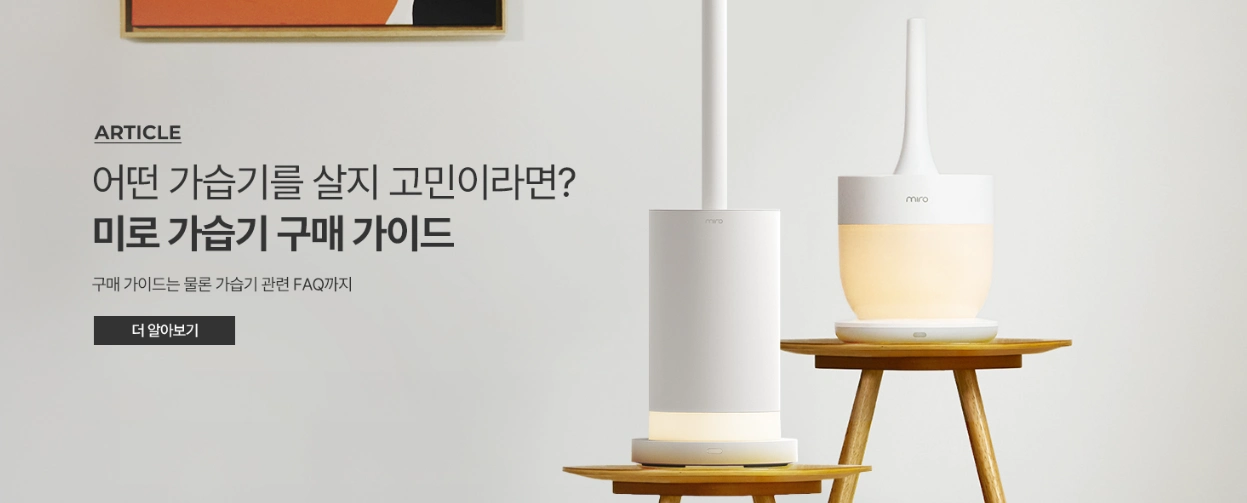
[Source: Miro Website]
Fatal Weakness and Intensified Competition... A Sudden Crisis
However, the glory did not last long. The inherent limitation of its flagship product, the humidifier, being a typical 'seasonal appliance' with sales concentrated in the winter season, held the company back. The imbalance in cash flow worsened as it failed to build a strong 'second engine' (electric fans, air purifiers, etc.) to sustain the company through the off-season from spring to autumn.
In addition, as the keyword 'completely washable' pioneered by Miro became popularized, large corporations and low-priced Chinese products entered the market in large numbers with similar concepts, and ultimately, the unrivaled 'edge' possessed only by Miro was greatly diluted.
These unfavorable factors were completely reflected in the performance indicators. Miro turned to a deficit, recording an operating loss of about 1.59 billion won on a separate basis in 2022. The situation worsened in the following year, 2023, with sales halving to about 10.88 billion won compared to the previous year (about 19.82 billion won), and operating losses snowballed to about 5.26 billion won. To resolve the severe financial difficulties, the company resorted to the desperate measure of selling its headquarters building (including all land and buildings) for about 15 billion won in June 2023, but it was not enough to normalize the leaning management.
Complete Capital Impairment and 'Disclaimer of Opinion' for Two Consecutive Years
Despite self-rescue efforts such as the sale of the headquarters building, Miro's total equity recorded approximately -3.78 billion won as of the end of 2024, falling into a state of complete capital impairment.
Ultimately, citing the extremely deteriorated financial situation, the external auditor accounting firm stated that significant doubt was cast on the company's ability to continue as a going concern, leading to expressing a 'disclaimer of opinion' for two consecutive years on the audit reports for the 2024 and 2025 fiscal years.
Having reached its limit, Miro eventually entrusted its fate to the court's judgment. On March 25, 2025, it applied for the commencement of corporate rehabilitation procedures with the Seoul Rehabilitation Court, and received the decision to commence rehabilitation procedures on April 14 of the same year.
Following this, it went through bone-crushing restructuring and the process of preparing self-rescue plans, and finally succeeded in receiving final approval for its rehabilitation plan from the Seoul Rehabilitation Court on January 14, 2026. Currently, under the court receivership system, Miro is aiming to maximize sales and normalize management through the launch of new products scheduled for 2026.
Miro, which was born with a 'father's heart' amidst the social crisis of humidifier disinfectants and gave a fresh shock to the market. Market attention is focused on whether it can regain its past glory on the new stage of court receivership after enduring a harsh winter.
Company financial data, investment reports, and startup analysis — all in one place
Explore PitchdeckCurated news, every week — straight to your inbox
Every Friday · Unsubscribe anytime