
A Startup Born from Inconvenience... Turning the Pandemic Crisis into an Opportunity
The fintech startup 'Travel Wallet', which has established itself as a must-have for overseas travel, started from a foreign exchange expert's long-standing contemplation and everyday inconvenience. CEO Kim Hyung-woo, who graduated from Korea University with a degree in economics and worked as a global fund manager and head of foreign exchange risk management at Samsung Asset Management, as well as a specialized researcher in foreign exchange derivatives at the Korea Center for International Finance, experienced the inefficiencies of the existing foreign exchange payment systems firsthand and founded the company in November 2017.
The biggest motivation for starting the business was the everyday inconvenience of 'dealing with leftover local bills and coins after a trip being a headache.' Travel Wallet, which set the goal of lowering fees by simplifying the existing complex payment network, achieved the remarkable feat of acquiring a VISA card issuance license in 2020, becoming the second fintech company in the world and the first in Asia to do so.
Of course, there was also a crisis. Due to the COVID-19 pandemic, borders were closed, and the footsteps of travelers, their main customer base, were cut off. However, Travel Wallet took this period as an opportunity to invest heavily in the research and development of its internal IT systems. As a result, it flawlessly handled the explosively increased traffic after the endemic, achieving an overwhelming performance of 8.5 million cumulative card issuances and 7 trillion won in cumulative transaction volume, and was named a 'Preliminary Unicorn' selected by the Ministry of SMEs and Startups.
A 26-Fold Vertical Jump in Revenue in 3 Years... Solid Fee Income
The company's fundamentals are improving. The most prominent aspect is the overwhelming top-line growth. Travel Wallet's operating revenue (sales), which was around 2.7 billion won in 2022, surged by about 26 times to 70.6 billion won in 2025 in just three years.
In particular, the company's main source of income, fee revenue, has steadily increased from 36.8 billion won in 2024 to 40.7 billion won in 2025, showing a solid presence as a reliable cash cow. This is the result of successfully establishing its own revenue model based on overwhelming payment traffic, while providing customers with fee-free benefits through automation and eliminating intermediary steps.
Indicators of profitability improvement are also showing a green light. While the scale of the deficit was very large in 2024 with an operating loss of 30.2 billion won and a net loss of 22.1 billion won, it significantly reduced the deficit margin in 2025, recording an operating loss of 12.3 billion won and a net loss of 5.6 billion won.
It is estimated that an 'Organic Growth' strategy lies behind this performance turnaround. Travel Wallet drastically reduced its marketing costs to one-tenth of the level while its revenue (operating revenue) scale more than doubled from 33.3 billion won to 70.6 billion won. It successfully controlled marketing expenditures by attracting customers through consumer word-of-mouth and excellent service quality alone, without relying on expensive advertising.
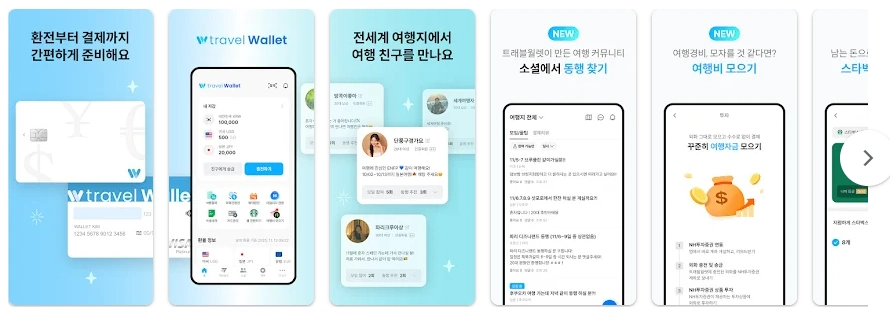
[Source: Travel Wallet Google Play Store]
Remaining Challenges: 'Exchange Rate Risk Defense', B2B, and 3rd Generation Payment Networks
Although successful in outward expansion and operational efficiency, 'exchange rate volatility,' the destiny of the cross-border payment business, is an inevitable challenge that must be overcome for future turnaround to profitability. According to the 2025 audit report, the cost burden caused by exchange rate fluctuations remains very high, with foreign exchange losses amounting to 44.5 billion won. Ultimately, it is analyzed that the company's sophisticated currency hedging strategy and advanced foreign exchange management capabilities will be the core key to a net profit turnaround in the future.
Meanwhile, Travel Wallet is leaping beyond a simple B2C travel card to become a B2B (business-to-business) cloud-based payment solution company. This B2B business, which lowers initial setup costs and lends out the payment network, is considered a core driver that will account for up to 50% of the company's total revenue in the future. In addition, following its successful settlement in the Japanese market, it is seeking to expand into more than 40 countries, including the United States and Mexico, and is drawing a long-term vision to ultimately replace the legacy financial network with a '3rd generation payment system' based on stablecoins and digital wallets.
Company financial data, investment reports, and startup analysis — all in one place
Explore PitchdeckCurated news, every week — straight to your inbox
Every Friday · Unsubscribe anytime